El Centro (Ciudad Amurallada)La Ciudad Amurallada (El Centro)
The Walled City - Cartagena's heart, and its biggest tourist magnet.La Ciudad Amurallada, el corazón de Cartagena y su mayor imán turístico.
Cartagena Guide
Last updated April 2026
Specific question while you read? Ask Catalina, the Cartagena Guide concierge.¿Pregunta específica mientras lees? Pregúntale a Catalina, la concierge de Cartagena Guide.Chat with Catalina ›Habla con Catalina ›
What it is
El Centro, officially Ciudad Amurallada, is the UNESCO-listed walled old city that most visitors picture when they think of Cartagena. Four hundred years of Spanish colonial and early Republican architecture, compressed into roughly one square kilometer and ringed by fortified stone walls. Plaza de Santo Domingo, Plaza de los Coches, Plaza de Bolívar, Torre del Reloj, Las Bóvedas - all inside these walls.
It is also, by a large margin, the most tourist-heavy part of the city. That's worth stating upfront: El Centro is beautiful and worth your time, but it is not a typical Cartagena neighborhood.
The vibe
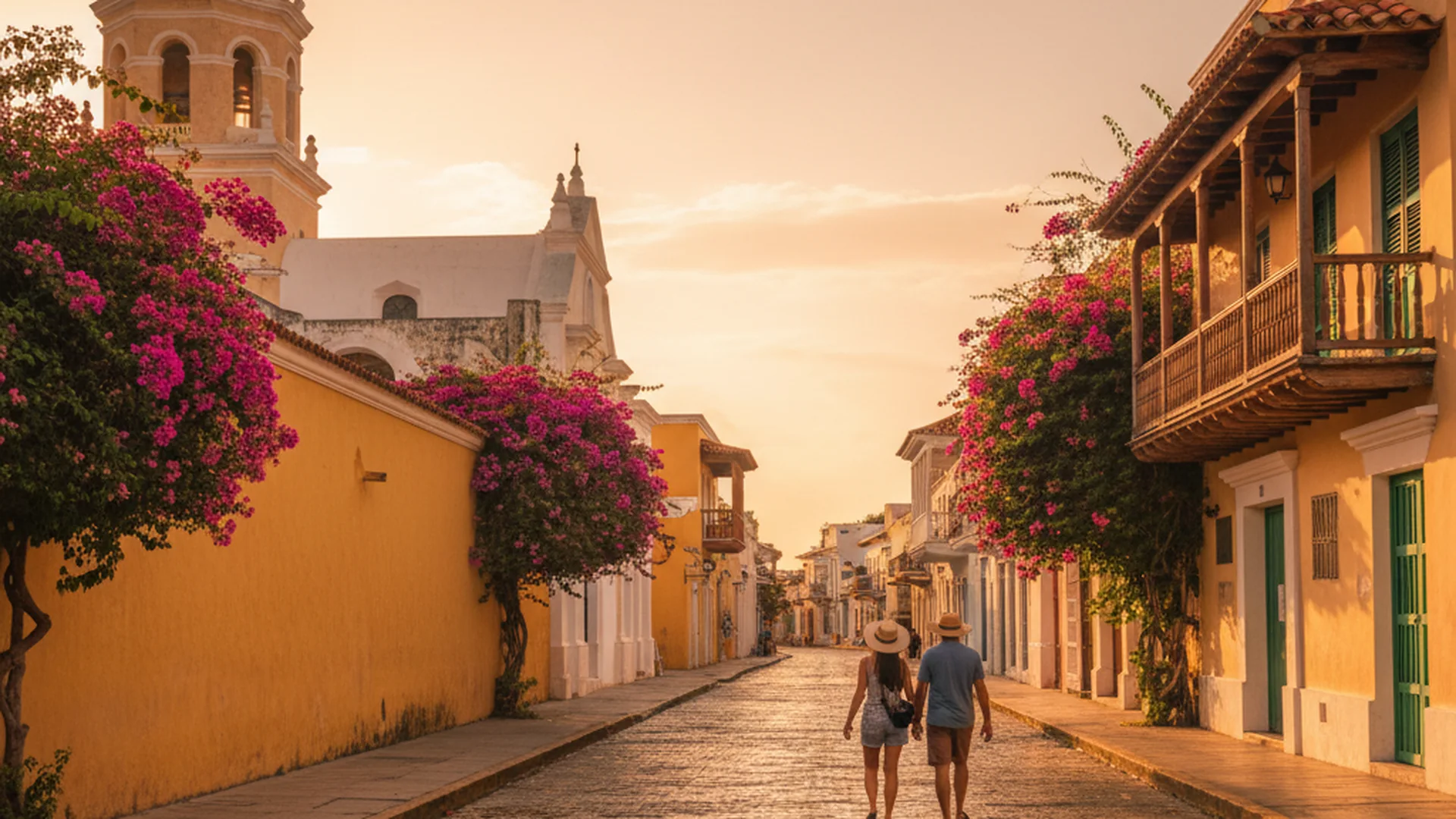
Balconies draped in bougainvillea. Horse-drawn carriages clopping past at sunset. Street vendors selling mango biche, coconut water, and Colombian-flag hats. Salsa spilling out of Café Havana. Aggressive hospitality touts on every corner once the sun goes down.
During the day it's photogenic and walkable. At night the main plazas turn into outdoor dining rooms that double as busker stages. Charming or overwhelming, depending on your tolerance for crowds.
Who stays here
First-time visitors. Couples on short trips. Travelers whose priority is being able to walk out the hotel door and immediately be somewhere beautiful. Cruise day-trippers (they show up midday and leave before dinner - the brief lull between 3pm and 6pm is the best time to walk the city yourself).
Very few expats live here. The rents are tourist-inflated, the noise carries late, and it's hard to get a normal errand done - a supermarket run means leaving the walls.
What's here
Hundreds of restaurants, rooftop bars, and boutiques. The better hotels are in restored colonial mansions (think Hotel Casa San Agustín, Casa Pestagua). Plaza Santo Domingo is the most famous dining square - touristy, pricey, always packed. Plaza Fernández de Madrid is slightly quieter. The churches and museums (Palacio de la Inquisición, Museo del Oro Zenú) are worth a morning. Las Bóvedas - 23 colonial dungeons converted to souvenir shops - sells mostly the same things for mostly the same prices.
The honest trade-offs
Expect to pay tourist prices. A decent dinner inside the walls is 60-80,000 COP per person; the same meal in Getsemaní or Manga is 30-45,000 COP. A cocktail on a rooftop bar runs 30-45,000 COP. Bottled water at a Plaza Santo Domingo restaurant: 10,000 COP for 330ml. You're paying for the view and the real estate.
Vendor pressure is real. You'll be offered hats, sunglasses, massages, salsa lessons, tours, and emeralds every few meters. A polite “no, gracias” works most of the time. Some vendors are pushier than others. Don't engage if you're not interested - even entertaining the pitch tends to extend it.
Cédula vs. passport: Colombian residents (with a cédula) pay the local price at museums and some attractions. Tourists pay more. Ask for the tarifa local if you're a resident.
Best for
First-time visitors staying 2-4 nights.
Couples and photographers.
Short-trip travelers who want everything within walking distance.
Skip if: you want to feel the everyday life of the city, you're on a tight budget, or you're staying longer than a week.
Spotted something?
This neighborhood profile is a living document. If a price has changed, a venue has closed, the map boundary is wrong, or something here doesn't match your on-the-ground experience, let us know. Corrections land publicly in the page's git history.
Specific question while you read? Ask Catalina, the Cartagena Guide concierge.¿Pregunta específica mientras lees? Pregúntale a Catalina, la concierge de Cartagena Guide.Chat with Catalina ›Habla con Catalina ›
Qué es
El Centro, oficialmente Ciudad Amurallada, es la ciudad vieja amurallada que está en la lista de la UNESCO y que la mayoría de visitantes imaginan cuando piensan en Cartagena. Cuatrocientos años de arquitectura colonial española y republicana temprana, comprimidos en aproximadamente un kilómetro cuadrado y rodeados por muros de piedra fortificada. Plaza de Santo Domingo, Plaza de los Coches, Plaza de Bolívar, Torre del Reloj, Las Bóvedas, todo dentro de estas murallas.
Es también, por un margen amplio, la parte más turística de la ciudad. Vale la pena decirlo desde el principio: El Centro es hermoso y vale tu tiempo, pero no es un barrio típico de Cartagena.
La onda
Balcones cubiertos de buganvillas. Carrozas tiradas por caballos que pasan al atardecer. Vendedores ambulantes vendiendo mango biche, agua de coco, y gorras con la bandera colombiana. Salsa saliendo de Café Havana. Vendedores insistentes en cada esquina una vez se mete el sol.
Durante el día es fotogénico y caminable. De noche las plazas principales se convierten en comidores al aire libre que funcionan también como escenarios de músicos callejeros. Encantador o abrumador, dependiendo de tu tolerancia para las multitudes.
Quién se hospeda aquí
Visitantes por primera vez. Parejas en viajes cortos. Viajeros cuya prioridad es poder salir de la puerta del hotel e inmediatamente estar en algún lugar hermoso. Turistas de cruceros (llegan al mediodía y se van antes de cenar, la pausa breve entre las 3pm y las 6pm es la mejor hora para caminar la ciudad por tu cuenta).
Muy pocos expatriados viven aquí. Los arriendos están inflados por turismo, el ruido llega hasta tarde, y es difícil hacer un mandado normal, una ida al supermercado significa salir de las murallas.
Qué hay aquí
Cientos de restaurantes, bares en azoteas, y boutiques. Los mejores hoteles están en mansiones coloniales restauradas (piensa en Hotel Casa San Agustín, Casa Pestagua). Plaza Santo Domingo es la plaza de comidas más famosa, turística, cara, siempre llena. Plaza Fernández de Madrid es un poco más tranquila. Las iglesias y museos (Palacio de la Inquisición, Museo del Oro Zenú) valen una mañana. Las Bóvedas, 23 mazmorras coloniales convertidas en tiendas de souvenirs, venden básicamente las mismas cosas por básicamente los mismos precios.
Los trade-offs honestos
Espera pagar precios de turista. Una cena decente dentro de las murallas son 60-80.000 COP por persona; la misma comida en Getsemaní o Manga cuesta 30-45.000 COP. Un trago en un bar de azotea ronda 30-45.000 COP. Agua embotellada en un restaurante de Plaza Santo Domingo: 10.000 COP por 330ml. Estás pagando por la vista y el terreno.
La presión de los vendedores es real. Te ofrecerán gorras, gafas de sol, masajes, clases de salsa, tours, y esmeraldas cada pocos metros. Un "no, gracias" educado funciona la mayoría de las veces. Algunos vendedores son más insistentes que otros. No entres en conversación si no estás interesado, incluso escuchar el argumento de venta tiende a alargarlo.
Cédula vs. pasaporte: Los residentes colombianos (con cédula) pagan el precio local en museos y algunas atracciones. Los turistas pagan más. Pide la tarifa local si eres residente.
Mejor para
Visitantes por primera vez que se quedan 2-4 noches.
Parejas y fotógrafos.
Viajeros de viajes cortos que quieren todo a distancia caminable.
Sáltalo si: quieres sentir la vida cotidiana de la ciudad, estás con presupuesto ajustado, o te vas a quedar más de una semana.
¿Viste algo?
Este perfil de barrio es un documento vivo. Si un precio ha cambiado, un lugar ha cerrado, el límite del mapa es incorrecto, o algo aquí no coincide con tu experiencia en terreno, cuéntanos. Las correcciones aparecen públicamente en el histórico de git de la página.
Newsletter
Get the guide in your inbox
One short email each Saturday. New posts, what's on this week, and anything worth knowing about Cartagena. No spam, unsubscribe anytime.