Bringing Money to Colombia: Transfers, Rates, Cash and the Rules That Catch People OutTraer Dinero a Colombia: Transferencias, Tasas, Efectivo y las Reglas que Atrapan a la Gente
By Mike Chartrand
Updated May 2026 · 13 min read
Specific question while you read? Ask Catalina, the Cartagena Guide concierge.¿Pregunta específica mientras lees? Pregúntale a Catalina, la concierge de Cartagena Guide.Chat with Catalina ›Habla con Catalina ›
Whether you are moving COP 2 millones (USD 500 at roughly 4,000 pesos to the dollar) for next month's rent or COP 1.000 millones (USD 250,000) to buy an apartment with a view of the bay, the path you pick and the paperwork you file decide how much of it you keep. This is the national playbook, with Cartagena flavor where it matters: the realistic ways to move money into Colombia, where you quietly lose money on the exchange rate, the taxes and thresholds, and the one registration step that protects investors. Informational only, not financial advice.
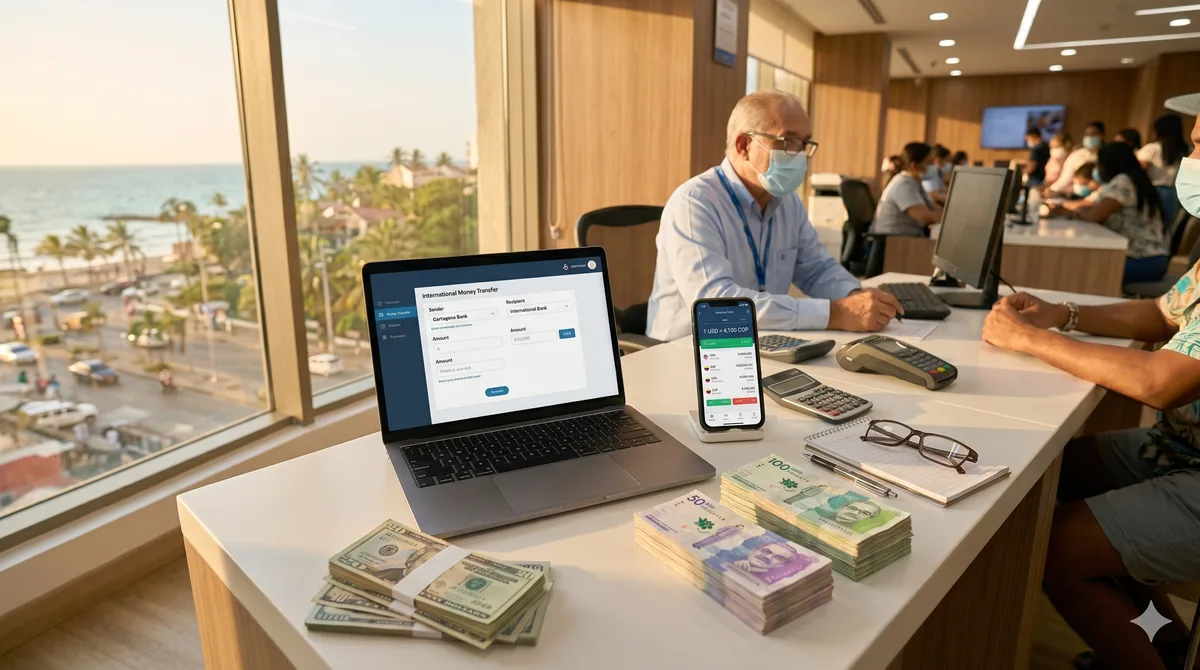
Money moving into Colombia falls into a handful of paths: consumer transfer apps (Wise and similar), remittance networks (Western Union, MoneyGram, Remitly), international bank wires over SWIFT, cash you physically carry and change at a casa de cambio, and ATM withdrawals on a foreign card. Each has a different cost, speed and legal footprint. The right choice depends on three things: how much you are sending, whether the money is for living or for an investment, and whether you are already a Colombian tax resident.
Before anything else, understand where the money leaks. Almost every loss happens on the exchange rate, not the headline fee. The mid-market rate is the real rate two currencies trade at, the one you see on a search engine. Your home bank, a remittance counter or an airport booth quotes you a worse rate and pockets the difference. That hidden spread is usually 2 to 4 percent, sometimes more, and it dwarfs the visible transfer fee. A service that charges a small flat fee but uses the mid-market rate beats a "no fee" service that buries 3 percent in the rate, every time.
Fast answer: For rent and living expenses, use a low-spread app such as Wise that converts at the mid-market rate. For investment-sized transfers, wire from your home bank into a Colombian bank (Bancolombia, BBVA Colombia, Davivienda, Itaú) and register the operation with Banco de la Republica. Treat cash and Western Union as last resorts, useful only when speed or cash-in-hand beats cost.
For reference, peso figures here use roughly 4,000 pesos to the US dollar. The real rate moves daily. The official daily reference is the TRM (Tasa Representativa del Mercado), published by the Superintendencia Financiera. Every legal exchange operation in Colombia references it.
Everyday transfers for living and rent
These are the tools expats and remote workers use for rent, groceries, restaurants and day-to-day life in Cartagena. Direct deposits to a Colombian account (Bancolombia, Nequi, Daviplata, BBVA) land in hours, not days.
Wise and similar low-spread apps
The default for nearly everyone. Wise converts at the real mid-market rate and charges a transparent fee of roughly 0.4 to 0.7 percent depending on the currency pair. A USD 1,000 transfer to a Bancolombia account, around COP 4 millones, typically costs the equivalent of COP 16.000 to 28.000 (USD 4 to 7) and arrives the same day. You can hold a multi-currency balance, receive a debit card that works at Colombian ATMs, and spend directly in pesos without your home bank's exchange markup. Revolut plays a similar role for users coming from the UK or EU.
Remittance apps (Remitly, Xoom)
Remitly is built for one-way transfers from the US, Canada, UK or Australia into Colombia. It offers two tiers: an express option (minutes, slightly worse rate) and an economy option (3 to 5 business days, better rate). Good for sending dollars from a US account straight to a Bancolombia or Davivienda account. Xoom, owned by PayPal, lets you fund a transfer from a PayPal balance, which is convenient, but PayPal occasionally freezes accounts for review and can lock up a transfer for weeks, so keep it as a backup rather than a primary.
Western Union and MoneyGram
Still useful for one case: sending cash to someone in Colombia who does not have a bank account, or an emergency where the recipient has to walk in and collect pesos the same day. Pickup points are everywhere, including Éxito supermarkets, Giros y Finanzas branches, dedicated Western Union counters in the malls, and corner shops under brands like Efecty. The catch is the rate: the exchange markup runs 2 to 4 percent, meaningfully worse than a low-spread app. Use it only when speed and cash pickup outweigh the cost.
Large transfers and investment money
Above roughly USD 10,000 (about COP 40 millones), consumer apps start hitting daily and monthly limits, and Colombian authorities start paying attention. The rules here are mostly not about paying tax. They are about proving where the money came from and routing the operation through the right channel.
International bank wire (SWIFT)
The traditional path for investment-sized money. You initiate a wire from your home bank to your Colombian account. Bancolombia, BBVA Colombia, Davivienda and Itaú all accept incoming SWIFT wires from abroad. Typical all-in cost: a flat fee of roughly COP 100.000 to 200.000 (USD 25 to 50) from your sending bank, plus a 0.5 to 1.5 percent exchange markup on the Colombian side. It is slower than an app (2 to 5 business days) but it supports any amount.
Key requirement: the Colombian bank receiving the money acts as your Intermediario del Mercado Cambiario (IMC, the authorized exchange intermediary). When the wire lands, the bank asks you to complete a declaración de cambio, the right form depending on whether the money is a personal transfer or an investment. You must do this. Without the declaration, the bank legally cannot release the funds into your account.
Apps for large amounts
Low-spread apps can handle transfers well above USD 10,000 (Wise's verified-account ceiling in most corridors is around USD 1 millón per transfer). For pure living-expense money this is cheaper than a SWIFT wire. But for investment money that you will want to bring back out later, a wire directly into your own name at a Colombian bank produces cleaner paperwork: one sender, one beneficiary, one exchange operation, and the receiving bank can register the foreign-investment declaration on the spot.
Registering foreign investment with Banco de la Republica
This is the single most important step for anyone buying property or investing in Colombia, and the one most new buyers skip. If the money is going to buy Colombian real estate, start or buy into a business, or acquire Colombian securities, you must register the inbound transfer with Banco de la Republica, the central bank, within a short window after the operation. The filing is done through your IMC (your Colombian bank) at the time of the exchange operation; the bank submits it electronically. The governing rules sit in the Estatuto Cambiario on the central bank's site.
Why this matters: Registration is what lets you legally take the original capital and any future profits back out of the country. Say you buy a Manga or Castillogrande apartment for COP 800 millones (USD 200,000), hold it five years, sell it for COP 1.100 millones (USD 275,000), and never registered the inbound transfer. Colombian law treats that original capital as if it never legally entered the country. You can still get the money out, but the process is slow, expensive and involves retroactive filings with penalties. Register at the time of the transfer and the repatriation of both principal and gains is straightforward.
Bringing cash and the declaration rule
Carrying physical cash into Colombia is legal, but heavily regulated once you cross a threshold.
Under USD 10,000 or the equivalent in any currency: no declaration needed at customs. Keep it on you and walk through.
USD 10,000 or more: you must declare it to DIAN (customs) on arrival, on the equipaje and cash declaration form. Failing to declare is treated as currency smuggling. The penalty is typically around 30 percent of the undeclared amount, plus a real risk of confiscation. Declaring is free and takes a few minutes.
The threshold is genuinely measured in US dollars (or the equivalent), so it applies whether you carry dollars, euros or pesos. Practical note: carrying well above the threshold, even fully declared, will draw extra questioning from DIAN about the source of the money. Have bank statements ready. And carrying large amounts of cash through any city, including the walled-city and Bocagrande tourist corridors of Cartagena, is a personal-safety risk that a bank transfer simply removes. For anything beyond a modest sum, a channeled transfer is both safer and usually cheaper once you count the exchange spread at a booth.
Casas de cambio and ATM withdrawals
Once cash is in Colombia, change it at a licensed casa de cambio. Well-known authorized networks operating nationally include Giros y Finanzas and Titán Intercontinental, with branches in major cities and shopping centers. In Cartagena you will also find exchange booths inside the larger malls and at Rafael Núñez airport (CTG), though airport rates are almost always the worst available. Rates from a licensed casa typically run 1 to 2 percent off the TRM. Avoid unlicensed street money-changers, particularly around the walled city, Getsemaní and the Bocagrande beach strip, where the rate is worse and the risk of counterfeit bills or short-counting is real.
ATM withdrawals are the simplest way to get pesos for small amounts. Use bank-branded ATMs inside branches or malls rather than standalone machines, and decline the machine's offer to "convert" for you (dynamic currency conversion), which always gives a worse rate than letting your own bank handle it. Most Colombian ATMs charge a withdrawal fee of roughly COP 15.000 to 25.000 (USD 4 to 6) per transaction for foreign cards, and many cap a single withdrawal around COP 600.000 to 1.000.000, so several pulls add up in fees. A multi-currency card from a low-spread app reduces the home-bank side of that cost.
Receiving money in Colombia
To receive money efficiently you want a Colombian account. The default for most people is Bancolombia (the largest bank, accepts incoming wires and app deposits) paired with Nequi, Bancolombia's mobile wallet, which almost everyone uses for quick peer-to-peer transfers, paying small vendors and splitting bills. Daviplata (from Davivienda) is the other widely used wallet. Landlords, casas and most local businesses move money between these rails constantly.
If you do not yet have a Colombian account, landlords will often accept a transfer to their Bancolombia account from an app's local peso rail, or a Western Union pickup. Having your own account makes everything far simpler. For how to open one as a foreigner, the cédula and proof-of-address requirements, and which bank suits which situation, see our Cartagena banking and cash guide.
The rules you must know, including the 4x1000
A brief tour of the regulators and thresholds that govern inbound money.
Banco de la Republica
Colombia's central bank. Its Estatuto Cambiario sets the rules for foreign-exchange operations. The key ideas: exchange operations must be "channeled" through an authorized IMC (a Colombian bank); each operation needs a declaración de cambio; and foreign investment must be registered to preserve your right to take the capital and profits back out.
DIAN
The tax and customs authority. DIAN does not tax the inbound transfer itself, since bringing money in is not a taxable event for a non-resident. It becomes relevant once you cross 183 days of presence in any continuous 365-day window, at which point you become a Colombian tax resident and must report worldwide income going forward. The full residency picture is in our Colombia tax residency guide.
UIAF and source of funds
UIAF is Colombia's anti-money-laundering unit. It does not contact you directly. Your bank does, because banks must report large or unusual inbound transfers. A single deposit above the equivalent of USD 10,000, or several deposits in a month that add up well beyond that without a clear origin, will trigger a request for documentation: a source-of-funds letter, home-country bank statements, a property sale contract, and so on. Have the paperwork ready and the transfer clears smoothly.
GMF, the 4x1000 tax
Colombia levies a small tax on most debit-side banking movements, known as the 4x1000 (GMF, gravamen a los movimientos financieros). It is 0.4 percent, four pesos per thousand, applied to withdrawals, transfers between different owners and some card payments. Crucially, every individual is entitled to designate one exempt account, free of the 4x1000 up to a monthly cap (a few hundred UVT, on the order of COP 17 millones in 2026). Ask your bank to mark your main account as exenta del GMF at opening. Most people forget, and quietly pay the tax on money they move every month for no reason.
Common mistakes
Wiring money for a property purchase without registering it with Banco de la Republica. The single most expensive mistake. Confirm with your Colombian bank that they will process the foreign-investment declaración de cambio at the moment the wire lands.
Carrying USD 10,000 or more in cash without declaring it. The penalty is around 30 percent of the undeclared amount. Declaring takes a few minutes and is free.
Letting your home bank convert to pesos before sending. Home banks routinely bury a 2 to 4 percent exchange markup in the rate, on top of a wire fee. Send the foreign currency and let a Colombian IMC or a low-spread app do the conversion near the real rate.
Judging a service by its fee instead of its rate. A "no fee" transfer with a 3 percent spread costs you far more than a small flat fee at the mid-market rate. Always compare the pesos that actually land.
Using remittance counters or airport booths for regular rent. You leave 2 to 4 percent on the table every month for no benefit over a low-spread app.
Not marking an account as 4x1000 exempt. Every resident gets one exempt account. Ask for it at account opening.
Ignoring the 183-day tax-residency trigger. Once you cross it, you owe DIAN a declaration on worldwide income going forward. Track your days from the start.
FAQ
Is there a limit to how much money I can bring into Colombia? No cap. Above the equivalent of USD 10,000 you must declare cash at customs or channel a transfer through an IMC. Beyond that, the only practical limits are those set by your own bank and the service you use.
Do I pay tax when I bring money in? Not on the transfer itself. You pay tax on Colombian-source income and, once you are a tax resident at 183 days, on worldwide income going forward. The inbound movement of capital is not taxed.
Can I pay Cartagena rent from abroad without a Colombian account? Yes, but inefficiently. Most landlords accept a Bancolombia transfer from an app's peso rail or a Western Union pickup. Having your own account, ideally Bancolombia plus Nequi, makes it far simpler. See the banking guide for opening one.
Why do the peso amounts I am quoted change daily? Because the TRM, the official USD to COP reference rate, is published daily and moves with the market. A transfer that takes three business days can land at a different TRM than the day you started it.
How do I prove source of funds to my Colombian bank? Bring three months of home-country bank statements, a letter from your employer or a tax return if relevant, and for a property or business investment a copy of the purchase contract or investment agreement. Banks prefer PDFs emailed directly from the originating institution.
Are pesos the only legal tender? Yes. A vendor is not required to accept dollars, though some short-term-rental hosts in the walled city and Bocagrande informally take USD cash. For anything that matters, pay and receive in pesos.
Informational only, not financial, tax or legal advice. Exchange rates, thresholds, fees and forms change; always confirm current figures with your bank, with Banco de la Republica and with DIAN before acting. Peso figures use roughly 4,000 pesos to the US dollar. Last review: May 2026.
Still have questions?¿Todavía tienes preguntas?
Catalina is our concierge. Ask her about visas, neighborhoods, healthcare, prices, anything Cartagena. She answers in chat or WhatsApp, English or Spanish, free.Catalina es nuestra concierge. Pregúntale sobre visas, barrios, salud, precios, cualquier cosa de Cartagena. Responde por chat o WhatsApp, en inglés o español, gratis.
Specific question while you read? Ask Catalina, the Cartagena Guide concierge.¿Pregunta específica mientras lees? Pregúntale a Catalina, la concierge de Cartagena Guide.Chat with Catalina ›Habla con Catalina ›
Ya sea que muevas COP 2 millones (USD 500 a razón de aproximadamente 4.000 pesos por dólar) para el arriendo del próximo mes o COP 1.000 millones (USD 250.000) para comprar un apartamento con vista a la bahía, el camino que escojas y los trámites que hagas determinan cuánto dinero te queda al final. Este es el manual nacional, con sabor cartaginés donde cuenta: las formas realistas de mover dinero hacia Colombia, dónde pierdes dinero silenciosamente en la tasa de cambio, los impuestos y los límites, y ese paso de registro que protege a los inversionistas. Solo información, no asesoría financiera.
El dinero que entra a Colombia sigue unos pocos caminos: aplicaciones de transferencia al consumidor (Wise y similares), redes de remesas (Western Union, MoneyGram, Remitly), transferencias bancarias internacionales por SWIFT, efectivo que llevas físicamente y cambias en una casa de cambio, y retiros en cajeros automáticos con tarjeta extranjera. Cada uno tiene un costo, velocidad y huella legal diferentes. La opción correcta depende de tres cosas: cuánto envíes, si el dinero es para vivir o para invertir, y si ya eres residente fiscal colombiano.
Antes que nada, entiende dónde se va el dinero. Casi toda la pérdida ocurre en la tasa de cambio, no en la comisión que ves. La tasa del punto medio es la tasa real a la que se cotizan dos monedas, la que ves en un buscador. Tu banco en el extranjero, un mostrador de remesas o una caseta en el aeropuerto te cotizan una tasa peor y se quedan con la diferencia. Ese margen oculto suele ser del 2 al 4 por ciento, a veces más, y eclipsa la comisión visible. Un servicio que cobra una comisión plana pequeña pero usa la tasa del punto medio siempre vence a un servicio "sin comisión" que oculta un 3 por ciento en la tasa.
Respuesta rápida: Para arriendo y gastos de vida, usa una aplicación de bajo margen como Wise que convierte a la tasa del punto medio. Para transferencias de inversión, haz una transferencia desde tu banco en el extranjero hacia un banco colombiano (Bancolombia, BBVA Colombia, Davivienda, Itaú) y registra la operación con el Banco de la República. Trata el efectivo y Western Union como último recurso, útiles solo cuando la velocidad o el efectivo en la mano valen más que el costo.
Para referencia, las cifras en pesos aquí usan aproximadamente 4.000 pesos por dólar estadounidense. La tasa real se mueve a diario. La referencia oficial diaria es la TRM (Tasa Representativa del Mercado), publicada por la Superintendencia Financiera. Toda operación de cambio legal en Colombia la referencia.
Transferencias cotidianas para vivir y pagar arriendo
Estas son las herramientas que usan expatriados y trabajadores remotos para arriendo, comida, restaurantes y la vida diaria en Cartagena. Los depósitos directos a una cuenta colombiana (Bancolombia, Nequi, Daviplata, BBVA) llegan en horas, no en días.
Wise y aplicaciones similares de bajo margen
La opción por defecto para casi todos. Wise convierte a la tasa real del punto medio y cobra una comisión transparente de aproximadamente 0,4 a 0,7 por ciento según el par de monedas. Una transferencia de USD 1.000 a una cuenta de Bancolombia, alrededor de COP 4 millones, suele costar el equivalente de COP 16.000 a 28.000 (USD 4 a 7) y llega el mismo día. Puedes mantener un saldo en múltiples monedas, recibir una tarjeta de débito que funciona en cajeros automáticos colombianos y gastar directamente en pesos sin el margen de cambio de tu banco en el extranjero. Revolut juega un papel similar para usuarios que vienen del Reino Unido o la UE.
Aplicaciones de remesas (Remitly, Xoom)
Remitly está diseñada para transferencias unidireccionales desde Estados Unidos, Canadá, Reino Unido o Australia hacia Colombia. Ofrece dos niveles: una opción exprés (minutos, tasa ligeramente peor) y una opción económica (3 a 5 días hábiles, tasa mejor). Buena para enviar dólares desde una cuenta estadounidense directo a una cuenta de Bancolombia o Davivienda. Xoom, propiedad de PayPal, te permite financiar una transferencia desde un saldo de PayPal, lo cual es conveniente, pero PayPal ocasionalmente congela cuentas para revisión y puede bloquear una transferencia durante semanas, así que mantenla como respaldo en lugar de principal.
Western Union y MoneyGram
Aún útil para un caso: enviar efectivo a alguien en Colombia que no tiene cuenta bancaria, o una emergencia donde el receptor tiene que pasar y cobrar pesos el mismo día. Hay puntos de retiro en todas partes, incluyendo supermercados Éxito, sucursales de Giros y Finanzas, mostradores dedicados a Western Union en los centros comerciales, y tiendas de barrio bajo marcas como Efecty. El problema es la tasa: el margen de cambio corre entre 2 y 4 por ciento, notablemente peor que una aplicación de bajo margen. Úsala solo cuando la velocidad y el retiro de efectivo superen el costo.
Transferencias grandes y dinero de inversión
Por encima de aproximadamente USD 10.000 (unos COP 40 millones), las aplicaciones al consumidor empiezan a topetarse con límites diarios y mensuales, y las autoridades colombianas empiezan a prestar atención. Las reglas aquí no hablan principalmente sobre pagar impuestos. Hablan sobre probar de dónde vino el dinero y encaminar la operación por el canal correcto.
Transferencia bancaria internacional (SWIFT)
El camino tradicional para dinero de inversión. Inicias una transferencia desde tu banco en el extranjero a tu cuenta colombiana. Bancolombia, BBVA Colombia, Davivienda e Itaú aceptan transferencias SWIFT entrantes del extranjero. Costo típico todo incluido: una comisión plana de aproximadamente COP 100.000 a 200.000 (USD 25 a 50) desde tu banco de envío, más un margen de cambio del 0,5 a 1,5 por ciento en el lado colombiano. Es más lento que una aplicación (2 a 5 días hábiles) pero soporta cualquier cantidad.
Requisito clave: el banco colombiano que recibe el dinero actúa como tu Intermediario del Mercado Cambiario (IMC, el intermediario de cambio autorizado). Cuando la transferencia llega, el banco te pide completar una declaración de cambio, la forma correcta según si el dinero es una transferencia personal o una inversión. Debes hacerlo. Sin la declaración, el banco legalmente no puede liberar los fondos a tu cuenta.
Aplicaciones para montos grandes
Las aplicaciones de bajo margen pueden manejar transferencias muy por encima de USD 10.000 (el techo de cuenta verificada de Wise en la mayoría de corredores es alrededor de USD 1 millón por transferencia). Para dinero de puro gasto de vida esto es más barato que una transferencia SWIFT. Pero para dinero de inversión que querrás sacar después, una transferencia directa a tu propio nombre en un banco colombiano produce papelería más limpia: un enviador, un beneficiario, una operación de cambio, y el banco receptor puede registrar la declaración de inversión extranjera al momento.
Registrar inversión extranjera ante el Banco de la República
Este es el paso más importante para cualquiera que compre propiedad o invierta en Colombia, y el que la mayoría de compradores nuevos se saltan. Si el dinero va a comprar bienes raíces colombianos, iniciar o entrar en un negocio, o adquirir valores colombianos, debes registrar la transferencia de entrada con el Banco de la República, el banco central, dentro de una ventana corta después de la operación. El trámite se hace a través de tu IMC (tu banco colombiano) al momento de la operación de cambio; el banco lo presenta electrónicamente. Las reglas que aplican están en el Estatuto Cambiario en el sitio del banco central.
Por qué importa: El registro es lo que te permite sacar legalmente el capital original y cualquier ganancia futura fuera del país. Digamos que compras un apartamento en Manga o Castillogrande por COP 800 millones (USD 200.000), lo mantienes cinco años, lo vendes por COP 1.100 millones (USD 275.000), y nunca registraste la transferencia de entrada. La ley colombiana trata ese capital original como si nunca hubiera entrado legalmente al país. Aun así puedes sacar el dinero, pero el proceso es lento, costoso e implica presentaciones retroactivas con multas. Registra al momento de la transferencia y la repatriación de tanto principal como ganancias es directa.
Llevar efectivo y la regla de declaración
Llevar efectivo físico a Colombia es legal, pero muy regulado una vez cruzas un límite.
Menos de USD 10.000 o el equivalente en cualquier moneda: ninguna declaración necesaria en aduanas. Llévalo contigo y camina directo.
USD 10.000 o más: debes declararlo a DIAN (aduanas) a tu llegada, en el formulario de declaración de equipaje y efectivo. No declarar se trata como contrabando de divisas. La multa es típicamente alrededor del 30 por ciento del monto no declarado, más riesgo real de confiscación. Declarar es gratis y toma unos pocos minutos.
El límite se mide genuinamente en dólares estadounidenses (o el equivalente), así que aplica ya sea que lleves dólares, euros o pesos. Nota práctica: llevar bien por encima del límite, incluso completamente declarado, atraerá cuestionamiento extra de DIAN sobre la fuente del dinero. Ten estados de cuenta bancarios listos. Y llevar grandes cantidades de efectivo por cualquier ciudad, incluyendo los corredores turísticos de la ciudad amurallada y Bocagrande de Cartagena, es un riesgo de seguridad personal que una transferencia bancaria simplemente elimina. Para cualquier cosa más que una suma modesta, una transferencia canalizada es tanto más segura como usualmente más barata una vez cuentas el margen de cambio en una caseta.
Casas de cambio y retiros en cajeros automáticos
Una vez el efectivo está en Colombia, cámbialo en una casa de cambio licenciada. Redes autorizadas bien conocidas que operan a nivel nacional incluyen Giros y Finanzas y Titán Intercontinental, con sucursales en ciudades grandes y centros comerciales. En Cartagena también encontrarás casetas de cambio dentro de los centros comerciales más grandes y en el aeropuerto Rafael Núñez (CTG), aunque las tarifas del aeropuerto casi siempre son las peores disponibles. Las tasas de una casa de cambio licenciada suelen andar 1 a 2 por ciento por debajo de la TRM. Evita cambistas callejeros no licenciados, particularmente alrededor de la ciudad amurallada, Getsemaní y la zona de playa de Bocagrande, donde la tasa es peor y el riesgo de billetes falsos o recuento corto es real.
Los retiros en cajeros automáticos son la forma más simple de conseguir pesos para cantidades pequeñas. Usa cajeros automáticos con marca de banco dentro de sucursales o centros comerciales en lugar de máquinas independientes, y rechaza la oferta de la máquina de "convertir" para ti (conversión dinámica de moneda), que siempre da una tasa peor que dejar que tu propio banco lo maneje. La mayoría de cajeros automáticos colombianos cobran una comisión de retiro de aproximadamente COP 15.000 a 25.000 (USD 4 a 6) por transacción para tarjetas extranjeras, y muchos limitan un solo retiro alrededor de COP 600.000 a 1.000.000, así que varios retiros se suman en comisiones. Una tarjeta multicurrency de una aplicación de bajo margen reduce el costo del lado del banco en el extranjero.
Recibir dinero en Colombia
Para recibir dinero eficientemente quieres una cuenta colombiana. La opción por defecto para la mayoría es Bancolombia (el banco más grande, acepta transferencias de entrada y depósitos de aplicación) emparejado con Nequi, la billetera móvil de Bancolombia, que casi todos usan para transferencias peer-to-peer rápidas, pagar pequeños vendedores y dividir cuentas. Daviplata (de Davivienda) es la otra billetera ampliamente usada. Propietarios, casas y la mayoría de negocios locales mueven dinero entre estos canales constantemente.
Si aún no tienes una cuenta colombiana, los propietarios a menudo aceptarán una transferencia a su cuenta de Bancolombia desde el carril de pesos local de una aplicación, o un retiro de Western Union. Tener tu propia cuenta hace todo mucho más simple. Para cómo abrir una como extranjero, los requisitos de cédula y comprobante de domicilio, y qué banco se ajusta a qué situación, ve nuestra guía completa de banca y efectivo en Cartagena.
Las reglas que debes conocer, incluyendo el 4x1000
Un breve recorrido por los reguladores y límites que gobiernan dinero de entrada.
Banco de la República
El banco central de Colombia. Su Estatuto Cambiario establece las reglas para operaciones de cambio extranjero. Las ideas clave: las operaciones de cambio deben ser "canalizadas" a través de un IMC autorizado (un banco colombiano); cada operación necesita una declaración de cambio; y la inversión extranjera debe registrarse para preservar tu derecho de sacar el capital y ganancias de vuelta.
DIAN
La autoridad fiscal y aduanal. DIAN no grava la transferencia de entrada en sí, ya que traer dinero no es un evento gravable para un no residente. Se vuelve relevante una vez cruzas 183 días de presencia en cualquier ventana continua de 365 días, en cuyo punto te conviertes en residente fiscal colombiano y debes reportar ingresos mundiales de ahí en adelante. El cuadro completo de residencia está en nuestra guía de residencia fiscal en Colombia.
UIAF y origen de fondos
UIAF es la unidad de anti-lavado de dinero de Colombia. No te contacta directamente. Tu banco lo hace, porque los bancos deben reportar transferencias de entrada grandes o inusuales. Un solo depósito por encima del equivalente de USD 10.000, o varios depósitos en un mes que sumen bien por encima de eso sin un origen claro, dispararán una solicitud de documentación: una carta de origen de fondos, estados de cuenta bancarios del país de origen, un contrato de venta de propiedad, y así. Ten la papelería lista y la transferencia se autoriza sin problemas.
GMF, el impuesto 4x1000
Colombia grava un impuesto pequeño en la mayoría de movimientos bancarios del lado de débito, conocido como el 4x1000 (GMF, gravamen a los movimientos financieros). Es 0,4 por ciento, cuatro pesos por mil, aplicado a retiros, transferencias entre dueños diferentes y algunos pagos con tarjeta. Crucialmente, cada individuo tiene derecho a designar una cuenta exenta, libre del 4x1000 hasta un límite mensual (algunas cientos de UVT, en el orden de COP 17 millones en 2026). Pídele a tu banco que marque tu cuenta principal como exenta del GMF al abrir. La mayoría de gente se olvida, y silenciosamente paga el impuesto en dinero que mueve cada mes sin razón.
Errores comunes
Transferir dinero para una compra de propiedad sin registrarlo con el Banco de la República. El error más caro. Confirma con tu banco colombiano que procesarán la declaración de cambio de inversión extranjera en el momento que la transferencia llegue.
Llevar USD 10.000 o más en efectivo sin declarar. La multa es alrededor del 30 por ciento del monto no declarado. Declarar toma unos pocos minutos y es gratis.
Dejar que tu banco en el extranjero convierta a pesos antes de enviar. Los bancos en el extranjero rutinariamente ocultan un margen de cambio del 2 al 4 por ciento en la tasa, además de una comisión de transferencia. Envía la moneda extranjera y deja que un IMC colombiano o una aplicación de bajo margen haga la conversión cerca de la tasa real.
Juzgar un servicio por su comisión en lugar de su tasa. Una transferencia "sin comisión" con un margen del 3 por ciento te cuesta mucho más que una comisión plana pequeña a la tasa del punto medio. Siempre compara los pesos que realmente llegan.
Usar mostradores de remesas o casetas de aeropuerto para el arriendo regular. Dejas 2 a 4 por ciento en la mesa cada mes sin beneficio sobre una aplicación de bajo margen.
No marcar una cuenta como exenta del 4x1000. Todo residente obtiene una cuenta exenta. Pídela al abrir la cuenta.
Ignorar el disparador de residencia fiscal de 183 días. Una vez lo cruzas, debes DIAN una declaración sobre ingresos mundiales de ahí en adelante. Rastrea tus días desde el principio.
Preguntas frecuentes
¿Hay un límite de cuánto dinero puedo traer a Colombia? Sin límite máximo. Por encima del equivalente de USD 10.000 debes declarar efectivo en aduanas o canalizar una transferencia a través de un IMC. Más allá de eso, los únicos límites prácticos son los establecidos por tu propio banco y el servicio que uses.
¿Pago impuesto cuando traigo dinero? No sobre la transferencia en sí. Pagas impuesto sobre ingresos de origen colombiano y, una vez seas residente fiscal a los 183 días, sobre ingresos mundiales de ahí en adelante. El movimiento de entrada de capital no se grava.
¿Puedo pagar el arriendo de Cartagena desde el extranjero sin una cuenta colombiana? Sí, pero ineficientemente. La mayoría de propietarios aceptan una transferencia de Bancolombia desde el carril de pesos de una aplicación o un retiro de Western Union. Tener tu propia cuenta, idealmente Bancolombia más Nequi, lo hace mucho más simple. Ve la guía de banca para abrir una.
¿Por qué los montos en pesos que me cotizan cambian diariamente? Porque la TRM, la tasa de referencia oficial de USD a COP, se publica diariamente y se mueve con el mercado. Una transferencia que toma tres días hábiles puede llegar a una TRM diferente que el día que la iniciaste.
¿Cómo pruebo origen de fondos a mi banco colombiano? Trae tres meses de estados de cuenta bancarios del país de origen, una carta de tu empleador o una declaración de impuestos si es relevante, y para una inversión de propiedad o negocio una copia del contrato de compra o acuerdo de inversión. Los bancos prefieren PDFs enviados directamente por email desde la institución originaria.
¿Son los pesos la única moneda legal? Sí. Un vendedor no está obligado a aceptar dólares, aunque algunos anfitriones de alquileres a corto plazo en la ciudad amurallada y Bocagrande informalmente aceptan efectivo en USD. Para cualquier cosa que importe, paga y recibe en pesos.
Solo información, no asesoría financiera, fiscal o legal. Las tasas de cambio, límites, comisiones y formularios cambian; siempre confirma cifras actuales con tu banco, con el Banco de la República y con la DIAN antes de actuar. Las cifras en pesos usan aproximadamente 4.000 pesos por dólar estadounidense. Última revisión: mayo de 2026.
Still have questions?¿Todavía tienes preguntas?
Catalina is our concierge. Ask her about visas, neighborhoods, healthcare, prices, anything Cartagena. She answers in chat or WhatsApp, English or Spanish, free.Catalina es nuestra concierge. Pregúntale sobre visas, barrios, salud, precios, cualquier cosa de Cartagena. Responde por chat o WhatsApp, en inglés o español, gratis.