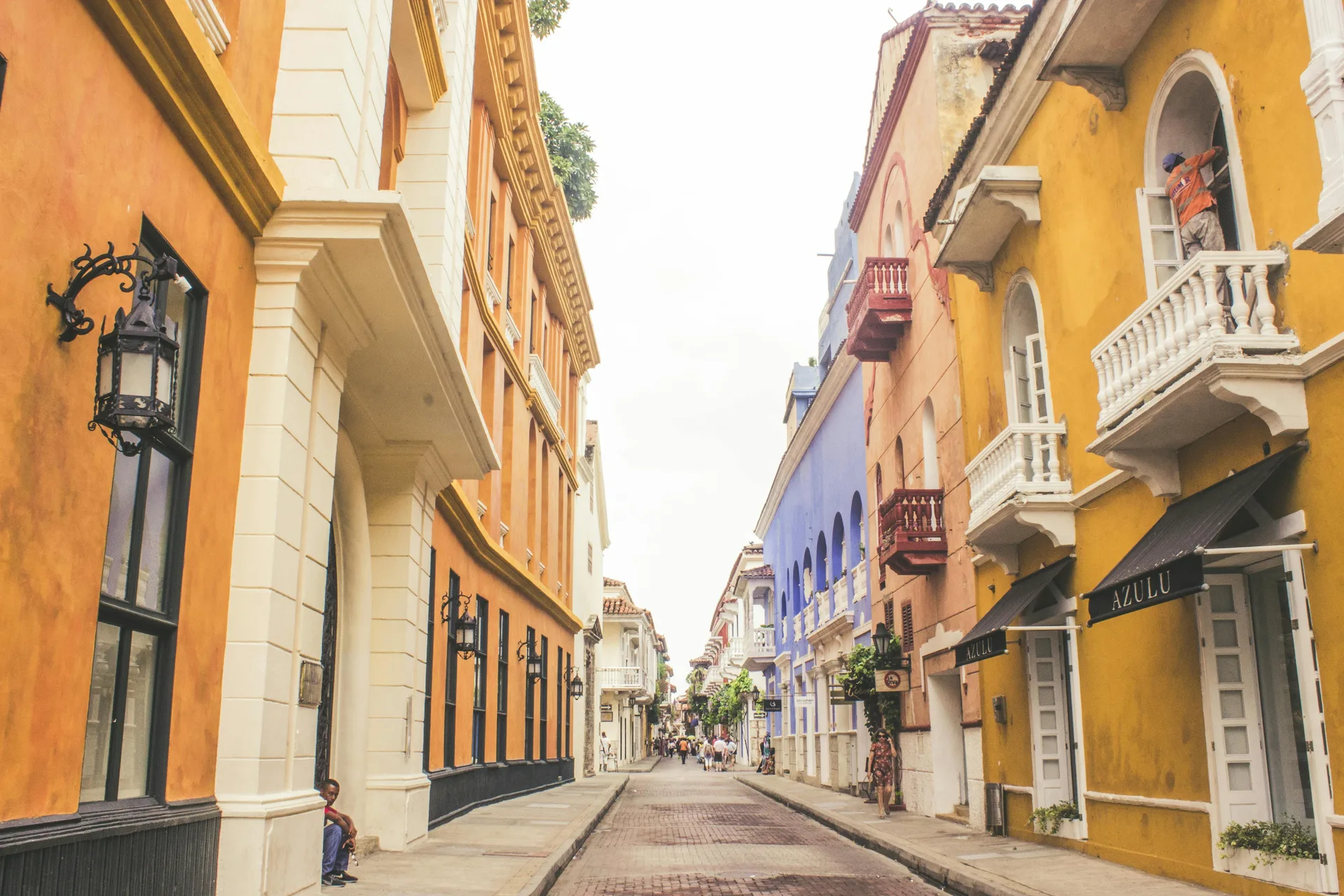
The History of Cartagena de Indias: From Founding to Modern DayLa historia de Cartagena de Indias: desde su fundación hasta hoy
Five hundred years of ambition, siege, slavery, independence, decline, and improbable revival - told with the specifics that most tourist blogs skip.
Mike Chartrand
April 2026 · 22 min read
Specific question while you read? Ask Catalina, the Cartagena Guide concierge.¿Pregunta específica mientras lees? Pregúntale a Catalina, la concierge de Cartagena Guide.Chat with Catalina ›Habla con Catalina ›
Walk the walls of Cartagena at sunset and you're walking on the most expensive fortifications the Spanish Empire ever built. The bay was once so valuable that a single ransom paid to Francis Drake wiped out the year's treasure fleet profit. The Castillo San Felipe de Barajas survived a British siege larger than anything launched across the Atlantic before D-Day. And the first town in the Americas whose freedom was formally recognized by royal decree sits just fifty kilometers inland, founded by an escaped enslaved man from what is now Guinea-Bissau.
Cartagena's history is wilder than the walking-tour version suggests. Here is the long arc - pre-Columbian origins through the modern tourist boom - with the specific dates, names, and numbers that anchor it.
Before the Spanish: the Calamarí and the Zenú
The bay the Spanish would later call "the best harbor of the Indies" was already inhabited. The Calamarí - a Karib-speaking people - called it Karmairí or Calamarí, "place of the crayfish," and had built a fishing and trading settlement on what is now the historic center's peninsula. To the south and inland, the Zenú civilization of the San Jorge, Cauca, and Sinú river valleys operated a hydraulic canal system covering roughly 500,000 hectares and produced the gold filigree that would, once looted, fund the first decade of the Spanish colony.
Population estimates for the wider region at contact are unreliable - Spanish chroniclers had reasons to inflate or deflate depending on the moment - but somewhere in the range of half a million people lived across the coastal and Sinú zones. Within a generation of Spanish contact, disease, forced labor, and displacement would collapse that number catastrophically.
The founding: June 1, 1533
Pedro de Heredia, a conquistador from Madrid with a famously broken nose from a street brawl, founded the city on June 1, 1533 with around 150 men. He called it Cartagena de Poniente - "Cartagena of the West" - to distinguish it from Cartagena, Spain. The "de Indias" came later and stuck.
The bay was the reason. It's one of the best natural deep-water harbors in the Caribbean: a large sheltered inner bay guarded by a chain of barrier islands (Tierrabomba, Barú), with two narrow entrances, Bocagrande and Bocachica, that could be fortified and controlled. Sailors of the era called it simply "the best harbor of the Indies."
Heredia's interpreter, a Calamarí woman called Catalina who had been taken to Santo Domingo as a child and raised bilingual, negotiated with the Calamarí chief Carex and made the founding possible. Within two years, Heredia's brother Alonso had shipped roughly 1.5 million pesos of looted Zenú grave gold back to Spain. Heredia himself was put on trial by the Crown in 1536 and again in 1544 for corruption and abuses against Indigenous people, and drowned in a 1554 shipwreck off Zahara, Spain, on his way back to face a third trial.
The treasure port era (1540 to 1700)
For roughly 160 years, Cartagena was one of the three official ports of the Spanish treasure fleet system, alongside Veracruz (Mexico) and Portobelo (Panama). Peruvian silver was carried overland from Panama, consolidated in Cartagena with New Granadan emeralds and gold, and loaded onto the annual Galeones de Tierra Firme fleet bound for Seville.
This was also the era in which Cartagena became the principal legal slaving port of Spanish South America. From roughly 1580 into the early 1700s, enslaved Africans disembarked here under the asiento licensing system - first held by Portuguese contractors, later by Dutch, Genoese, and French, and from 1713 by the British South Sea Company. Estimates of the total number disembarked range from around 500,000 (per the Trans-Atlantic Slave Trade Database) to nearly a million (in popular Colombian accounts). Whatever the true figure, Cartagena was the entry point for the vast majority of enslaved Africans brought into northern South America.
Out of that history came one of the most remarkable stories in the Americas. Benkos Biohó, a man born in the Bissau region of West Africa and enslaved in Cartagena, escaped around 1599 and founded a maroon community, Palenque de San Basilio, in the Montes de María roughly fifty kilometers southeast of the city. He was captured and executed in Cartagena in 1621. Nearly a century later, in 1713, a royal decree signed by Philip V formally recognized Palenque's freedom and autonomy - making it the first town of the Americas whose freedom was recognized by royal decree. The Palenquero language, a Spanish creole with a Kikongo substrate, still survives and was declared a UNESCO Masterpiece of the Oral and Intangible Heritage of Humanity in 2005.
In the same period, the Spanish crown established Cartagena's Tribunal of the Holy Office of the Inquisition in 1610 - one of only three in Spanish America, alongside Lima and Mexico City. It operated out of what is now the Palacio de la Inquisición on Plaza de Bolívar (the current Baroque building was completed in 1770) and prosecuted accused witches, crypto-Jews, and enslaved Africans accused of brujería. Tourist copy often describes thousands of people burned at the stake here; the actual confirmed executions number five. The institution was abolished in 1811, briefly restored under Spanish reconquest in 1815, and finally closed in 1821.
The same era produced Pedro Claver, a Catalan Jesuit who arrived in Cartagena in 1610 and spent the next 38 years ministering to enslaved Africans as they disembarked. The canonization-era number for his baptisms - 300,000 - is devotional inflation that no modern historian defends, but the work was real. He called himself Aethiopum semper servus, "slave of the Blacks forever," and was canonized in 1888 by Pope Leo XIII. His preserved body rests under the altar of the Iglesia de San Pedro Claver in the walled city.
Pirates, the 1741 siege, and the fortification boom
A port that rich attracted the predictable attention. The first serious sack was by the French corsair Roberto Baal in 1544. John Hawkins threatened the city and was paid off in 1568. The big one came in 1586: Sir Francis Drake arrived with 23 ships and around 3,000 men, occupied Cartagena for roughly six weeks, and left after extracting a ransom of 107,000 ducats. Drake burned selective buildings - including the cathedral, which was then under construction - as leverage rather than razing the city. Tourist copy often describes this as a swift military conquest; it was a drawn-out, humiliating negotiation.
A century later came the Baron de Pointis and Jean-Baptiste Ducasse with 4,000 French troops and twenty-plus ships. They broke through the Bocachica channel in 1697 and sacked the city so thoroughly - extracting somewhere between 8 and 20 million livres, depending on which source you trust - that the Spanish crown responded with the fortification program that produced the walls and bastions you see today.
The crowning test came in 1741. Admiral Edward Vernon arrived with 186 ships and roughly 27,000 men - the largest Atlantic fleet assembled before D-Day, including about 3,600 American colonial troops under Lawrence Washington (George's half-brother, who later named his estate Mount Vernon after the admiral). Defending the city was Don Blas de Lezo y Olavarrieta, the legendary "Medio Hombre" - "Half-Man" - who had lost a leg at Vélez-Málaga in 1704, an eye at Toulon in 1707, and use of one arm at Barcelona in 1714, all decades before Cartagena. His force numbered roughly 3,600 Spanish regulars plus 600 Indigenous archers, and six ships of the line.
The siege lasted sixty-seven days, March through May. Vernon's fleet eventually withdrew with roughly 11,000 to 18,000 dead - most from yellow fever and dysentery rather than Spanish guns - and fifty-some ships lost or scuttled. Spanish losses were around 800. The British government had been so confident of victory that they had struck commemorative medals before the battle depicting Blas de Lezo kneeling in surrender. The medals are real. They are one of history's great premature celebrations.
Blas de Lezo himself died of plague or wound complications in September 1741. The English-speaking world scrubbed the defeat from its histories for two centuries. In Cartagena, his statue stands at the foot of the Castillo San Felipe, and the fortress that bears the brunt of the defense - expanded massively between 1762 and 1798 by military engineer Antonio de Arévalo - is still the single most commanding site in the city.
By the end of the eighteenth century, the fortification system included eleven kilometers of walls around the historic center, the San Felipe complex, Fuerte San Fernando de Bocachica, the submerged Escollera that forced all shipping through the Bocachica channel, and a network of auxiliary batteries. It was the most elaborate Spanish military infrastructure in the New World, and it was reputedly so expensive that the king once asked, looking through a telescope from Madrid, "where are these walls, they must be visible from here for what they cost." The line is apocryphal but endlessly quoted for a reason.
Independence and "La Heroica" (1810 to 1821)
The first junta deposed Spanish governor Francisco Montes on May 22, 1810. On November 11, 1811, Cartagena signed the Acta de Independencia Absoluta in the Palacio de la Gobernación - the first major New Granadan city to declare outright independence from Spain, months ahead of Bogotá. The day is still celebrated as the Fiestas de la Independencia, Colombia's largest folk celebration outside of Barranquilla's carnival. The triggering moment was an uprising led by an Afro-Colombian artisan from Getsemaní named Pedro Romero; his statue stands in Plaza de la Trinidad today.
A year later, a young Simón Bolívar wrote the Cartagena Manifesto here, on December 15, 1812 - one of the foundational documents of Spanish American independence thought, laying out why the first republic had failed and what would need to change.
Then came the brutal chapter. Spanish general Pablo Morillo arrived at the head of the reconquista expedition and besieged the city from August 22 to December 5, 1815 - 105 days. Cartagena held out until starvation broke it. Somewhere around 6,000 of 18,000 residents died, mostly of hunger. After surrender, Morillo had nine independence leaders executed by firing squad - the Nueve Mártires, including Manuel Rodríguez Torices and José María García de Toledo. The suffering earned the city its permanent title: La Heroica, formally granted by the Congreso de Cúcuta in 1821.
Final liberation came on October 10, 1821, under Venezuelan general Mariano Montilla, part of Bolívar's northern campaign.
A long century of decline
Independence was followed by seventy years of visible stagnation. The city's population fell from roughly 20,000 in 1810 to about 9,000 by 1870 - halved by siege, emigration, and recurring yellow fever epidemics in 1849 to 50 and 1853.
The deeper problem was geographic. Barranquilla, 120 km to the northeast, sat at the mouth of the Magdalena River - Colombia's main transportation artery. Once the Ferrocarril de Bolívar opened in 1871 linking Barranquilla to the sea at Sabanilla, Barranquilla displaced Cartagena as the Caribbean coast's main port. Cartagena's bay was superior strategically but irrelevant commercially; the Canal del Dique, which linked it to the Magdalena, silted repeatedly and was only fully reopened in 1923.
By the 1880s, the city was so broken that the municipal council debated demolishing the walls as "obstacles to progress." They survived only because there was no money to tear them down. It is the great structural irony of Cartagena: the walls everyone photographs today were preserved by bankruptcy.
One republican-era figure left a lasting mark. Rafael Núñez, Cartagena-born, served four times as president of Colombia and authored the 1886 Constitution that governed the country until 1991. He lived and died at his home in El Cabrero in 1894; the house is now a museum.
The twentieth-century revival
The turn came slowly. Dredging of the harbor began in 1917. In 1934, a petroleum refinery was established at Mamonal, the beginning of what is now Refinería de Cartagena - Reficar - one of the largest refineries in Latin America, with a capacity of around 165,000 barrels a day.
Domestic Colombian tourism picked up in the 1950s and 60s. Bocagrande was developed as a beach-resort strip, with its Miami-style high-rises mostly dating from the 1970s through 1990s. But the defining moment was 1984: UNESCO inscribed Cartagena as a World Heritage Site, covering the walled city, Getsemaní, and the fortress system under criteria iv and vi (outstanding examples of architectural ensembles illustrating significant stages in human history).
Then came the Gabo effect. Gabriel García Márquez, who owned a home in the walled city, set much of Love in the Time of Cholera (1985) in a thinly fictionalized Cartagena. International attention rose sharply. In 1994, Of Love and Other Demons set a section of its plot in the Convento de Santa Clara - now the Sofitel Legend Santa Clara, where guests can see the excavated crypt that sparked the novel.
The population curve tells the broader story: about 128,000 in 1951, 292,000 in 1973, 656,000 in 1993, and roughly 1.1 million today.
Modern Cartagena
Today Cartagena is three cities layered on the same peninsula: the UNESCO walled core, the beach-resort high-rise strip of Bocagrande and Castillogrande, and a rapidly growing metropolitan belt of working-class neighborhoods to the east and south that most tourists never see.
The economy is remarkably diverse for a city of its size. Beyond tourism, Cartagena hosts Reficar (petrochemicals), Cotecmar (Colombia's state shipbuilder and one of the largest in Latin America), and the Sociedad Portuaria de Cartagena - consistently Colombia's #1 or #2 container port by TEUs. Tourism is, however, the cultural and visible engine. International visitors passing through Cartagena's Rafael Núñez airport (CTG) numbered roughly 700,000 in 2023 per Migración Colombia; the widely-cited "five million visitors" figure counts domestic tourists and cruise day-trippers together.
Cruise traffic is significant - around 320 cruise calls in the 2023 to 24 season, bringing more than 500,000 passengers for short shore visits. The economic spillover is concentrated: those visitors mostly spend a few hours in the walled city, eat one meal, and reboard.
The friction points are real and visible. Getsemaní, the historically Afro-Colombian working-class barrio just outside the walls, has been transformed since 2010 by boutique-hotel and short-term-rental development - property values have reportedly risen 400 to 600 percent in a decade, and long-time residents have been priced out in significant numbers. Inequality is stark: Cartagena consistently ranks among the most unequal cities in Colombia, with a Gini coefficient around 0.50, and an estimated 25 to 30 percent of residents living in multidimensional poverty in neighborhoods like Olaya Herrera and Nelson Mandela that the tourist gaze rarely reaches.
The 2018 census reported Cartagena as roughly 36 percent Afro-descendant - the highest proportion among Colombia's major cities - which is both the cultural baseline (champeta, the palenqueras, the coastal dialect) and a constant reminder of the historical layer described above.
Where to see this history in person
Three sites do most of the heavy lifting for a visitor trying to connect the timeline to physical space.
Castillo de San Felipe de Barajas is the single best site for the Spanish military story. The fortress complex - originally begun in 1657, massively expanded by Arévalo between 1762 and 1798 - has climbable tunnels, cannon batteries, and panoramic views. Entry is around COP 35,000 (about USD 9 at 4,000:1) for foreigners; residents with a cédula pay substantially less. Go early - 7:30 to 8:30 AM - to beat both the heat on the exposed ramparts and the cruise-tour groups.
Palacio de la Inquisición / Museo Histórico de Cartagena, on Plaza de Bolívar, is the 1770 Baroque palace that housed the Inquisition tribunal. Today it displays Inquisition-era instruments (curated with more restraint than tourist copy suggests), pre-Columbian Zenú goldwork, and an independence-era documents room including a facsimile of the 1811 Acta de Independencia. Entry is around COP 25,000 (about USD 6).
Museo Naval del Caribe, housed in the former Jesuit college on Calle San Juan de Dios, is the best English-friendly presentation of the pirate era, the 1741 siege, and the independence-era naval campaigns. A dedicated hall covers Blas de Lezo. This museum is underrated and usually quiet.
Honorable mentions: the Iglesia de San Pedro Claver (the saint's preserved body under the altar, plus a small museum on the Afro-Cartagena experience); the Convento de la Popa atop Cerro de la Popa (1607 monastery, best panoramic view of the city); the Casa Museo Rafael Núñez in El Cabrero (republican-era presidential home); and a half-day cultural trip to San Basilio de Palenque with a certified guide from the community (bookable on Viator).
Photo via Viator
Three myths to correct
"Drake destroyed Cartagena in a swift raid." He didn't. Drake occupied the city for roughly six weeks in 1586 in a drawn-out ransom negotiation, burning selective buildings as leverage and leaving after he was paid. Characterizing it as a military conquest overstates the violence and understates the systematic ransom mechanic that governed most pirate episodes of the era.
"Blas de Lezo single-handedly defeated the British with six ships and six hundred men." Tropical disease, not Spanish guns, killed the majority of the British dead in 1741. The Spanish force was around 3,600 regulars plus 600 Indigenous archers, not "600 men total." Blas de Lezo was a brilliant tactician - no question - but the mosquito was the co-victor.
"Palenque de San Basilio is the first free town in the Americas." More precisely: it is the first town whose freedom was formally recognized by royal decree, in 1713. Maroon communities in Hispaniola, Panama, and Brazil (Palmares) predated it as de facto free settlements. The royal recognition is what makes Palenque unique - not the fact of self-liberation, which was the norm in maroon history.
Further reading
For a deeper dive, the definitive English-language academic source is Aline Helg, Liberty and Equality in Caribbean Colombia, 1770 to 1835 (University of North Carolina Press, 2004). For the slave trade specifically: David Wheat, Atlantic Africa and the Spanish Caribbean, 1570 to 1640 (UNC Press, 2016). For the pirate era: Kris Lane, Pillaging the Empire: Global Piracy on the High Seas, 1500 to 1750. UNESCO's World Heritage file #285 on Cartagena is freely available online and gives the conservation-angle view.
Connected guides on this site
This cornerstone is designed to connect to the rest of the site. If you're ready to walk the city with this history in mind, start with the self-guided walking tour of the Walled City. For the broader picture of what to do, see the things-to-do hub. To explore Cartagena by neighborhood - which is where this history lives today - start with El Centro, Getsemaní, and Pie de la Popa.
Source-disagreement flags: estimates of enslaved Africans disembarked at Cartagena range from ~500,000 (Trans-Atlantic Slave Trade Database) to ~1 million (popular Colombian accounts). British casualties at the 1741 siege range from ~8,000 to ~18,000 depending on whether naval dead, colonial militia, and disease deaths are counted. Visitor numbers to Cartagena in 2023 range from ~700,000 (Migración Colombia, international air arrivals) to 5M+ (including domestic and cruise). Where this guide picks a number, it errs toward the more conservative, better-sourced figure. Last full review: April 2026.
Specific question while you read? Ask Catalina, the Cartagena Guide concierge.¿Pregunta específica mientras lees? Pregúntale a Catalina, la concierge de Cartagena Guide.Chat with Catalina ›Habla con Catalina ›
Camina por las murallas de Cartagena al atardecer y estás pisando las fortificaciones más caras que jamás construyó el Imperio Español. La bahía fue alguna vez tan valiosa que un único rescate pagado a Francis Drake borró el beneficio de toda la flota de tesoros del año. El Castillo San Felipe de Barajas resistió un asedio británico más grande que cualquier cosa lanzada al otro lado del Atlántico antes del Día D. Y la primera ciudad en las Américas cuya libertad fue reconocida formalmente por decreto real está apenas a cincuenta kilómetros tierra adentro, fundada por un hombre esclavizado que escapó de lo que hoy es Guinea-Bisáu.
La historia de Cartagena es más salvaje de lo que sugieren los recorridos turísticos. Aquí está el arco completo, desde los orígenes precolombinos hasta el auge turístico moderno, con las fechas, nombres y números específicos que lo sostienen.
Antes de los españoles: los Calamarí y los Zenú
La bahía que los españoles llamarían después "el mejor puerto de las Indias" ya estaba habitada. Los Calamarí, un pueblo de habla karibe, la llamaban Karmairí o Calamarí, "lugar de los camarones", y habían construido un asentamiento de pesca y comercio en lo que hoy es la península del centro histórico. Al sur y tierra adentro, la civilización Zenú de los valles de los ríos San Jorge, Cauca y Sinú operaba un sistema de canales hidráulicos que cubría aproximadamente 500.000 hectáreas y producía la filigrana de oro que, una vez saqueada, financiaría la primera década de la colonia española.
Las estimaciones de población para la región más amplia en el contacto no son confiables, los cronistas españoles tenían razones para inflar o desinflar dependiendo del momento, pero algo en el rango de medio millón de personas vivía en las zonas costeras y del Sinú. Dentro de una generación del contacto español, la enfermedad, el trabajo forzado y el desplazamiento colapsarían esa cifra de manera catastrófica.
La fundación: 1 de junio de 1533
Pedro de Heredia, un conquistador de Madrid con una nariz famosamente rota por una pelea callejera, fundó la ciudad el 1 de junio de 1533 con alrededor de 150 hombres. La llamó Cartagena de Poniente, "Cartagena de Occidente", para distinguirla de Cartagena, España. El "de Indias" llegó después y se quedó.
La bahía era la razón. Es uno de los mejores puertos naturales de agua profunda del Caribe: una gran bahía interior protegida custodiada por una cadena de islas barrera (Tierrabomba, Barú), con dos estrechos accesos, Bocagrande y Bocachica, que podían ser fortificados y controlados. Los marineros de la época simplemente la llamaban "el mejor puerto de las Indias".
La intérprete de Heredia, una mujer Calamarí llamada Catalina que había sido llevada a Santo Domingo de niña y criada bilingüe, negoció con el cacique Calamarí Carex e hizo posible la fundación. Dentro de dos años, el hermano de Heredia, Alonso, había enviado aproximadamente 1.5 millones de pesos en oro Zenú saqueado de tumbas de vuelta a España. El mismo Heredia fue juzgado por la Corona en 1536 y nuevamente en 1544 por corrupción y abusos contra indígenas, y se ahogó en un naufragio en 1554 frente a Zahara, España, en su camino de regreso para enfrentar un tercer juicio.
La era del puerto de tesoros (1540 a 1700)
Durante aproximadamente 160 años, Cartagena fue uno de los tres puertos oficiales del sistema de la flota de tesoros españoles, junto con Veracruz (México) y Portobelo (Panamá). La plata peruana se transportaba por tierra desde Panamá, se consolidaba en Cartagena con esmeraldas y oro neogranadino, y se cargaba en la flota anual Galeones de Tierra Firme con destino a Sevilla.
Esta también fue la era en la que Cartagena se convirtió en el principal puerto legal de esclavitud de América del Sur Española. Desde aproximadamente 1580 hasta principios de los años 1700, los africanos esclavizados desembarcaban aquí bajo el sistema de licencias asiento, primero en manos de contratistas portugueses, luego holandeses, genoveses y franceses, y desde 1713 por la Compañía Británica del Mar del Sur. Las estimaciones del número total desembarcado oscilan entre alrededor de 500.000 (según la Base de Datos del Comercio Transatlántico de Esclavos) a casi un millón (en relatos populares colombianos). Sea cual sea la cifra verdadera, Cartagena fue el punto de entrada para la gran mayoría de los africanos esclavizados traídos a América del Sur septentrional.
De esa historia surgió una de las historias más notables en las Américas. Benkos Biohó, un hombre nacido en la región de Bissau en África Occidental y esclavizado en Cartagena, escapó alrededor de 1599 y fundó una comunidad de cimarrones, Palenque de San Basilio, en los Montes de María aproximadamente a cincuenta kilómetros al sureste de la ciudad. Fue capturado y ejecutado en Cartagena en 1621. Casi un siglo después, en 1713, un decreto real firmado por Felipe V reconoció formalmente la libertad y autonomía de Palenque, lo que lo convierte en el primer pueblo de las Américas cuya libertad fue reconocida por decreto real. La lengua Palenquero, un criollo español con sustrato Kikongo, todavía sobrevive y fue declarada Obra Maestra del Patrimonio Oral e Intangible de la Humanidad de la UNESCO en 2005.
En el mismo período, la corona española estableció el Tribunal del Santo Oficio de la Inquisición de Cartagena en 1610, uno de solo tres en América Española, junto con Lima y Ciudad de México. Funcionó desde lo que ahora es el Palacio de la Inquisición en la Plaza de Bolívar (el actual edificio Barroco se completó en 1770) y procesó acusados de brujería, criptojudíos y africanos esclavizados acusados de brujería. Las descripciones turísticas a menudo hablan de miles de personas quemadas en la hoguera aquí; el número real de ejecuciones confirmadas es cinco. La institución fue abolida en 1811, brevemente restaurada bajo la reconquista española en 1815, y finalmente cerrada en 1821.
La misma era produjo a Pedro Claver, un jesuita catalán que llegó a Cartagena en 1610 y pasó los siguientes 38 años ministrando a africanos esclavizados mientras desembarcaban. El número de canonización de sus bautismos, 300.000, es una inflación devocional que ningún historiador moderno defiende, pero el trabajo fue real. Se llamaba a sí mismo Aethiopum semper servus, "esclavo de los Negros para siempre", y fue canonizado en 1888 por el Papa León XIII. Su cuerpo preservado descansa bajo el altar de la Iglesia de San Pedro Claver en la ciudad amurallada.
Piratas, el asedio de 1741 y el auge de la fortificación
Un puerto tan rico atrajo la atención predecible. El primer saqueo serio fue por el corso francés Roberto Baal en 1544. John Hawkins amenazó la ciudad y fue pagado en 1568. El grande llegó en 1586: Sir Francis Drake arribó con 23 barcos y alrededor de 3.000 hombres, ocupó Cartagena durante aproximadamente seis semanas, y se fue después de extraer un rescate de 107.000 ducados. Drake quemó edificios selectivamente, incluyendo la catedral, que estaba en construcción, como apalancamiento en lugar de arrasar la ciudad. Los textos turísticos a menudo describen esto como una conquista militar rápida; fue una negociación larga y humillante.
Un siglo después llegó el Barón de Pointis y Jean-Baptiste Ducasse con 4.000 tropas francesas y más de veinte barcos. Irrumpieron a través del canal de Bocachica en 1697 y saquearon la ciudad tan a fondo, extrayendo entre 8 y 20 millones de libras, dependiendo de la fuente que confíes, que la corona española respondió con el programa de fortificación que produjo las murallas y bastiones que ves hoy.
La prueba de fuego llegó en 1741. El Almirante Edward Vernon llegó con 186 barcos y aproximadamente 27.000 hombres, la flota atlántica más grande reunida antes del Día D, incluyendo alrededor de 3.600 tropas coloniales americanas bajo Lawrence Washington (medio hermano de George, quien más tarde nombró su finca Mount Vernon en honor al almirante). Defendiendo la ciudad estaba Don Blas de Lezo y Olavarrieta, el legendario "Medio Hombre", quien había perdido una pierna en Vélez-Málaga en 1704, un ojo en Tolón en 1707, y el uso de un brazo en Barcelona en 1714, todo décadas antes de Cartagena. Su fuerza incluía aproximadamente 3.600 regulares españoles más 600 arqueros indígenas, y seis navíos de línea.
El asedio duró sesenta y siete días, de marzo a mayo. La flota de Vernon eventualmente se retiró con aproximadamente 11.000 a 18.000 muertos, la mayoría por fiebre amarilla y disentería en lugar de cañones españoles, y alrededor de cincuenta barcos perdidos o hundidos. Las bajas españolas fueron alrededor de 800. El gobierno británico había estado tan seguro de la victoria que había acuñado medallas conmemorativas antes de la batalla mostrando a Blas de Lezo arrodillándose en rendición. Las medallas son reales. Son una de las grandes celebraciones prematuras de la historia.
El mismo Blas de Lezo murió de peste o complicaciones de heridas en septiembre de 1741. El mundo angloparlante borró la derrota de sus historias durante dos siglos. En Cartagena, su estatua está al pie del Castillo San Felipe, y la fortaleza que soportó el grueso de la defensa, expandida masivamente entre 1762 y 1798 por el ingeniero militar Antonio de Arévalo, es aún el sitio más imponente de la ciudad.
Para finales del siglo dieciocho, el sistema de fortificación incluía once kilómetros de murallas alrededor del centro histórico, el complejo de San Felipe, Fuerte San Fernando de Bocachica, la Escollera sumergida que forzaba toda la navegación a través del canal de Bocachica, y una red de baterías auxiliares. Fue la infraestructura militar española más elaborada del Nuevo Mundo, y se dice que fue tan cara que el rey una vez preguntó, mirando a través de un telescopio desde Madrid, "¿dónde están estas murallas, deben ser visibles desde aquí por lo que costaron?". La frase es apócrifa pero infinitamente citada por una razón.
Independencia y "La Heroica" (1810 a 1821)
La primera junta destituyó al gobernador español Francisco Montes el 22 de mayo de 1810. El 11 de noviembre de 1811, Cartagena firmó el Acta de Independencia Absoluta en el Palacio de la Gobernación, la primera gran ciudad neogranadina en declarar independencia absoluta de España, meses antes de Bogotá. El día aún se celebra como las Fiestas de la Independencia, la celebración folclórica más grande de Colombia fuera del carnaval de Barranquilla. El momento desencadenante fue un levantamiento liderado por un artesano afrocolombian de Getsemaní llamado Pedro Romero; su estatua está en la Plaza de la Trinidad hoy.
Un año después, un joven Simón Bolívar escribió el Manifiesto de Cartagena aquí, el 15 de diciembre de 1812, uno de los documentos fundamentales del pensamiento de independencia de América Española, explicando por qué la primera república había fallado y qué necesitaría cambiar.
Luego vino el capítulo brutal. El general español Pablo Morillo llegó al mando de la expedición de la reconquista y asedió la ciudad del 22 de agosto al 5 de diciembre de 1815, 105 días. Cartagena resistió hasta que el hambre la quebró. Alrededor de 6.000 de 18.000 residentes murieron, mayormente de hambre. Después de la rendición, Morillo ejecutó por pelotón de fusilamiento a nueve líderes de la independencia, los Nueve Mártires, incluyendo Manuel Rodríguez Torices y José María García de Toledo. El sufrimiento le ganó a la ciudad su título permanente: La Heroica, formalmente otorgado por el Congreso de Cúcuta en 1821.
La liberación final llegó el 10 de octubre de 1821, bajo el general venezolano Mariano Montilla, parte de la campaña norteña de Bolívar.
Un largo siglo de declive
La independencia fue seguida por setenta años de estancamiento visible. La población de la ciudad cayó de aproximadamente 20.000 en 1810 a alrededor de 9.000 en 1870, se redujo a la mitad por el asedio, emigración y epidemias recurrentes de fiebre amarilla en 1849-50 y 1853.
El problema más profundo era geográfico. Barranquilla, 120 km al noreste, estaba en la desembocadura del Río Magdalena, la arteria principal de transporte de Colombia. Una vez que el Ferrocarril de Bolívar abrió en 1871 conectando Barranquilla al mar en Sabanilla, Barranquilla desplazó a Cartagena como el puerto principal de la costa caribeña. La bahía de Cartagena era superior estratégicamente pero irrelevante comercialmente; el Canal del Dique, que la conectaba al Magdalena, se azolvó repetidamente y solo fue completamente reabierto en 1923.
Para los años 1880, la ciudad estaba tan arruinada que el consejo municipal debatió demoler las murallas como "obstáculos al progreso". Sobrevivieron solo porque no había dinero para derribarlas. Es la gran ironía estructural de Cartagena: las murallas que todos fotografían hoy fueron preservadas por la bancarrota.
Una figura de la era republicana dejó una marca duradera. Rafael Núñez, nacido en Cartagena, sirvió cuatro veces como presidente de Colombia y fue autor de la Constitución de 1886 que gobernó el país hasta 1991. Vivió y murió en su casa en El Cabrero en 1894; la casa ahora es un museo.
El resurgimiento del siglo veinte
El giro llegó lentamente. El dragado del puerto comenzó en 1917. En 1934, una refinería de petróleo fue establecida en Mamonal, el comienzo de lo que hoy es Refinería de Cartagena · Reficar · una de las refinerías más grandes de América Latina, con una capacidad de alrededor de 165.000 barriles diarios.
El turismo doméstico colombiano se aceleró en los años 1950 y 60. Bocagrande fue desarrollado como una franja de balneario playero, con sus rascacielos estilo Miami datan principalmente de los años 1970 a 1990. Pero el momento definitorio fue 1984: la UNESCO inscribió Cartagena como Sitio de Patrimonio Mundial, cubriendo la ciudad amurallada, Getsemaní y el sistema de fortalezas bajo los criterios iv y vi (ejemplos destacados de conjuntos arquitectónicos que ilustran etapas significativas en la historia de la humanidad).
Luego vino el efecto Gabo. Gabriel García Márquez, quien poseía una casa en la ciudad amurallada, ambientó gran parte de El amor en los tiempos del cólera (1985) en una Cartagena ligeramente ficticia. La atención internacional aumentó considerablemente. En 1994, Del amor y otros demonios ambientó una sección de su trama en el Convento de Santa Clara, ahora el Sofitel Legend Santa Clara, donde los huéspedes pueden ver la cripta excavada que inspiró la novela.
La curva de población cuenta la historia más amplia: alrededor de 128.000 en 1951, 292.000 en 1973, 656.000 en 1993, y aproximadamente 1.1 millones hoy.
Cartagena moderna
Hoy Cartagena son tres ciudades superpuestas en la misma península: el núcleo amurallado de la UNESCO, la franja de balneario de rascacielos de Bocagrande y Castillogrande, y un cinturón metropolitano de rápido crecimiento con barrios de clase trabajadora al este y sur que la mayoría de los turistas nunca ven.
La economía es notablemente diversa para una ciudad de su tamaño. Más allá del turismo, Cartagena alberga Reficar (petroquímica), Cotecmar (el astillero estatal de Colombia y uno de los más grandes de América Latina), y la Sociedad Portuaria de Cartagena, consistentemente el puerto #1 o #2 de contenedores de Colombia por TEUs. El turismo es, sin embargo, el motor cultural y visible. Los visitantes internacionales que pasan por el aeropuerto Rafael Núñez de Cartagena (CTG) fueron aproximadamente 700.000 en 2023 según Migración Colombia; la cifra ampliamente citada de "cinco millones de visitantes" cuenta turistas domésticos y excursionistas de cruceros juntos.
El tráfico de cruceros es significativo, alrededor de 320 llamadas de crucero en la temporada 2023 a 24, trayendo más de 500.000 pasajeros para visitas cortas a tierra. El derrame económico está concentrado: esos visitantes principalmente gastan pocas horas en la ciudad amurallada, comen una comida, y vuelven a bordo.
Los puntos de fricción son reales y visibles. Getsemaní, el barrio históricamente afrocolombian de clase trabajadora justo afuera de las murallas, ha sido transformado desde 2010 por desarrollo de hoteles boutique y alquileres a corto plazo, los valores de propiedad supuestamente han subido 400 a 600 por ciento en una década, y los residentes de largo plazo han sido excluidos en números significativos. La desigualdad es marcada: Cartagena consistentemente se clasifica entre las ciudades más desiguales de Colombia, con un coeficiente de Gini alrededor de 0.50, y un estimado 25 a 30 por ciento de residentes viviendo en pobreza multidimensional en barrios como Olaya Herrera y Nelson Mandela que la mirada turística raramente alcanza.
El censo de 2018 reportó Cartagena como aproximadamente 36 por ciento afrodescendiente, la proporción más alta entre las grandes ciudades de Colombia, lo cual es tanto la línea base cultural (champeta, las palenqueras, el dialecto costeño) como un recordatorio constante de la capa histórica descrita arriba.
Dónde ver esta historia en persona
Tres sitios hacen la mayor parte del trabajo para un visitante intentando conectar la cronología al espacio físico.
Castillo de San Felipe de Barajas es el mejor sitio único para la historia militar española. El complejo de fortaleza, originalmente comenzado en 1657, masivamente expandido por Arévalo entre 1762 y 1798, tiene túneles escalables, baterías de cañones y vistas panorámicas. La entrada es alrededor de COP 35.000 (alrededor de USD 9 a 4.000:1) para extranjeros; los residentes con cédula pagan significativamente menos. Ve temprano, de 7:30 a 8:30 AM, para evitar tanto el calor en las almenas expuestas como los grupos de tours de crucero.
Palacio de la Inquisición / Museo Histórico de Cartagena, en la Plaza de Bolívar, es el palacio Barroco de 1770 que albergó el tribunal de la Inquisición. Hoy exhibe instrumentos de la era de la Inquisición (curados con más contención de lo que sugieren los textos turísticos), orfebría Zenú precolombina, y una sala de documentos de la era de independencia incluyendo un facsímil del Acta de Independencia de 1811. La entrada es alrededor de COP 25.000 (alrededor de USD 6).
Museo Naval del Caribe, alojado en la antigua colegiata jesuita en la Calle San Juan de Dios, es la mejor presentación amigable en inglés de la era de los piratas, el asedio de 1741, y las campañas navales de la era de independencia. Una sala dedicada cubre a Blas de Lezo. Este museo está subestimado y usualmente tranquilo.
Menciones honoríficas: la Iglesia de San Pedro Claver (el cuerpo preservado del santo bajo el altar, más un pequeño museo sobre la experiencia afro-Cartagena); el Convento de la Popa en la cima del Cerro de la Popa (monasterio de 1607, mejor vista panorámica de la ciudad); la Casa Museo Rafael Núñez en El Cabrero (casa presidencial de la era republicana); y un viaje cultural de medio día a San Basilio de Palenque con un guía certificado de la comunidad (reservable en Viator).
Foto vía Viator
Tres mitos que corregir
"Drake destruyó Cartagena en un rápido ataque." No lo hizo. Drake ocupó la ciudad durante aproximadamente seis semanas en 1586 en una negociación de rescate larga, quemando edificios selectivos como apalancamiento y yéndose después de ser pagado. Caracterizarlo como una conquista militar exagera la violencia y subestima la mecánica sistemática de rescate que gobernó la mayoría de episodios de piratas de la era.
"Blas de Lezo derrotó solo a los británicos con seis barcos y seiscientos hombres." La enfermedad tropical, no los cañones españoles, mató a la mayoría de los muertos británicos en 1741. La fuerza española era alrededor de 3.600 regulares más 600 arqueros indígenas, no "600 hombres en total". Blas de Lezo fue un táctico brillante, sin pregunta, pero el mosquito fue el co-vencedor.
"Palenque de San Basilio es el primer pueblo libre en las Américas." Más precisamente: es el primer pueblo cuya libertad fue formalmente reconocida por decreto real, en 1713. Las comunidades de cimarrones en Hispaniola, Panamá y Brasil (Palmares) la precedieron como asentamientos de facto libres. El reconocimiento real es lo que hace a Palenque único, no el hecho de la auto-liberación, que fue la norma en la historia de cimarrones.
Lecturas adicionales
Para una inmersión más profunda, la fuente académica definitiva en inglés es Aline Helg, Liberty and Equality in Caribbean Colombia, 1770 to 1835 (University of North Carolina Press, 2004). Para el comercio de esclavos específicamente: David Wheat, Atlantic Africa and the Spanish Caribbean, 1570 to 1640 (UNC Press, 2016). Para la era de los piratas: Kris Lane, Pillaging the Empire: Global Piracy on the High Seas, 1500 to 1750. El archivo de Patrimonio Mundial de la UNESCO #285 sobre Cartagena está disponible libremente en línea y da la vista de ángulo de conservación.
Banderas de desacuerdo de fuentes: las estimaciones de africanos esclavizados desembarcados en Cartagena oscilan entre ~500.000 (Base de Datos del Comercio Transatlántico de Esclavos) a ~1 millón (relatos populares colombianos). Las bajas británicas en el asedio de 1741 oscilan entre ~8.000 a ~18.000 dependiendo de si se cuentan muertos navales, milicias coloniales y muertes por enfermedad. Los números de visitantes a Cartagena en 2023 oscilan entre ~700.000 (Migración Colombia, llegadas aéreas internacionales) a 5M+ (incluyendo domésticos y cruceristas). Cuando esta guía elige un número, se inclina por la cifra más conservadora y mejor documentada. Última revisión completa: abril de 2026.
Newsletter
Get the guide in your inbox
One short email each Saturday. New posts, what's on this week, and anything worth knowing about Cartagena. No spam, unsubscribe anytime.