Self-Guided Walking Tour of Cartagena's Walled CityRecorrido a pie autoguiado por la Ciudad Amurallada de Cartagena
A 2-to-3 hour loop through the Walled City and San Diego, with fourteen specific stops, real entry fees, and honest notes on what to skip.
Mike Chartrand
April 2026 · 14 min read
Specific question while you read? Ask Catalina, the Cartagena Guide concierge.¿Pregunta específica mientras lees? Pregúntale a Catalina, la concierge de Cartagena Guide.Chat with Catalina ›Habla con Catalina ›
Map of locations in this guide
10 locations marked. Click any marker for details.
The Walled City is walkable end-to-end in about an hour if you don't stop. Which is the problem, because the whole point is to stop. This guide plots a 2-to-3 hour self-guided loop through El Centro and San Diego with fourteen specific stops, opens the question of which entries are worth paying for, and ends you at the edge of Getsemaní for dinner. Every price was accurate at time of writing; all are worth re-checking at the door because Cartagena attraction fees have risen fast.
Heat and timing: read this before you go
Cartagena sits at 10 degrees north. The sun is directly overhead for most of the year, and humidity stays in the 75 to 85 percent range year-round. This matters more than almost anything else about this tour.
Best windows: 7:30 to 10:00 AM (empty plazas, soft light, shade on east-facing walls) or 4:00 PM to sunset (golden light, cooler air, walls lit up).
Avoid: 11:00 AM to 3:00 PM if you can. The shade is minimal, pavement radiates heat, and crowds peak.
What to bring: 1 litre of water per person (refill at any tienda), a sun hat, sunscreen, light cotton or linen, comfortable shoes (the cobblestones are uneven), and small COP bills for entry fees and snacks.
Free vs paid guided tours: walking the route solo is free. A licensed guide (agree COP 80,000 to 150,000 for 2 to 3 hours, per group, before you start) adds historical depth. Tip COP 20,000 to 40,000 if you're happy. If you'd rather skip the street-guide negotiation entirely, you can book a private walking tour on Viator in advance.
The 14-stop loop through El Centro and San Diego, finishing in Getsemaní. Click any numbered marker to see the stop.
When to go (this matters more than you think)
Cartagena sits at 10°N. The sun is directly overhead for most of the year, and the humidity stays in the 75 to 85 percent range regardless of season. The difference between a great walking tour and a punishing one is timing.
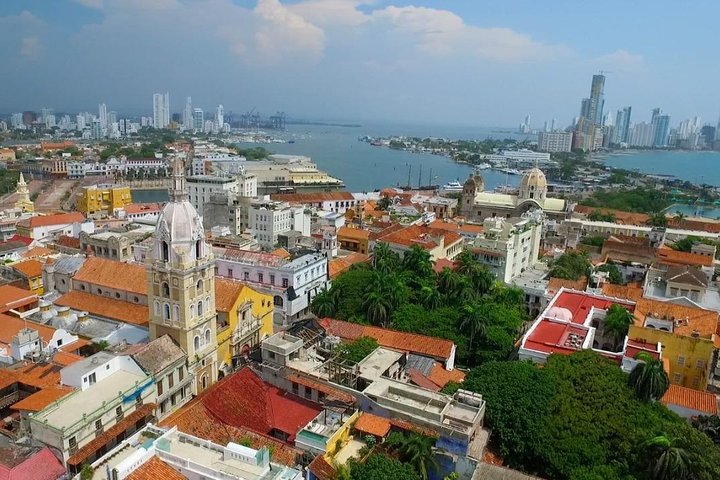
Photo via Viator
Ideal windows: 7:30 to 10:00 AM or 4:00 PM through sunset (around 6:00 PM). Morning gives you soft light, empty plazas before the cruise-ship groups arrive, and the shade of east-facing walls. The late afternoon gives you golden light, shade moving into the west-facing streets, and the walls themselves lit up for sunset.
What to avoid: 11:00 AM to 3:00 PM. The sun is brutal, the shade is minimal, and the crowds peak. If this is your only window, plan for indoor stops (Palacio de la Inquisición, churches, air-conditioned cafés) and accept that a lot of standing in direct sun will be part of the experience.
What to bring: at least one liter of water per person (tiendas and cafés are on every block for refills); a sun hat; sunscreen; light cotton or linen; comfortable walking shoes (the cobblestones are uneven); a small day bag; and some small bills in Colombian pesos for snacks, water, and the occasional entry fee. Expect to sweat through whatever you're wearing.
Where to start and how to orient
Start at Torre del Reloj, the yellow clock-tower gate that is the historic main entrance to the walled city. This is where every guided tour starts, which makes it easy to orient, easy for taxis to find, and the natural transition point between the walled city and Getsemaní. You'll arrive from wherever your hotel is - Uber and InDriver both work; negotiate a flat fare with a street taxi (expect COP 10,000 to 15,000 from Bocagrande).
The loop below runs clockwise: through El Centro, up into San Diego, along the walls, and back out to Getsemaní. Pace it for about three hours including all the stops; shave to two if you skip the paid museums.
Stop 1: Torre del Reloj (Plaza de los Coches)
The yellow clock tower - originally called the Boca del Puente - is the main historic gate into the walled city. The current clock mechanism is Swiss, installed in the late nineteenth century; the tower itself sits on a seventeenth-century base.
Immediately inside the gate is Plaza de los Coches, a triangular plaza that served as the colonial slave market. Today it's lined with candy vendors (the Portal de los Dulces) selling traditional sweets - cocadas, bocadillos, tamarind balls. At the center stands a statue of the city's founder, Pedro de Heredia. Five minutes for photos, ten if you buy sweets.
Stop 2: Plaza de la Aduana
The largest plaza in the walled city, anchored by the old Royal Customs House (Casa del Marqués de Premio Real). This is where Spanish colonial administration physically sat. It's a civic plaza more than a social one, good for a slow walk across rather than a sit. Allow five to ten minutes. (Map)
Stop 3: Iglesia y Convento de San Pedro Claver
The Jesuit priest Pedro Claver (1580 to 1654) ministered to enslaved Africans as they disembarked at Cartagena's port, and spent the last decades of his life doing so. His preserved body rests in a glass reliquary beneath the main altar. The attached convent cloister houses a small museum with religious art, pre-Columbian pieces, and context on the Afro-Cartagena experience that anchors the whole city.
Entry: approximately COP 14,000 to 16,000 (USD 3.50 to 4 at 4,000:1). Allow thirty minutes. This is one of the entries worth paying for. (Map)
Stop 4: Museo Naval del Caribe (optional)
Directly across from San Pedro Claver, housed in the former Jesuit college. The Naval Museum is the best English-friendly presentation of the pirate era and the 1741 siege. A dedicated hall covers Blas de Lezo (see the history of Cartagena for why). If you only have time for one museum, this is a better pick than the Palacio de la Inquisición for visitors more interested in naval history than Inquisition artifacts.
Entry: approximately COP 20,000 (USD 5). Allow thirty to forty-five minutes.
Stop 5: Plaza Santo Domingo
The most photographed plaza in Cartagena, anchored by the Iglesia de Santo Domingo - the oldest church in the city, construction started in 1551 and completed in the early seventeenth century. The leaning bell tower is real; local legend says the devil tried to knock it down.
In front sits Fernando Botero's bronze Figura Reclinada "Gertrudis", donated by the artist. The plaza is ringed with restaurants with aggressive touts; the prices inside the plaza run meaningfully higher than two streets over for comparable food. Good for a drink and the view; risky as a full dinner unless you've specifically chosen a place. Fifteen to twenty minutes. Church entry is free; donations expected.
Stop 6: Plaza de Bolívar and the Cathedral
The most shaded plaza in the walled city - which, given the climate, makes it the one you'll want to linger in. Big trees, a statue of Simón Bolívar on horseback, vallenato buskers through most of the day. Two paid entries sit on this plaza.
Catedral de Santa Catalina de Alejandría: construction started in 1577 and the building was partially destroyed by Drake's 1586 attack mid-build; finished in 1612. Entry approximately COP 18,000 (USD 4.50). Fifteen minutes.
Palacio de la Inquisición / Museo Histórico de Cartagena: the 1770 Baroque palace that housed the Inquisition tribunal from 1610 to 1811. Today it's the city's historical museum - Inquisition-era instruments, pre-Columbian Zenú goldwork, independence-era documents. Entry approximately COP 25,000 (USD 6). Allow forty-five to sixty minutes. If you pick one museum, pick this one.
Stop 7: Transition through the streets to San Diego
From Plaza de Bolívar, walk north through the narrow cobblestone streets - Calle de la Factoría, Calle del Colegio, Calle de los Estribos - toward the quieter northern half of the walled city. This stretch is the scene-setter: bougainvillea draped over balconies, heavy wooden doors with brass knockers, cats on the stoops. Fifteen to twenty minutes of walking and photography.
Stop 8: Plaza de San Diego
The quieter, more residential plaza in the San Diego barrio. Fewer tourists, better dinner options than Plaza Santo Domingo at generally lower prices. Plaza de San Diego has El Santísimo (Colombian fine dining) and Juan del Mar (seafood) as two well-reviewed picks around it. This is where you'd stop for lunch if you're running through the loop in the middle of the day.
Stop 9: Convento de Santa Clara (now Sofitel)
The seventeenth-century Poor Clares convent was converted into the Sofitel Legend Santa Clara in 1995. The lobby and courtyard are open to the public; non-guests are welcome to walk through, have a coffee or a cocktail in the bar, and look at the excavated crypt on site. This was the convent whose 1949 excavation inspired Gabriel García Márquez to write Of Love and Other Demons.
Entry: free to the lobby. Ten to fifteen minutes. An expensive cocktail is a reasonable price for a hit of AC in the middle of a hot afternoon.
Stop 10: Plaza Fernández de Madrid
The plaza where Florentino Ariza sits on a bench watching Fermina Daza in Love in the Time of Cholera. Leafy, low-key, residential. Ten minutes to sit on a bench and take it in.
Stop 11: Las Bóvedas
Twenty-three vaulted arches built into the wall in 1798 as military storage and, later, dungeons. Today they're a row of twenty-three souvenir shops selling crafts. The architecture is worth seeing. The merchandise inside - magnets, generic "Colombia" t-shirts, mass-produced imitations of Wayúu bags - mostly is not. If you want authentic Wayúu mochilas, buy from Artesanías de Colombia (government-run, fair trade). If you want authentic Palenquera sweets, buy from street vendors. Fifteen to twenty minutes for the architecture and a quick walk.
Stop 12: Walk the walls (Baluarte de Santa Catalina → Baluarte de San Ignacio)
Climb the wall at Las Bóvedas (stairs next to the last arch) and walk southwest along the ramparts toward the Plaza de Santa Teresa corner. There are no tickets, no hours, no gates - the wall is a public walkway.
The sunset stretches are the Baluarte de Santo Domingo (open views, relatively few vendors), the Baluarte de la Merced (quieter), and the Baluarte de San Ignacio, where you'll find Café del Mar - the famous sunset bar. Drinks are two to three times standard Cartagena prices (budget COP 35,000 to 50,000 for a cocktail, USD 9 to 12), and you need to arrive by 4:30 PM to get a rampart-edge table. No reservations.
Say this (if you hire a street guide)
¿Cuánto cobra por un tour de dos horas por la ciudad amurallada? ¿Está certificado por la Alcaldía?
How much do you charge for a two-hour tour of the walled city? Are you certified by the city?
The honest alternative: walk past Café del Mar and sit on the wall itself for the same view without the markup. Thirty to forty-five minutes total depending on pace.
Stop 13: Exit through Plaza de la Trinidad, Getsemaní
Exit the walls via Torre del Reloj or the Pegasos statue corner, cross Parque del Centenario, and enter Getsemaní via Calle Larga or Calle de la Media Luna. Plaza de la Trinidad fills up every evening around seven - locals, travelers, buskers, street food from carts, beer from plastic cups. This is the natural endpoint of the walking tour: sit on the steps of the Iglesia de la Santísima Trinidad for twenty minutes and watch the neighborhood assemble.
From here: dinner options range from street food on the plaza itself, to mid-range (Demente tapas on the plaza), to fine dining a few blocks away (Celele for Colombian-Caribbean tasting menus - reserve days ahead). Or a cocktail at Alquímico on Calle del Colegio, the most talked-about bar in the city. See the Getsemaní neighborhood guide for a fuller treatment.
Stop 14 (optional add-on): Castillo San Felipe de Barajas
Not technically within the walls, but a natural continuation. The Castillo sits on Cerro San Lázaro, a ten-minute walk east across the bridge from Getsemaní. It is the largest Spanish fortress in the Americas - the one that defeated the British siege of 1741. Tunnels you can climb through, cannon batteries, panoramic views over the city.
Entry: approximately COP 30,000 (USD 7.50) for foreigners; cédula discounts for residents. Allow 1.5 to 2 hours. Best done early in the morning rather than as a walking-tour continuation - the ramparts have almost no shade and the heat at midday is punishing. If you have only one day, do the Castillo the morning of, then the walking tour in the late afternoon, or book a guided combo tour covering the Walled City, the Castillo, and Popa Convent on Viator and let someone else handle the logistics.
Photo via Viator
What to skip (or at least know about)
Horse-drawn carriage rides along the walls. Widely criticized on animal-welfare grounds - horses working long hours on hot concrete - and phased out by many responsible operators. Thoughtful travelers increasingly decline.
"Emerald museums" inside the walls. These free-entry sites are primarily retail showrooms - a short film, a small display, then a hard sales pitch. Fine as an air-conditioned break on a hot afternoon; bad as a purchase venue. Buy emeralds only from certified sources, never on impulse.
Restaurant touts in Plaza Santo Domingo. Menus there are often priced 40 to 60 percent above comparable restaurants two streets inland. You pay for the Botero sculpture view.
Unsolicited street "guides" at major sites. Can be legitimate or not. If you engage, agree on a price in Colombian pesos before the tour starts (COP 30,000 to 50,000 for thirty minutes is the ceiling).
Palenquera photo demands. The women in bright fruit-basket-headdress dresses near Torre del Reloj will pose for a photo and then demand COP 20,000 to 50,000. Either agree on a smaller price (COP 5,000 to 10,000) before the photo, or politely decline. This is not rudeness on anyone's part - it's the actual economic arrangement.
Safety notes
The walled city and the main Getsemaní drags (Plaza de la Trinidad, Calle del Arsenal, Calle de la Media Luna) are heavily patrolled, well-lit, and busy with foot traffic until around midnight - walk freely. On quieter side streets in outer Getsemaní after midnight, grab an Uber or InDriver for the few blocks rather than walk. Don't flash phones, watches, or cash in any area you don't recognize - Cartagena's petty crime is opportunistic rather than targeted, which means visible valuables get you picked.
The Colombian phrase is no dar papaya - "don't give papaya," meaning don't offer opportunity. Apply it.
Going deeper
If the walking tour leaves you wanting more context, the history of Cartagena goes long on founding, the 1741 siege, the slavery era, independence, and the modern city. For the next steps on your itinerary, the things-to-do hub covers day trips, beaches, adventure sports, and night life. For neighborhood-by-neighborhood detail, start with El Centro, Getsemaní, and Bocagrande.
Entry fees are approximate as of April 2026. Cartagena attraction prices have risen quickly in 2023 to 2025 - confirm at the door. Hours vary; most museums close one day a week (often Monday). Last full review: April 2026.
Specific question while you read? Ask Catalina, the Cartagena Guide concierge.¿Pregunta específica mientras lees? Pregúntale a Catalina, la concierge de Cartagena Guide.Chat with Catalina ›Habla con Catalina ›
Mapa de lugares en esta guía
10 lugares marcados. Haz clic en cualquier marcador para ver los detalles.
La ciudad amurallada es caminable de punta a punta en una hora si no te detienes. Que es el problema, porque el punto es detenerse. Esta guía traza un recorrido autoguiado de 2 a 3 horas por El Centro y San Diego con catorce paradas específicas, abre la pregunta de cuáles entradas valen la pena pagar, y te deja en el borde de Getsemaní para cenar. Todos los precios eran exactos al momento de escribir; todos merecen double-check en la puerta porque las tarifas de atracciones en Cartagena han subido rápido.
Calor y horario: lee esto antes de irte
Cartagena queda a 10 grados norte. El sol está directamente arriba durante la mayor parte del año, y la humedad se mantiene en el rango de 75 a 85 por ciento todo el año. Esto importa más que casi cualquier otra cosa de este recorrido.
Mejores ventanas: 7:30 a 10:00 AM (plazas vacías, luz suave, sombra en las paredes orientadas al este) o 4:00 PM hasta el atardecer (luz dorada, aire más fresco, muros iluminados).
Evita: 11:00 AM a 3:00 PM si puedes. La sombra es mínima, el pavimento irradia calor, y las multitudes alcanzan su pico.
Qué traer: 1 litro de agua por persona (rellena en cualquier tienda), un sombrero, bloqueador solar, algodón ligero o lino, zapatos cómodos (los adoquines son irregulares), y billetes pequeños de COP para entradas y snacks.
Tours guiados gratis vs pagos: caminar la ruta solo es gratis. Un guía certificado (negocia COP 80,000 a 150,000 por 2 a 3 horas, por grupo, antes de empezar) añade profundidad histórica. Propina COP 20,000 a 40,000 si estás contento. Si prefieres saltarte la negociación con guías callejeros, puedes reservar un tour privado a pie en Viator con anticipación.
El recorrido de 14 paradas por El Centro y San Diego, terminando en Getsemaní. Haz clic en cualquier marcador numerado para ver la parada.
Cuándo ir (esto importa más de lo que crees)
Cartagena queda a 10°N. El sol está directamente arriba durante la mayor parte del año, y la humedad se mantiene en el rango de 75 a 85 por ciento independientemente de la estación. La diferencia entre un excelente recorrido a pie y uno punzante es la hora.
Foto vía Viator
Ventanas ideales: 7:30 a 10:00 AM o 4:00 PM hasta el atardecer (alrededor de las 6:00 PM). La mañana te da luz suave, plazas vacías antes de que lleguen los grupos de cruceros, y la sombra de las paredes orientadas al este. El final de la tarde te da luz dorada, sombra moviendose hacia las calles orientadas al oeste, y los muros mismos iluminados para el atardecer.
Qué evitar: 11:00 AM a 3:00 PM. El sol es brutal, la sombra es mínima, y las multitudes llegan a su máximo. Si esta es tu única ventana, planifica paradas en interiores (Palacio de la Inquisición, iglesias, cafés con aire acondicionado) y acepta que mucho estar de pie bajo el sol directo será parte de la experiencia.
Qué traer: al menos un litro de agua por persona (tiendas y cafés están en cada cuadra para rellenar); un sombrero; bloqueador solar; algodón ligero o lino; zapatos cómodos para caminar (los adoquines son irregulares); una mochila pequeña; y algunos billetes pequeños en pesos colombianos para snacks, agua, y la ocasional entrada. Espera sudar a través de lo que lleves puesto.
Dónde empezar y cómo orientarte
Empieza en Torre del Reloj, la puerta de la torre amarilla que es la entrada histórica principal a la ciudad amurallada. Es por donde todo tour guiado comienza, lo que la hace fácil de orientarse, fácil para los taxis de encontrar, y el punto de transición natural entre la ciudad amurallada y Getsemaní. Llegarás desde dondequiera que esté tu hotel · Uber e InDriver funcionan; negocia una tarifa plana con un taxi en la calle (espera COP 10,000 a 15,000 desde Bocagrande).
El recorrido de abajo va en sentido de las agujas del reloj: por El Centro, hacia San Diego, a lo largo de los muros, y de regreso a Getsemaní. Pácialo para alrededor de tres horas incluyendo todas las paradas; reduce a dos si saltas los museos pagos.
Parada 1: Torre del Reloj (Plaza de los Coches)
La torre amarilla del reloj, originalmente llamada la Boca del Puente, es la puerta histórica principal a la ciudad amurallada. El mecanismo del reloj actual es suizo, instalado a finales del siglo diecinueve; la torre misma está sobre una base del siglo diecisiete.
Inmediatamente dentro de la puerta está Plaza de los Coches, una plaza triangular que sirvió como mercado de esclavos colonial. Hoy está rodeada de vendedores de dulces (el Portal de los Dulces) vendiendo golosinas tradicionales · cocadas, bocadillos, bolas de tamarindo. En el centro se alza una estatua del fundador de la ciudad, Pedro de Heredia. Cinco minutos para fotos, diez si compras dulces.
Parada 2: Plaza de la Aduana
La plaza más grande de la ciudad amurallada, anclada por la antigua Casa Real de Aduanas (Casa del Marqués de Premio Real). Aquí es donde la administración colonial española se sentaba físicamente. Es una plaza cívica más que social, buena para un paseo lento a través en lugar de sentarse. Permite cinco a diez minutos. (Mapa)
Parada 3: Iglesia y Convento de San Pedro Claver
El sacerdote jesuita Pedro Claver (1580 a 1654) ministró a africanos esclavizados mientras desembarcaban en el puerto de Cartagena, y pasó las últimas décadas de su vida haciéndolo. Su cuerpo preservado descansa en un relicario de vidrio bajo el altar mayor. El convento contiguo alberga un pequeño museo con arte religioso, piezas precolombinas, y contexto sobre la experiencia afro-cartagenera que ancla toda la ciudad.
Entrada: aproximadamente COP 14,000 a 16,000 (USD 3.50 a 4 a razón de 4,000:1). Permite treinta minutos. Esta es una de las entradas que vale la pena pagar. (Mapa)
Parada 4: Museo Naval del Caribe (opcional)
Directamente al otro lado de San Pedro Claver, alojado en el antiguo colegio de los jesuitas. El Museo Naval es la mejor presentación amigable en inglés de la era de piratas y el sitio de 1741. Una sala dedicada cubre a Blas de Lezo (mira la historia de Cartagena para ver por qué). Si tienes tiempo para solo un museo, esta es mejor opción que el Palacio de la Inquisición para visitantes más interesados en historia naval que artefactos de la Inquisición.
Entrada: aproximadamente COP 20,000 (USD 5). Permite treinta a cuarenta y cinco minutos.
Parada 5: Plaza Santo Domingo
La plaza más fotografiada en Cartagena, anclada por la Iglesia de Santo Domingo · la iglesia más vieja de la ciudad, la construcción comenzó en 1551 y fue completada en el siglo diecisiete temprano. El campanario inclinado es real; la leyenda local dice que el diablo trató de tirarlo.
Al frente se alza el bronce de Fernando Botero Figura Reclinada "Gertrudis", donado por el artista. La plaza está rodeada de restaurantes con vendedores agresivos; los precios dentro de la plaza corren significativamente más altos que dos calles adentro por comida comparable. Buena para un trago y la vista; riesgosa como cena completa a menos que hayas elegido específicamente un lugar. Quince a veinte minutos. La entrada a la iglesia es gratis; se esperan donaciones.
Parada 6: Plaza de Bolívar y la Catedral
La plaza más sombreada en la ciudad amurallada · que, dada el clima, la hace la que querrás pasar más tiempo. Árboles grandes, una estatua de Simón Bolívar a caballo, jugladores de vallenato durante la mayor parte del día. Dos entradas pagadas se sientan en esta plaza.
Catedral de Santa Catalina de Alejandría: la construcción comenzó en 1577 y el edificio fue parcialmente destruido por el ataque de Drake en 1586 a mitad de construcción; terminada en 1612. Entrada aproximadamente COP 18,000 (USD 4.50). Quince minutos.
Palacio de la Inquisición / Museo Histórico de Cartagena: el palacio Barroco de 1770 que alojó el tribunal de la Inquisición desde 1610 a 1811. Hoy es el museo histórico de la ciudad · instrumentos de la era de la Inquisición, orfebrería Zenú precolombina, documentos de la independencia. Entrada aproximadamente COP 25,000 (USD 6). Permite cuarenta y cinco a sesenta minutos. Si escoges un museo, escoge este.
Parada 7: Transición a través de las calles a San Diego
Desde Plaza de Bolívar, camina norte por las calles angostas de adoquines · Calle de la Factoría, Calle del Colegio, Calle de los Estribos · hacia la mitad norte más tranquila de la ciudad amurallada. Este trecho es el fondo: buganvilia colgando sobre balcones, puertas de madera pesada con aldabas de latón, gatos en los umbrales. Quince a veinte minutos de caminar y fotografía.
Parada 8: Plaza de San Diego
La plaza más tranquila y residencial en el barrio San Diego. Menos turistas, mejores opciones de cena que Plaza Santo Domingo generalmente a precios más bajos. Plaza de San Diego tiene El Santísimo (gastronomía colombiana fina) y Juan del Mar (mariscos) como dos opciones bien reseñadas alrededor. Aquí es donde te detendrías para almorzar si estás haciendo el recorrido en medio del día.
Parada 9: Convento de Santa Clara (ahora Sofitel)
El convento de las Hermanas Pobres del siglo diecisiete fue convertido en el Sofitel Legend Santa Clara en 1995. El lobby y el patio están abiertos al público; los no huéspedes son bienvenidos a caminar, tomar un café o un cóctel en el bar, y ver la cripta excavada en el sitio. Este fue el convento cuya excavación de 1949 inspiró a Gabriel García Márquez a escribir Of Love and Other Demons.
Entrada: gratis al lobby. Diez a quince minutos. Un cóctel caro es un precio razonable para un poco de aire acondicionado en medio de una tarde calurosa.
Parada 10: Plaza Fernández de Madrid
La plaza donde Florentino Ariza se sienta en una banca viendo a Fermina Daza en Love in the Time of Cholera. Frondosa, sin pretensiones, residencial. Diez minutos para sentarse en una banca y tomar todo.
Parada 11: Las Bóvedas
Veintitrés arcos abovedados construidos en el muro en 1798 como almacenes militares y, después, mazmorras. Hoy son una fila de veintitrés tiendas de souvenirs vendiendo artesanías. La arquitectura vale la pena ver. La mercancía adentro · imanes, camisetas genéricas de "Colombia", imitaciones producidas en masa de bolsos Wayúu · en su mayoría no. Si quieres auténticas mochilas Wayúu, compra en Artesanías de Colombia (estatal, comercio justo). Si quieres auténticos dulces de Palenquera, compra de vendedores en las calles. Quince a veinte minutos para la arquitectura y un paseo rápido.
Parada 12: Camina los muros (Baluarte de Santa Catalina · Baluarte de San Ignacio)
Sube al muro en Las Bóvedas (escaleras al lado del último arco) y camina suroeste a lo largo de los parapetos hacia la esquina de Plaza de Santa Teresa. No hay tiquetes, no hay horarios, no hay puertas · el muro es un camino público.
Los tramos del atardecer son el Baluarte de Santo Domingo (vistas abiertas, relativamente pocos vendedores), el Baluarte de la Merced (más tranquilo), y el Baluarte de San Ignacio, donde encontrarás Café del Mar · el famoso bar del atardecer. Las bebidas son dos a tres veces los precios estándar de Cartagena (presupuesta COP 35,000 a 50,000 por un cóctel, USD 9 a 12), y necesitas llegar por 4:30 PM para conseguir una mesa en el borde del parapeto. Sin reservaciones.
Di esto (si contratas un guía de la calle)
¿Cuánto cobra por un tour de dos horas por la ciudad amurallada? ¿Está certificado por la Alcaldía?
How much do you charge for a two-hour tour of the walled city? Are you certified by the city?
La alternativa honesta: camina pasado Café del Mar y siéntate en el muro mismo por la misma vista sin el sobreprecio. Treinta a cuarenta y cinco minutos totales dependiendo del ritmo.
Parada 13: Salida a través de Plaza de la Trinidad, Getsemaní
Sal de los muros vía Torre del Reloj o la esquina de la estatua de Pegasos, cruza Parque del Centenario, e ingresa a Getsemaní vía Calle Larga o Calle de la Media Luna. Plaza de la Trinidad se llena cada noche alrededor de las siete · locales, viajeros, jugladores, comida callejera de carritos, cerveza de vasos plásticos. Este es el punto natural de final del recorrido a pie: siéntate en los escalones de la Iglesia de la Santísima Trinidad por veinte minutos y mira el barrio reunirse.
Desde aquí: opciones de cena van desde comida callejera en la plaza misma, a medio rango (Demente tapas en la plaza), a gastronomía fina algunos bloques lejos (Celele para menú degustación colombiano-caribeño · reserva días antes). O un cóctel en Alquímico en Calle del Colegio, el bar más mencionado de la ciudad. Mira la guía del barrio Getsemaní para un tratamiento más completo.
Parada 14 (complemento opcional): Castillo San Felipe de Barajas
No técnicamente dentro de los muros, pero una continuación natural. El Castillo se sienta en Cerro San Lázaro, una caminata de diez minutos al este a través del puente desde Getsemaní. Es la fortaleza española más grande en las Américas · la que derrotó el sitio británico de 1741. Túneles por los que puedes subir, baterías de cañones, vistas panorámicas sobre la ciudad.
Entrada: aproximadamente COP 30,000 (USD 7.50) para extranjeros; descuentos de cédula para residentes. Permite 1.5 a 2 horas. Mejor hecho temprano en la mañana en lugar de como continuación del recorrido a pie · los parapetos casi no tienen sombra y el calor al mediodía es punzante. Si tienes solo un día, haz el Castillo la mañana de, luego el recorrido a pie en el final de la tarde, o reserva un tour combinado guiado por la Ciudad Amurallada, el Castillo y el Convento de la Popa en Viator y deja que alguien más maneje la logística.
Foto vía Viator
Qué saltarse (o al menos saber sobre)
Paseos en carrozas tiradas por caballos a lo largo de los muros. Ampliamente criticados por razones de bienestar animal · caballos trabajando largas horas en concreto caliente · y eliminados gradualmente por muchos operadores responsables. Los viajeros reflexivos cada vez más rechazan.
"Museos de esmeraldas" dentro de los muros. Estos sitios de entrada libre son principalmente salas de exhibición minorista · una película corta, una pequeña exhibición, luego un discurso de venta agresivo. Bien como un descanso con aire acondicionado en una tarde calurosa; malo como un lugar para comprar. Compra esmeraldas solo de fuentes certificadas, nunca por impulso.
Vendedores agresivos de restaurantes en Plaza Santo Domingo. Los menús allí a menudo están precios 40 a 60 por ciento por encima de restaurantes comparables dos calles adentro. Pagas por la vista de la escultura de Botero.
"Guías" callejeros no solicitados en sitios principales. Pueden ser legítimos o no. Si te envuelves, acuerda un precio en pesos colombianos antes del recorrido (COP 30,000 a 50,000 por treinta minutos es el techo).
Demandas de fotos de Palenqueras. Las mujeres en trajes de vestido de cesta de frutas de cabeza brillante cerca de Torre del Reloj posarán para una foto y luego demandarán COP 20,000 a 50,000. Tanto acuerda un precio más pequeño (COP 5,000 a 10,000) antes de la foto, o cortésmente declina. Esto no es rudeza de parte de nadie · es el arreglo económico actual.
Notas de seguridad
La ciudad amurallada y los arrastres principales de Getsemaní (Plaza de la Trinidad, Calle del Arsenal, Calle de la Media Luna) están fuertemente patrullados, bien iluminados, y concurridos con tráfico peatonal hasta alrededor de la medianoche · camina libremente. En calles laterales más tranquilas en Getsemaní exterior después de medianoche, agarra un Uber o InDriver por algunos bloques en lugar de caminar. No muestres teléfonos, relojes, o dinero en efectivo en ningún área que no reconozcas · el crimen pequeño de Cartagena es oportunista en lugar de dirigido, lo que significa que objetos de valor visibles te ponen a la vista.
La frase colombiana es no dar papaya · "no dar papaya", significando no ofrezca oportunidad. Aplícalo.
Profundizar
Si el recorrido a pie te deja queriendo más contexto, la historia de Cartagena va largo en fundación, el sitio de 1741, la era de esclavitud, independencia, y la ciudad moderna. Para los siguientes pasos en tu itinerario, el hub de cosas que hacer cubre excursiones de un día, playas, deportes de aventura, y vida nocturna. Para detalle barrio-por-barrio, comienza con El Centro, Getsemaní, y Bocagrande.
Las tarifas de entrada son aproximadas a partir de abril de 2026. Los precios de atracciones en Cartagena han subido rápido en 2023 a 2025 · confirma en la puerta. Los horarios varían; la mayoría de museos cierran un día a la semana (a menudo lunes). Última revisión completa: abril de 2026.
Newsletter
Get the guide in your inbox
One short email each Saturday. New posts, what's on this week, and anything worth knowing about Cartagena. No spam, unsubscribe anytime.