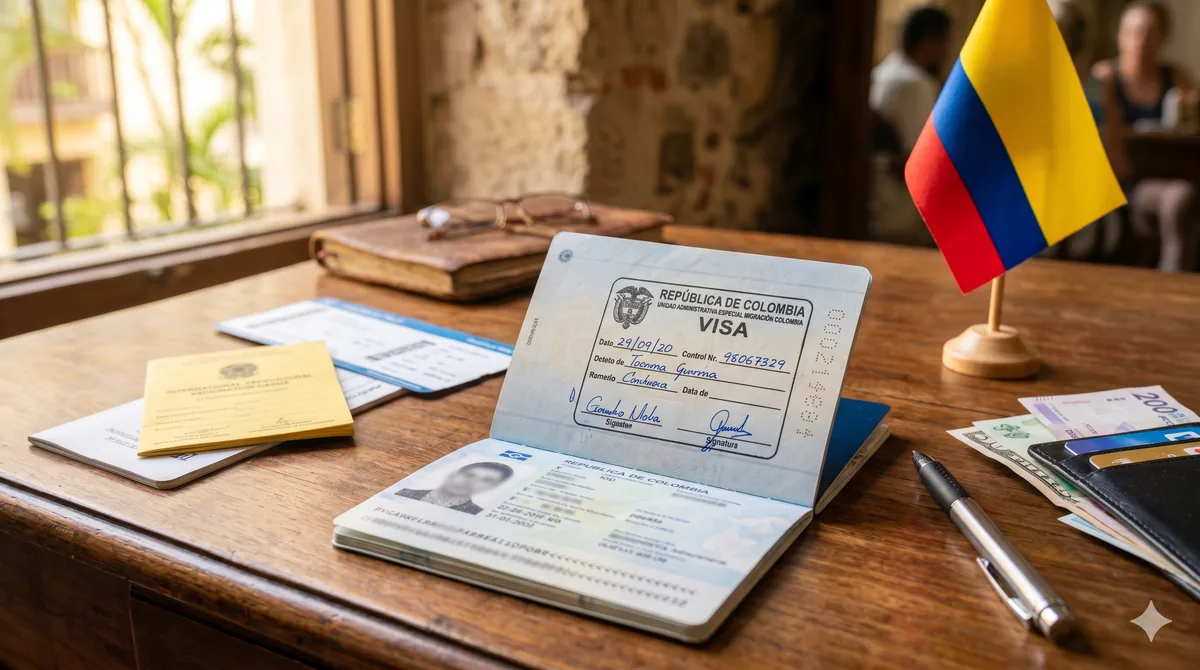
Colombia Visa Guide 2026: Every Option for Living in CartagenaGuía de Visas Colombia 2026: Todas las Opciones para Vivir en Cartagena
Mike Chartrand
April 9, 2026 - Updated April 23, 2026 · 18 min read
Specific question while you read? Ask Catalina, the Cartagena Guide concierge.¿Pregunta específica mientras lees? Pregúntale a Catalina, la concierge de Cartagena Guide.Chat with Catalina ›Habla con Catalina ›
Last updated: May 2026. Colombia’s visa system is well-documented and, if you read it carefully, fair and predictable. The mistakes travelers make are almost all about vocabulary: confusing tourist permits with visas, confusing extensions with new visas, or confusing the visa with the ID card you get after. This guide separates those clearly and walks through every realistic option for visiting, working remotely from, or moving permanently to Cartagena. For the city context behind the visa decision, see everything you need to know about Cartagena.
Which visa fits you? Quick decision guide
Retiring on a pension (consistent monthly pension income above COP 5,252,715 / about USD 1,380 at today's exchange rate): M, Pensionado is the most direct route. Easiest to document, highly recommended for retirees. Builds to residency (R) after 5 years.
Living on investment income or rental income (not a pension, not a salary, above COP 17,509,050 / about USD 4,400 per month): V, Rentista. Reclassified from M to V in October 2022. Up to 2 years per issue. Does NOT build to residency.
Remote worker or freelancer with foreign clients (earning above COP 5,252,715 per month, income from outside Colombia): V, Nómada Digital. V-class visa introduced in 2022 under Resolution 5477 (Article 46). Up to 2 years. Does NOT build to residency.
Buying property or investing in a Colombian company (real estate above COP 612,816,750 or company investment above COP 175,090,500): M, Inversionista.
Not sure yet / planning to visit first: enter on the PIP tourist permit (no application needed for about 100 nationalities), see how the city feels, then decide which M visa to pursue.
Specific question while you read? Ask Catalina, the Cartagena Guide concierge.¿Pregunta específica mientras lees? Pregúntale a Catalina, la concierge de Cartagena Guide.Chat with Catalina ›Habla con Catalina ›
Última actualización: mayo de 2026. El sistema de visas de Colombia está bien documentado y, si lo lees cuidadosamente, es justo y predecible. Los errores que cometen los viajeros son casi todos sobre vocabulario: confundir permisos de turista con visas, confundir extensiones con visas nuevas, o confundir la visa con la cédula de extranjería que recibes después. Esta guía separa eso claramente y recorre cada opción realista para visitar, trabajar remoto desde, o mudarte permanentemente a Cartagena. Para el contexto de la ciudad detrás de la decisión de visa, ve todo lo que necesitas saber sobre Cartagena.
¿Qué visa te conviene? Guía de decisión rápida
Jubilado con pensión (ingresos de pensión consistentes superiores a COP 5,252,715 / aproximadamente USD 1,380 al tipo de cambio actual): M, Pensionado es la ruta más directa. La más fácil de documentar, muy recomendada para jubilados. Se convierte en residencia (R) después de 5 años.
Vivir de ingresos de inversión o ingresos por alquiler (no es pensión, no es salario, superior a COP 17,509,050 / aproximadamente USD 4,400 por mes): V, Rentista. Reclasificada de M a V en octubre de 2022. Hasta 2 años por emisión. NO se convierte en residencia.
Trabajador remoto o freelancer con clientes en el extranjero (ganando superior a COP 5,252,715 por mes, ingresos desde fuera de Colombia): V, Nómada Digital. Visa clase V introducida en 2022 bajo Resolución 5477 (Artículo 46). Hasta 2 años. NO se convierte en residencia.
Compra de propiedad o inversión en una empresa colombiana (bienes raíces superiores a COP 612,816,750 o inversión en empresa superior a COP 175,090,500): M, Inversionista.
Pareja o cónyuge de un colombiano: M, Cónyuge / Compañero Permanente. Después de 2 años (no 5) calificas para la visa de residente R.
No estoy seguro aún / planeo visitar primero: entra con el permiso de turista PIP (no se requiere solicitud para alrededor de 100 nacionalidades), mira cómo se siente la ciudad, y luego decide qué visa M perseguir.
Colombia has two separate systems, learn them first
Everything below makes more sense once you understand that Colombia runs two parallel systems, and they are not the same thing:
Tourist permits, issued by Migración Colombia at the airport (or at a land border). These are permits, not visas. The main ones are the PIP (entry stamp given on arrival) and the PTP (in-country extension of a PIP).
Visas, issued by the Cancillería (Ministry of Foreign Affairs, cancilleria.gov.co) through its online portal. Visas are categorized V (Visitor), M (Migrant), and R (Resident).
Two agencies, two kinds of document. Most people visiting on vacation never touch the Cancillería at all, they enter visa-free, get a PIP stamp, and leave. People moving to Colombia apply for a visa through the Cancillería portal.
There’s also a third artifact, the Cédula de Extranjería (CE), the foreign-resident ID card issued by Migración Colombia after your visa is approved. The CE is an ID card, not a visa; we’ll cover it below.
Visa-free tourist entry (the PIP)
Citizens of roughly 100 countries, including the United States, Canada, the UK, all EU/Schengen countries, Australia, New Zealand, Japan, South Korea, Israel, and most of Latin America, can enter Colombia as tourists without applying for anything in advance. Full up-to-date list: Cancillería, countries that don’t need a visa.
At the airport you’ll receive the PIP (Permiso de Ingreso y Permanencia), an entry permit, logged digitally and stamped in your passport. Usual grant: 90 days. The officer can grant less (30 or 60) at their discretion if they think your plans don’t require 90; always ask politely for 90 if you want it.
Important rules about the PIP:
You may spend a maximum of 180 days per calendar year in Colombia as a tourist. That cap includes extensions. It resets on January 1.
The PIP does not let you work for a Colombian employer or earn Colombian income. Remote work for a non-Colombian employer is in a gray zone most tourists operate in without issue, but it is not what the PIP legally authorizes, the Digital Nomad Visa exists precisely to put that on a proper footing.
Overstaying triggers a fine (roughly 1 to 7 times the minimum daily wage per day, in 2026 that’s approximately COP 48,000 to 340,000 per day) plus problems re-entering later. Don’t overstay.
Entry requirements at the airport: passport valid at least until your departure date (no 6-month rule in Colombia, but airlines may enforce their own), proof of onward travel (airlines check this), and an address in Colombia. You’ll also complete the Check-Mig online form within 72 hours before your flight: apps.migracioncolombia.gov.co/pre-registro.
Extending your tourist stay (the PTP)
If you want more time, you apply for a PTP (Permiso Temporal de Permanencia) through Migración Colombia, inside Colombia, before your PIP expires. This is the extension, and it is still a permit, not a visa.
Maximum extension: up to 90 additional days.
Combined with the PIP, it still can’t exceed the 180-day annual cap.
Where to apply: online at apps.migracioncolombia.gov.co (look for Prórroga de Permanencia). Pay the fee (approximately COP 150,000 per Migración Resolución 0599 of February 2026, with some nationalities qualifying for reciprocity-based discounts), upload your passport and PIP, and wait for email approval.
You can also do the procedure in person at the Migración Colombia office in Cartagena. The office has moved in recent years; verify the current address and opening hours at migracioncolombia.gov.co before going. National info line: +57 601 605 5454. Expect 1 to 2 hours on site and bring printed copies of everything.
Apply before the PIP expires. Applying the day before or after is risky; give yourself a week.
After 180 days in a calendar year, your only options are to leave the country, switch to a visa, or wait for January 1. A so-called “visa run” (leaving and coming back) does not reset the counter, the 180-day clock is cumulative, not per-entry.
The three visa categories, V, M, and R
Colombian visas are grouped into three tiers, each a step closer to permanent residency and eventually citizenship:
V, Visitante (Visitor): short-term, up to 2 years. For a specific purpose (work on a defined project, study, medical treatment, volunteering, religious mission, event, independent contracting, digital nomadism, etc.). Time on a V visa does not count toward residency.
M, Migrante (Migrant): medium-term, up to 3 years. For people building a life in Colombia: spouses/partners of Colombians, parents of Colombians, pensioners, employees with a local contract, investors, long-term students. After 5 continuous years on an M visa, you’re eligible for the R visa. Note: as of October 2022, Rentista and Nómada Digital are both V-class (not M), and neither builds to R.
R, Residente (Resident): 5-year renewable permanent residency. Can be granted after 5 years in the M category or 2 years if you’re married to a Colombian. The R visa is the path to Colombian citizenship, which requires 5 years of continuous residency on R generally, 2 years for spouses or parents of Colombians, and 1 year for Latin American and Caribbean nationals and Spaniards by birth.
Each category has several sub-types identified by a number or name. Below are the ones foreigners in Cartagena most commonly apply for.
V, Nómada Digital (Digital Nomad Visa)
Class correction. The Nómada Digital was introduced in October 2022 (Resolution 5477) as a V (Visitor) class visa under Article 46, not M. Many older sources still call it M class; that is incorrect. As a V-class visa it does not count toward R-visa eligibility.
The Nómada Digital visa is for remote workers and digital entrepreneurs whose income comes from outside Colombia. It is not a PIP extension. As a V-class visa it is capped at 2 years per issue and does not accumulate years toward residency.
Eligibility:
You work remotely for a company outside Colombia, or you are a freelancer/entrepreneur providing services to clients outside Colombia.
You’re from a country that doesn’t require a short-stay visa to enter Colombia (the same roughly-100-country list above).
You earn at least 3 times the Colombian monthly minimum wage (SMMLV) per month over the last 3 months. In 2026 the SMMLV is COP 1,750,905, so the minimum is around COP 5,252,715 (about USD 1,380 at today's exchange rate) per month. Each month must individually meet the threshold; Cancillería does not average. Check the current SMMLV before applying.
Mandatory health insurance covering all risks in Colombia for the full duration of the visa.
Duration: up to 2 years. As a V-type visa, time on the Nómada Digital does not count toward R-visa eligibility. To build toward residency, you would need to switch to an M-class visa (Pensionado, Inversionista, Cónyuge, Padre/Madre, or Trabajador).
What you can do on it: live in Colombia, work for your overseas employer/clients, bring a spouse and minor children as beneficiaries. What you can’t do: take a job with a Colombian employer (that’s the M, Trabajador visa).
Motivation letter explaining the remote work arrangement.
Proof of employment (contract with a foreign employer) or proof of freelance activity (contracts, client list, invoicing).
Bank statements for the last 3 months showing the income threshold.
Health-insurance policy valid in Colombia.
Clean criminal record (some consulates ask, some don’t).
Fees (2026, approximate, change annually, verify at application time): study fee ~USD 55 (charged when you submit), and if approved, a visa fee of ~USD 180. Both are payable online by card.
Timeline: most applications are decided in 5 to 30 business days. Status updates arrive by email through the Cancillería portal.
M, Pensionado (Pensioner / Retiree Visa)
For retirees receiving a pension from a government source: a foreign government pension, military pension, or Social Security. Private 401(k), IRA, or RRSP withdrawals do NOT qualify here, those route to the V Rentista visa instead.
Income requirement: at least 3× the Colombian SMMLV per month in verifiable pension income (COP 5,252,715 / about USD 1,380 at today's exchange rate in 2026, based on SMMLV COP 1,750,905).
Duration: up to 3 years, renewable.
Work rights: limited, you may work as an independent contractor but cannot take a traditional Colombian employee role.
Counts toward the R visa: yes. Apply for R after 5 continuous years on M Pensionado.
Key documents: pension certification from the source (US Social Security, UK state pension, etc.), apostilled and translated into Spanish; mandatory health insurance covering all risks including repatriation of remains; passport.
V, Rentista (Independent Income Visa)
Class change in 2022. Until October 2022 the Rentista was an M-class visa with a 3-year duration that counted toward residency. Resolution 5477 reclassified it to V-class, capped at 2 years, and removed the path to R. Older articles online still describe it the old way. They are out of date.
For people with regular independent income from investments or holdings, dividends, rental income, annuities, that isn’t a pension and isn’t a salary.
Income requirement: at least 10× the SMMLV per month (COP 17,509,050 / about USD 4,400 at today's exchange rate in 2026) for at least the last 6 months, and sustainable.
Duration: up to 2 years per issue. Renewable but each new issue is fresh; time does NOT accumulate toward R.
Path to R: none directly. To build toward permanent residency, switch to an M visa class (Pensionado, Inversionista, Cónyuge, Padre/Madre, or Trabajador).
Restrictions: does not permit employment in Colombia. Allows studying. Becomes invalid if you stay outside Colombia for 6 or more consecutive months.
Requires documented source of income (brokerage statements, lease contracts), 6 months of bank statements, and a CPA letter from a licensed Colombian contador público (or a foreign CPA with license number and apostille).
M, Inversionista (Investor Visa)
For foreigners who invest in Colombian real estate or register foreign capital in a Colombian company. Investment thresholds are expressed in SMMLV:
Real estate investment: at least 350× SMMLV (COP 612,816,750 / about USD 161,000 at today's exchange rate, 2026). Formal visa code M-10.
Business/company investment: at least 100× SMMLV (COP 175,090,500 / about USD 46,000 at today's exchange rate, 2026) registered with the central bank (Banco de la República).
Duration: up to 3 years, renewable. Counts toward R.
The investment must be documented with the registered foreign-investment certificate from Banco de la República (Formulario 4) for both real estate and company investments. Without Formulario 4 the visa is denied even if title is in your name.
Loses validity if you stay outside Colombia for more than 180 consecutive days. Plan extended trips carefully.
Cartagena’s Bocagrande, Castillogrande, El Laguito, and Manga neighborhoods have plenty of properties comfortably above the real-estate threshold. See our neighborhoods guide.
M, Cónyuge / Compañero Permanente de Nacional Colombiano (Partner of a Colombian)
If you’re married to a Colombian or in a registered domestic partnership (unión marital de hecho) with one, you qualify for this M visa.
Marriage or partnership must be legally registered in Colombia, if you married abroad, register the marriage through a Colombian consulate or notary. Domestic partnerships can be formalized at a Colombian notary (escritura pública de unión marital de hecho).
Duration: 3 years, renewable. Counts toward R.
After 2 years (not 5) on this visa, you’re eligible to switch to an R visa as spouse of a Colombian, one of the fastest paths to residency.
Work rights: unrestricted. You can work for any Colombian employer or as an independent contractor.
M, Padre o Madre de Nacional Colombiano (Parent of a Colombian)
For parents of Colombian nationals, commonly, foreigners whose child was born in Colombia. The child’s Colombian registration (registro civil de nacimiento) is the anchor document. Duration and rules mirror the spouse visa.
V, Prestador de servicios (Short-Term Service Provider)
For foreigners taking a specific, time-limited service or work assignment for a Colombian company or counterparty. Issued under one of the V subtypes defined by Resolution 5477 (typically V para prestador de servicios temporales).
Duration: up to 2 years per issue (V visas are capped at 2 years under Resolution 5477). Does not count toward R.
Many foreigners working in Cartagena’s energy, logistics, and shared-services sectors start on this V subtype and later transition to an M, Trabajador if the employment continues longer term.
M, Trabajador (Long-Term Work Visa)
For longer employment relationships with a Colombian employer, similar requirements to V, Trabajador but issued in the M category, so it counts toward residency.
V, Estudiante / M, Estudiante (Student Visas)
V, Estudiante covers short, specific programs. M, Estudiante covers full-time enrollment in a Colombian degree program at a recognized institution (institución de educación superior). For Cartagena-based study, Universidad de Cartagena, Universidad Tecnológica de Bolívar (UTB), and Universidad del Sinú-Cartagena issue the acceptance letters that anchor these applications.
R, Visa de Residente
The R visa is 5-year renewable permanent residency. It’s the milestone visa, no more renewals every few years, and it’s the gateway to citizenship.
How to qualify:
5 continuous years on an M visa (any subtype), counted from the first M visa. “Continuous” means you did not have a gap in legal status; brief trips abroad are fine. The 5-year clock counts from your first M visa, not from when you entered Colombia.
2 years if married to a Colombian or the parent of a Colombian.
Investment R: invest at least 650× SMMLV (COP 1,138,088,250 / approx. USD 284,522 in 2026) in Colombian real estate or a registered Colombian company.
Ancestry: grandchildren of Colombians through a specific naturalization pathway.
Important: If you leave Colombia for more than 2 continuous years after getting the R visa, it’s automatically cancelled. Plan extended trips carefully.
Rights: unrestricted work, full access to healthcare, banking, property ownership. You still need to renew the physical ID card (Cédula de Extranjería) every 5 years.
The Cédula de Extranjería (Foreign ID Card)
After any visa is granted (V, M, or R), you have 15 calendar days to register with Migración Colombia and get your Cédula de Extranjería (CE). Miss the deadline and you face a fine even though the visa itself is still valid.
Register online at apps.migracioncolombia.gov.co, pay the fee (COP 294,000 in 2026 per Migración Colombia Resolution 0599 of February 2026, a 5.1% increase from 2025 indexed to inflation), upload documents, and book an appointment at the Migración office.
At the appointment, they take biometrics (photo and fingerprints).
The card arrives in 5 to 10 business days for pickup.
Cartagena office: confirm the current address and opening hours at migracioncolombia.gov.co before going. Open weekdays. Bring printed copies of everything.
The CE is what you’ll use for almost every everyday task a Colombian uses their cédula for: opening a bank account, signing a lease, registering for health insurance (EPS), getting a phone line, paying taxes. Without a CE, many things are harder or impossible even if your visa is valid.
How a visa application actually works
Pick the right category. The Cancillería portal starts by asking why you’re applying, pick correctly, because each subtype has its own documents.
Assemble documents, most in PDF, under 2 MB each. Translations into Spanish by an official translator are required for many documents issued abroad; apostilles (or consular legalization) are required for foreign public documents like birth certificates, pension letters, or marriage certificates.
The apostille and translation gotcha (do this before you leave home)
Most foreign public documents, pension certification letters, birth certificates, marriage certificates, police clearance records, need two things before Colombia accepts them: (1) an apostille from the authority that issued them (in the country of origin, not in Colombia), and (2) an official Spanish translation done by a certified translator after you arrive in Colombia. Getting an apostille from abroad once you are already living in Cartagena is slow and expensive. Get every document apostilled before you leave your home country, ideally before you even book the one-way flight. If your country is not part of the Hague Apostille Convention (a short list), you will need consular legalization instead, a slightly different process at a Colombian consulate.
Wait for review. The Cancillería responds by email: approved, denied, or requerido (more documents requested, you’ll have ~5 business days to reply).
Pay the visa fee on approval (~USD 177 for most M visas).
Stamp or electronic visa. Modern visas are almost always issued electronically, you print the PDF and carry it. If you’re outside Colombia and need a passport stamp, visit a consulate or Migración on arrival.
Register with Migración within 15 days and get your CE (above).
Say this at Migración Colombia (Cartagena office)
"Buenos días. Acabo de recibir mi visa y necesito registrarme para solicitar la Cédula de Extranjería. ¿Podría indicarme los documentos que necesito y si hay que pedir cita en línea primero?"
Good morning. I just received my visa and need to register to apply for the Cédula de Extranjería. Could you tell me the documents I need and whether I need to book an online appointment first?
You can apply from inside Colombia as long as you currently have legal status (a valid PIP or existing visa). You can’t apply while overstayed.
Tax residency, the 183-day rule
Spending more than 183 days in Colombia in any rolling 365-day period makes you a tax resident. As a tax resident, Colombia taxes your worldwide income. Colombia has double-tax treaties with Spain, the UK, Canada, and several other countries, but not with the United States as of 2026, American citizens can end up filing in both jurisdictions (though the US Foreign Earned Income Exclusion and foreign tax credits usually prevent double taxation).
If you’re on the Digital Nomad visa or spending long stretches on PIP/PTP, track your days carefully and consult a Colombian accountant (contador público). We don’t provide tax advice on this site, get a professional.
Path to Colombian citizenship
After 5 years of continuous residency on the R visa, you can apply for naturalization. The timeline drops to 2 years if you’re married to a Colombian or the parent of a Colombian, and to 1 year for nationals of Latin American and Caribbean countries (by birth) and Spaniards by birth under reciprocity treaties (Ley 43 de 1993).
Requirements include a language/culture test (in Spanish), a clean criminal record in Colombia and your home country, proof of continuous residency, and financial self-sufficiency. Colombia accepts dual citizenship, so you do not need to give up your current nationality.
Common mistakes to avoid
Calling the PIP a “visa”. It’s a permit; it does not give you work rights or a path to residency.
Assuming the Nómada Digital is a “tourist extension.” It’s a full M visa. Applying for it is an in-depth process, not a quick renewal.
Treating visa and Cédula de Extranjería as the same thing. The visa is the legal authorization; the CE is the physical ID that lets you function day-to-day. You need both.
Border runs to reset the 180-day cap. The cap is annual and cumulative, leaving and returning doesn’t reset it. Leaving and returning resets the PIP’s 90-day count only if you’re under the 180-day annual cap.
Waiting until the last minute. Apply for extensions and visas before your current status expires, not after.
Ignoring the 15-day CE window after visa approval. The visa is approved, but without registration, the clock on the fine starts ticking.
Paying touts at the Migración office. People outside the office offer “express service” for a fee. Not necessary and sometimes a scam. Do the online appointment yourself.
Missing apostilles/translations. Foreign documents used in visa applications almost always need (a) an apostille or consular legalization in the country of issue, and (b) translation into Spanish by an official translator in Colombia.
Official links and offices
Cancillería, visa applications and information: cancilleria.gov.co, apply online, check status, pay fees
Cartagena Migración office: address and hours change periodically. Check the latest at migracioncolombia.gov.co before visiting. National info line +57 601 605 5454.
Cartagena Notarías (for marriage/partnership registration, apostilles, and translations): notaries are spread across Centro, Bocagrande, and Manga; cost of public deed for unión marital de hecho runs COP 200 to 400,000.
Should I hire an immigration lawyer?
Most straightforward cases, Digital Nomad, Pensionado, Cónyuge, can be done solo. The Cancillería portal is in Spanish and English, documents are listed clearly, and the requerido back-and-forth is manageable if your Spanish is okay or you have a translator friend.
Consider a lawyer when: you have a visa denial on your record, you’re on the borderline of an income requirement, you have complicated documentation from multiple countries, your investment or company-structure case needs Banco de la República paperwork, or your Spanish is limited. Budget USD 500 to 1,500 for a straightforward case, more for investor or complex family cases.
FAQ
Is the tourist permit a visa? No. The PIP is an entry permit issued by Migración Colombia, not a visa. Visas are issued only by the Cancillería and belong to one of the V, M, or R categories.
Is the Digital Nomad visa an extension of my tourist permit? No. The Nómada Digital is a full M-category visa (medium-term Migrant). Tourist-permit extension is done via the PTP at Migración Colombia and is a separate, simpler process that tops up your stay to the 180-day annual cap.
Can I apply for a visa from inside Colombia? Yes, as long as you currently have legal status (unexpired PIP or existing visa). You submit online and can receive the visa electronically without leaving the country.
Do visa days count toward the 180-day tourist cap? No. The 180-day annual cap applies only to the PIP/PTP system. Once you’re on a visa, you’re outside the tourist system.
Can I work remotely on a tourist permit? Technically the PIP doesn’t authorize work. In practice, quiet remote work for a foreign employer has long been tolerated, but it is not what the permit is for, and the Nómada Digital visa exists specifically to make it legitimate.
How long does the Nómada Digital take? Most decisions land in 5 to 30 business days.
Can my spouse and children come with me? Yes. Every M visa accepts beneficiaries: legal spouse/partner and minor children. Each beneficiary pays a reduced visa fee and registers for their own CE.
Does Colombia allow dual citizenship? Yes. You don’t have to give up your current passport if you naturalize.
What happens if I overstay my PIP? You accrue a fine per day overstayed (roughly 1 to 7 times the minimum daily wage per day, in practice often applied at the lower end). Pay the fine at Migración Colombia; you can still leave the country. Repeat overstays risk bans.
Can I switch from a tourist permit to a visa without leaving? Yes, apply online from Colombia before the PIP expires.
Are same-sex marriages recognized for the Cónyuge visa? Yes. Colombia legalized same-sex marriage in 2016; same-sex spouses of Colombians qualify for the M, Cónyuge visa on the same basis.
Do I need a return ticket to enter Colombia as a tourist? Officially yes, airlines enforce it. Onward travel to anywhere outside Colombia satisfies the rule, you don’t need a flight back to your origin country.
This guide is informational, not legal advice. Visa rules and fees are updated by Colombia periodically, always verify with the Cancillería and Migración Colombia at the time you apply. The 2026 SMMLV figures above are used to compute income thresholds that shift each January. Last full review: May 2026.
Still have questions?¿Todavía tienes preguntas?
Catalina is our concierge. Ask her about visas, neighborhoods, healthcare, prices, anything Cartagena. She answers in chat or WhatsApp, English or Spanish, free.Catalina es nuestra concierge. Pregúntale sobre visas, barrios, salud, precios, cualquier cosa de Cartagena. Responde por chat o WhatsApp, en inglés o español, gratis.