Healthcare in Cartagena: Hospitals & Health Insurance (2026)Salud en Cartagena: Hospitales y Seguros de Salud (2026)
By Mike Chartrand · Updated May 2026
Specific question while you read? Ask Catalina, the Cartagena Guide concierge.¿Pregunta específica mientras lees? Pregúntale a Catalina, la concierge de Cartagena Guide.Chat with Catalina ›Habla con Catalina ›
Last updated: May 2026. Colombia runs one of the better healthcare systems in Latin America, and Cartagena, a Caribbean port city that also draws medical tourists, has the private hospitals to match. But the system has its own logic: a mandatory public layer (EPS), a prepaid private layer (medicina prepagada) that most middle-class Colombians and expats use, and pure out-of-pocket care that is often cheap enough to be viable on its own. This guide explains how each track works, which hospitals to use, what care actually costs in 2026, the heat-and-mosquito realities specific to the Caribbean coast, and how to set up cover once you are here.
How the Colombian healthcare system works
Colombia has universal healthcare through a two-pillar model: the contributory regime for people who work or can afford monthly contributions, and the subsidized regime for low-income Colombians. The law mandating this is Ley 100 de 1993. Both regimes are run through intermediaries called EPS (Entidades Promotoras de Salud), private health-insurance companies that administer the system on behalf of the state. You pick an EPS; it contracts with hospitals and clinics (called IPS) that actually deliver the care.
On top of that base layer, most Colombians who can afford it buy medicina prepagada, a prepaid private plan that buys faster access, shorter queues, a choice of top specialists, and private rooms. Plenty of expats do the same. Below the public system, pure private out-of-pocket care is also very affordable by US or European standards. A private specialist visit in Cartagena runs roughly COP 180,000 to 350,000 (USD 45 to 88 at about 4,000 pesos to the dollar).
The single most important thing to understand as a foreigner is the cédula vs passport split. If you are a resident with a Cédula de Extranjería (CE), you are required by law to be enrolled in an EPS. It is not optional. If you are here on a tourist permit (the PIP or PTP stamp you get at the airport), you cannot join an EPS at all. Tourists pay cash or rely on travel health insurance. There is no public enrollment path open to you without a cédula.
The main hospitals and clinics in Cartagena
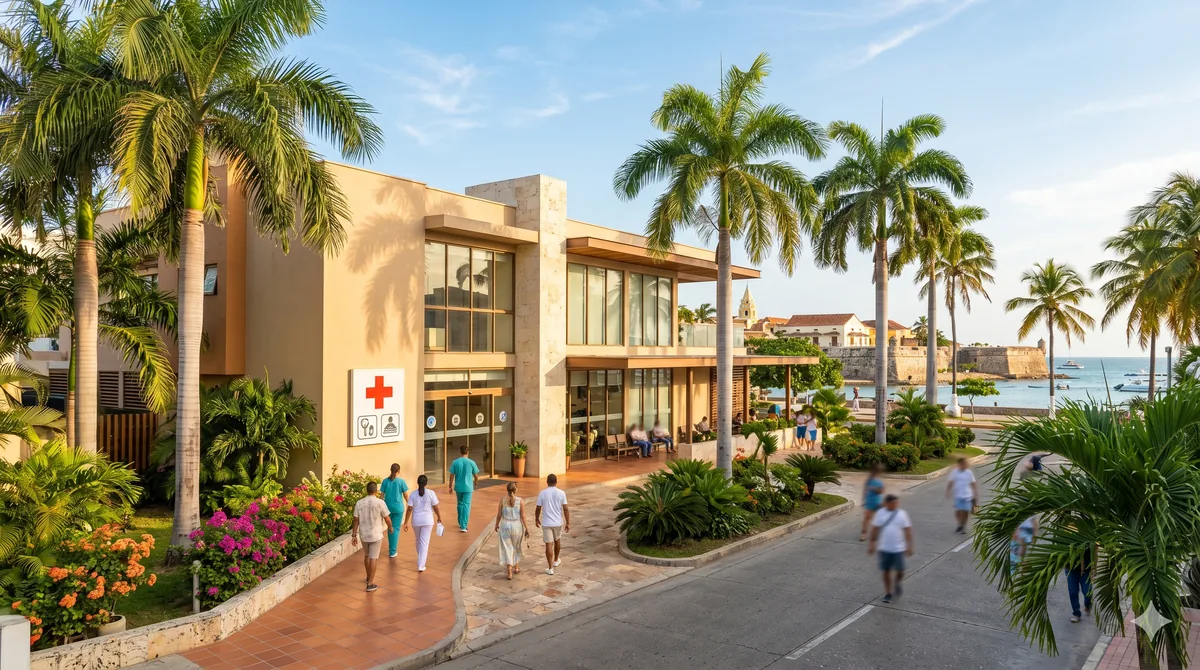
Cartagena's private hospitals are concentrated in two areas. The first is the longstanding Bocagrande and Castillogrande medical corridor on the peninsula, where several large private clinics sit within a few blocks of each other, close to where most expats and well-off Cartageneros live. The second is Serena del Mar, the large modern hospital complex in the planned development north of the city toward the airport and Manzanillo, which has become the reference for high-end, internationally minded care on the coast.
The Bocagrande and Castillogrande cluster is the practical default for anyone living on the peninsula: it is close, it handles emergencies, imaging, surgery, and maternal care, and the major national prepaid networks contract with clinics there. Serena del Mar, further out, is the place people choose for complex or planned procedures and for a more international-hospital experience. Both are comfortable with English-speaking patients at the doctor level, though reception and administrative staff are Spanish-first.
For public-system care, Cartagena's main public reference hospital handles the high-volume EPS and subsidized caseload. Quality is serviceable for the public tier but expect queues. Most expats on an EPS will be routed to a private IPS that contracts with their EPS rather than to the public hospital. If you are choosing where you want to be seen, decide on the hospital first, then pick an EPS or prepaid plan whose network includes it.
How to choose an EPS in Cartagena
Not every EPS operates in every city, and network quality varies by region. For Cartagena (Bolívar department), the practical shortlist in 2026:
EPS Sanitas (Grupo Keralty), consistently among the best-rated nationally for service, paired with the Colsanitas private network. Many expats default to Sanitas.
Sura EPS, part of the Sura insurance and finance group. Strong network, top-tier reputation, usually tied with or just behind Sanitas in the rankings.
Salud Total, wide national footprint and a common pick on the coast.
Nueva EPS, large, with state participation. Mixed service reputation but the broadest network, often the fallback when others have closed enrollment.
Coosalud and Mutual Ser, regional EPS that are common in the Bolívar and broader Caribbean market.
How to decide: confirm where you want to be seen (a Bocagrande or Castillogrande clinic, or Serena del Mar) and pick an EPS whose contracted IPS network includes that hospital. Ask the hospital directly which EPS they take. Check the ADRES records or the Superintendencia Nacional de Salud rankings for current performance data before you commit.
What EPS actually costs in 2026
If you work for a Colombian employer, the health contribution is 12.5% of your salary, 4% paid by you and 8.5% by the employer. The amount you see deducted from your pay is the 4%.
If you are independent (freelancer, digital nomad, pensioner, rentista), you pay the full 12.5% yourself, calculated on an income base (IBC) of at least 1 SMMLV (the 2026 minimum wage, COP 1,750,905) and typically 40% of your declared monthly income. The floor contribution in 2026 is roughly COP 219,000 per month (12.5% of 1 SMMLV, approximately USD 55). Realistic contributions for a middle-class expat declaring on USD 3,000 to 5,000 monthly land around COP 400,000 to 750,000 per month (USD 100 to 190).
You register contributions through PILA (Planilla Integrada de Liquidación de Aportes), either via your bank or through an operator like Mi Planilla or Simple (miplanilla.com). Most expats set up a monthly auto-debit once enrolled.
How to enroll in an EPS
You need your Cédula de Extranjería (CE), the foreign-resident ID card issued by Migración Colombia after your visa is approved (see our visa guide). A passport alone will not enroll you. With a CE in hand:
Pick an EPS.
Apply online or walk into a local office. Bring your passport, your CE, and your visa.
Sign the affiliation form. If you are independent, register on PILA and set up the first month's contribution.
Coverage typically starts on the 1st of the following month.
Receive your EPS card or digital ID within a week.
Say this at the EPS office when enrolling
"Quiero afiliarme como cotizante independiente. Traigo mi cédula de extranjería, mi visa y mi pasaporte. ¿Cuál es el formulario de afiliación?"
"I want to enroll as an independent contributor. I have my Cédula de Extranjería, my visa, and my passport. Which enrollment form do I fill out?"
Dependents (spouse, minor children, parents if economically dependent) can be added without an extra contribution, as long as your income base covers them. Bring marriage and birth certificates, apostilled and translated.
Medicina prepagada, the private top-up most expats want
An EPS alone is the floor. It covers you, but you will wait. Medicina prepagada sits on top of your EPS and gives direct access to private hospitals and specialists, often the same day. The main providers available in Cartagena:
Colsanitas / Medisanitas Medicina Prepagada, the default pick, pairs naturally with EPS Sanitas.
Colmédica, premium tier, smaller but high-end network.
Sura Medicina Prepagada.
Monthly premiums depend on age, coverage tier, and number of beneficiaries. A 2026 ballpark for a healthy 35-year-old is COP 280,000 to 500,000 per month (USD 70 to 125). For a family of four, expect COP 900,000 to 1.8 million per month (USD 225 to 450). Premiums rise steeply from age 60, where a full plan can run USD 300 to 800 per month.
Do not confuse medicina prepagada with pólizas de salud, the reimbursement-model health insurance sold by carriers like Axa Colpatria or Allianz. Those work US-style: you pay the provider, then file a claim. Less common among expats here, but available.
What tourists and short-term visitors should do
If you are on a PIP or PTP tourist permit, you cannot join an EPS. Carry travel health insurance instead. Colombia technically requires health insurance covering your full stay at entry, though it is rarely checked. Policies from SafetyWing, World Nomads, Allianz Travel, or Colombian issuers like Assist Card and Sura run roughly USD 40 to 120 per month and cover emergencies, accidents, and medical evacuation. Our Cartagena travel insurance guide goes into which plans actually pay out without a fight.
If you do get sick or hurt as a tourist, you go to a private clinic in the Bocagrande or Castillogrande corridor, or to Serena del Mar, and you either pay cash on the spot or pay and then claim against your travel policy. Keep every receipt and ask for your historia clínica (the clinical record), you will need it to file.
Out-of-pocket costs without insurance
Colombia is cheap enough by US or European standards that many short-term visitors simply pay cash. Typical 2026 private-rate prices in Cartagena:
GP consultation: COP 100,000 to 200,000 (USD 25 to 50).
Specialist consultation: COP 180,000 to 350,000 (USD 45 to 88).
Blood panel (CBC plus chemistry): COP 100,000 to 200,000 (USD 25 to 50).
Chest X-ray: COP 80,000 to 150,000 (USD 20 to 38).
MRI (single area): COP 500,000 to 900,000 (USD 125 to 225).
ER visit, non-admitted: COP 200,000 to 500,000 (USD 50 to 125).
Uncomplicated vaginal delivery (private hospital): COP 6 to 12 million (USD 1,500 to 3,000).
Appendectomy (laparoscopic, private): COP 8 to 15 million (USD 2,000 to 3,750).
How billing works for foreigners is worth flagging: in the public and prepaid networks you rarely touch money, but for pure private care and for anything you intend to claim on travel insurance, the model is pay then claim. The clinic bills you, you settle it (card or transfer), and you recover it later from your insurer. Budget the cash flow accordingly.
Cartagena-specific health realities
Living on the Caribbean coast brings a few health considerations that the Andean cities do not share:
Heat and dehydration. Cartagena is hot and humid year-round, often 31 to 34C with near-constant humidity. Heat exhaustion is genuinely common among new arrivals who walk the walled city or explore Getsemaní at midday. Symptoms: heavy sweating, weakness, cold or pale skin, fast or weak pulse, nausea. If you feel these, get indoors and into air conditioning immediately, drink water or an electrolyte solution (Gatorade or suero oral from any pharmacy), and rest. If symptoms progress to confusion, hot dry skin, or loss of consciousness, that is heat stroke: call 123 or go directly to an ER. Prevention: carry a bottle of water everywhere, drink before you are thirsty, and build in shade or A/C breaks between roughly 11am and 3pm every day.
Mosquito-borne illness, mainly dengue. Dengue circulates year-round in Cartagena and spikes in the rainy season (April to May, October to November). Use repellent with 20% or more DEET on all exposed skin, sleep with screens or A/C, and remove standing water from your environment (the Aedes aegypti mosquito that carries dengue breeds in clean, still water in pots, buckets, roof tanks, and plant saucers, it only needs a bottle cap's worth). Warning signs of dengue: sudden high fever (39 to 40C), severe body aches, pain behind the eyes, rash, and exhaustion. If you develop these, see a doctor and ask for a dengue test. Do not take aspirin or ibuprofen before a diagnosis: dengue can cause bleeding and NSAIDs increase that risk. Zika and chikungunya are present but low-incidence in 2026; the same repellent habits cover all three.
Tap water. Cartagena's municipal water is treated, but most residents and nearly all visitors drink filtered or bottled water to avoid stomach upset, especially in the first weeks while your gut adjusts. Ice in established restaurants and hotels is generally made from purified water; be more cautious with street vendors.
Sun. The UV index in Cartagena is routinely 11 or above (extreme). Sunburn and heatstroke off a day at the beach or on a boat to the Rosario Islands are among the most common reasons tourists end up at a clinic. Use reef-safe SPF 50, reapply every 90 minutes in the water, wear a hat, and get out of direct sun between midday and 3pm.
Where tourists usually get treated. Visitors who fall ill are typically seen at a private clinic in the Bocagrande or Castillogrande corridor (closest to the hotels and the walled city) or at Serena del Mar for anything more serious. Both corridors are reachable by rideshare or taxi in minutes from the Centro or Bocagrande.
In an emergency
Dial 123 for any emergency (police, fire, ambulance). It is the single national emergency number across Colombia.
Ambulance reality in Cartagena: the public ambulance dispatched via 123 typically arrives in 20 to 45 minutes, routed by traffic and dispatch load. In many situations, getting yourself or the patient into a taxi or DiDi and heading directly to the nearest private clinic on the Bocagrande or Castillogrande corridor is faster. The exceptions are trauma, suspected spinal injury, heart attack with AED needed, or any situation where moving the person safely is not possible. In those cases, call 123, keep the patient still, and wait. For everything else, a private clinic just minutes away by car is often the faster and better choice.
If you have medicina prepagada, call your plan's 24-hour emergency line first. They will dispatch their own ambulance and route you to a network hospital, which is generally faster than the public 123 response. The prepaid line number is on the back of your membership card, save it in your phone before you need it.
Say this when calling 123 (or describing the emergency in Spanish)
"Necesito una ambulancia. Hay una persona [inconsciente / con dolor en el pecho / que no puede moverse]. La dirección es [dirección], en [barrio / Bocagrande / el Centro]."
"I need an ambulance. There is a person [unconscious / with chest pain / who cannot move]. The address is [address], in [neighborhood / Bocagrande / the Centro]."
Pharmacies
The national chains are reliable and many stay open late. The ones you will see most:
Cruz Verde, the biggest chain, stores across the city.
Farmatodo, wide selection and strong private-label products.
Droguería La Rebaja / Copidrogas, budget pricing.
Locatel, specialty in medical equipment and harder-to-find meds.
Many medications that need a prescription in the US, including some antibiotics and common blood-pressure meds, are sold over the counter here. That is convenient but not always wise, do not self-prescribe, especially antibiotics. Controlled substances (opioids, some psychiatric meds) still require a physician's prescription. Generic equivalents are everywhere and save 40 to 70% versus brand names.
Say this at the pharmacy to ask for the generic equivalent
"¿Tienen el genérico de [nombre del medicamento]? ¿Tiene una alternativa más económica para esto?"
"Do you have the generic version of [medication name]? Is there a more affordable alternative for this?"
Telemedicine and appointments
On an EPS alone, primary care is routed through a general practitioner (médico general), and you need a referral (remisión) to see a specialist. Appointments are booked through the EPS app or call center, with in-person walk-ins for urgencies at the IPS door.
With medicina prepagada you book directly with the specialist through the provider's app, no referral needed. Sanitas, Colmédica, and Sura all run competent apps with telemedicine options, video consults for the EPS and prepaid networks have become standard since 2020, and they are useful when you would rather not sit in a Cartagena waiting room in the heat.
For pure private care, call the clinic directly, or use Doctoralia to find specialists, read reviews, filter by language, and book.
Mental health
Cartagena has qualified psychologists and psychiatrists, though fewer English-speaking practitioners than Bogotá or Medellín. Private pricing per session:
Psychologist (private): COP 150,000 to 300,000 (USD 38 to 75).
Psychiatrist (private): COP 250,000 to 450,000 (USD 63 to 113).
Online options work well from Cartagena and let you keep an English-speaking therapist: Spanish-language platforms with bilingual providers like Psonríe or Terapify, and US-based services like BetterHelp or Talkspace. Local expat Facebook groups are a good way to find bilingual in-person providers.
Dental care and medical tourism
Dental work in Colombia is cheap enough that some people fly down specifically for it. A cleaning runs about COP 80,000 to 150,000 (USD 20 to 38), a filling COP 150,000 to 300,000, and a crown COP 800,000 to 1.5 million. Cartagena, like Medellín and Cali, also draws medical tourists for plastic surgery and major procedures, which can run 50 to 70% cheaper than the US at comparable quality. As with anywhere, vet the surgeon and the facility carefully rather than chasing the lowest quote.
How reimbursements and copays work
On an EPS: a small cuota moderadora (moderating fee) applies per visit, a few thousand pesos, scaled to your income tier. Some procedures carry a separate copago. Big-ticket items, hospitalizations and surgeries, are typically 100% covered inside the EPS network.
On medicina prepagada: in-network private care is usually zero out-of-pocket beyond the monthly premium. Out-of-network bills route to the EPS first, with the prepaid plan topping up.
On travel insurance or pólizas de salud: you pay the provider, save the receipts and your historia clínica, then file the claim through the insurer's portal. Reimbursement lands in roughly 2 to 6 weeks depending on the carrier.
The visa angle on health cover
Health coverage is not just a comfort question, it can be a visa requirement. Several Colombian visa categories ask you to prove health insurance valid in Colombia for the duration of the visa as part of the application. A travel policy may satisfy the application stage, but once you hold a CE you are legally required to be in an EPS regardless. Read the specific requirements for your category before you apply, our visa guide breaks down which visas demand proof of coverage and what counts.
Navigating as an English speaker
At the larger private clinics in the Bocagrande and Castillogrande corridor and at Serena del Mar, many specialists, especially younger doctors, can run a consultation in functional English. Reception and administrative staff: plan on Spanish. Bring a Spanish-speaking friend or use Doctoralia's language filter if your Spanish is basic and the visit is complex. Writing your symptoms and medication list in Spanish in advance saves a lot of friction.
For official translations of medical records, for example to file a claim back home, use a traductor oficial registered with the Ministry of Foreign Affairs. Rates run about COP 40,000 to 80,000 per page.
If you want a specific intro to a doctor or hospital
The decision moment with healthcare in Cartagena is usually after you've picked your EPS or prepagada plan and need a specific specialist who can manage your case in English. That's where we help.
Mike (Canadian, lives in Medellín since 2011) and Santiago (paisa, born in Colombia) put this guide together with our Cartagena team. Our concierge Catalina keeps a short list of doctors and specialists in Cartagena we trust personally for English-speaking patients, the ones who answer their own WhatsApp, write a clear treatment plan, and don't push procedures you don't need. If you want a specific intro she'll set up the appointment, confirm pricing in writing, and translate at the consult if you want.
Phone Catalina: coming soon (we're activating a Colombian number now). For now, chat at catalina.thecartagena.guide. She'll call you back on WhatsApp if you prefer voice.
We don't charge you. The doctor or hospital pays us only if you choose to use them. No email list, no upsells, no pressure to commit today. If your case is one where flying to Medellín or Bogotá makes more sense for the depth of specialist bench, we'll tell you plainly.
FAQ
Do I need a cédula to get healthcare in Cartagena? To enroll in an EPS, yes, the Cédula de Extranjería is required and a passport alone will not do it. For private out-of-pocket care or travel-insurance care, no, a passport is enough; you simply pay (or pay and claim).
Is Colombian healthcare actually good? At the private end, yes. The top hospitals are well-equipped and staffed by doctors often trained in the US, Europe, or Colombia's strong medical schools. Public-tier care is serviceable but slower.
Can I use my US or European insurance here? Most US plans do not cover non-emergency care abroad. International plans (Cigna Global, GeoBlue, Bupa) can be excellent. Check whether yours has a Colombian network or requires pay-and-claim.
What is the EPS waiting time for a specialist? On an EPS alone, roughly 2 to 6 weeks for most specialists, longer for high-demand ones like dermatology. With medicina prepagada, 1 to 7 days, often the same week.
Can I have a baby in Cartagena as a foreigner? Yes, the larger private clinics have strong maternal units. Children born in Colombia are Colombian nationals (and eligible for a Colombian passport), which also qualifies the parents for the M (Padre o Madre de Colombiano) visa.
Is dengue a real risk? Yes, cases climb in the rainy season. Use repellent, keep screens or A/C, and remove standing water. If you get high fever plus severe body aches plus pain behind the eyes, see a doctor and get a dengue test, and do not take aspirin or NSAIDs before a diagnosis.
Can I drink the tap water? It is treated, but most residents and visitors drink filtered or bottled water, especially in the first weeks.
This guide is informational, not medical advice. Coverage details, premiums, and EPS networks change, always verify with the provider at enrollment. The 2026 SMMLV and fee figures shift each January, and USD figures use an approximate rate of 4,000 pesos to the dollar. Last review: May 2026.
Still have questions?¿Todavía tienes preguntas?
Catalina is our concierge. Ask her about visas, neighborhoods, healthcare, prices, anything Cartagena. She answers in chat or WhatsApp, English or Spanish, free.Catalina es nuestra concierge. Pregúntale sobre visas, barrios, salud, precios, cualquier cosa de Cartagena. Responde por chat o WhatsApp, en inglés o español, gratis.
Specific question while you read? Ask Catalina, the Cartagena Guide concierge.¿Pregunta específica mientras lees? Pregúntale a Catalina, la concierge de Cartagena Guide.Chat with Catalina ›Habla con Catalina ›
Última actualización: mayo 2026. Colombia maneja uno de los mejores sistemas de salud de América Latina, y Cartagena, puerto caribeño que también atrae turismo médico, tiene los hospitales privados para demostrarlo. Pero el sistema tiene su propia lógica: una capa pública obligatoria (EPS), una capa privada prepagada (medicina prepagada) que usa la mayoría de colombianos clase media y expatriados, y atención pura de bolsillo que muchas veces es lo bastante barata para ser viable por sí sola. Esta guía explica cómo funciona cada canal, qué hospitales usar, cuánto cuesta la atención en 2026, las realidades del calor y los mosquitos propias de la costa Caribe, y cómo armar cobertura una vez que llegues.
Cómo funciona el sistema de salud colombiano
Colombia tiene salud universal a través de un modelo de dos pilares: el régimen contributivo para personas que trabajan o pueden permitirse aportes mensuales, y el régimen subsidiado para colombianos de bajos ingresos. La ley que lo ordena es la Ley 100 de 1993. Ambos regímenes se administran a través de intermediarios llamados EPS (Entidades Promotoras de Salud), aseguradoras de salud privadas que manejan el sistema en nombre del estado. Escoges una EPS; ella contrata con hospitales y clínicas (llamados IPS) que entregan la atención.
Encima de esa capa base, la mayoría de colombianos que pueden pagarlo compra medicina prepagada, un plan privado prepagado que compra acceso más rápido, colas más cortas, opción de especialistas de primer nivel y cuartos privados. Muchos expatriados hacen lo mismo. Debajo del sistema público, la atención privada pura de bolsillo es muy asequible según estándares estadounidenses o europeos. Una consulta de especialista privado en Cartagena corre entre COP 180.000 y 350.000 (USD 45 a 88 a unos 4.000 pesos por dólar).
La cosa más importante para entender como extranjero es la división cédula vs pasaporte. Si eres residente con Cédula de Extranjería (CE), la ley te obliga a estar afiliado a una EPS. No es opcional. Si estás acá con un sello de turista (el PIP o PTP que te dan en el aeropuerto), no puedes afiliarte a una EPS en absoluto. Los turistas pagan de bolsillo o dependen del seguro de viaje. No hay camino de afiliación pública abierto sin cédula.
Los principales hospitales y clínicas en Cartagena
Los hospitales privados de Cartagena se concentran en dos zonas. La primera es el corredor médico Bocagrande y Castillogrande de largo recorrido en la península, donde varias clínicas privadas grandes quedan a pocas cuadras una de otra, cerca de donde viven la mayoría de expatriados y cartageneros de recursos. La segunda es Serena del Mar, el complejo hospitalario moderno grande en el desarrollo planificado al norte de la ciudad hacia el aeropuerto y Manzanillo, que se ha convertido en la referencia de atención de alto nivel e internacionalmente orientada en la costa.
El conglomerado Bocagrande y Castillogrande es el estándar práctico para quien viva en la península: queda cerca, maneja emergencias, imágenes, cirugía y atención materna, y las redes prepagadas nacionales grandes contratan con clínicas ahí. Serena del Mar, más lejos, es adónde va la gente para procedimientos complejos o programados y para una experiencia más internacional de hospital. Ambos están cómodos con pacientes que hablen inglés a nivel de médico, aunque la recepción y el personal administrativo hablan español primero.
Para atención del sistema público, el hospital de referencia público principal de Cartagena maneja la carga alta de casos de EPS y subsidiados. La calidad es servible para el nivel público pero espera colas. La mayoría de expatriados en una EPS serán dirigidos a un IPS privado que contrata con su EPS antes que al hospital público. Si estás escogiendo dónde quieres ser atendido, decide el hospital primero, después escoge una EPS o plan prepagado cuya red lo incluya.
Cómo escoger una EPS en Cartagena
No toda EPS opera en toda ciudad, y la calidad de red varía por región. Para Cartagena (departamento de Bolívar), la lista corta práctica en 2026:
EPS Sanitas (Grupo Keralty), consistentemente entre las mejor calificadas a nivel nacional por servicio, emparejada con la red privada Colsanitas. Muchos expatriados usan Sanitas por defecto.
Sura EPS, parte del grupo de seguros y finanzas Sura. Red fuerte, reputación de primer nivel, normalmente empatada con o justo detrás de Sanitas en los rankings.
Salud Total, huella nacional amplia y selección común en la costa.
Nueva EPS, grande, con participación estatal. Reputación de servicio mixta pero la red más amplia, a menudo la opción de retaguardia cuando otras cierran afiliaciones.
Coosalud y Mutual Ser, EPS regionales que son comunes en el mercado de Bolívar y Caribe más amplio.
Cómo decidir: confirma dónde quieres ser atendido (una clínica Bocagrande o Castillogrande, o Serena del Mar) y escoge una EPS cuya red de IPS contratados incluya ese hospital. Pregunta directamente al hospital qué EPS reciben. Revisa los registros ADRES o los rankings de la Superintendencia Nacional de Salud para datos de desempeño actual antes de comprometerte.
Qué cuesta la EPS en realidad en 2026
Si trabajas para un empleador colombiano, la contribución de salud es 12,5% de tu salario, 4% pagado por ti y 8,5% por el empleador. La cantidad que ves descontada de tu nómina es el 4%.
Si eres independiente (freelancer, nómada digital, pensionado, rentista), pagas el 12,5% completo tú mismo, calculado sobre una base de ingreso (IBC) de por lo menos 1 SMMLV (el salario mínimo 2026, COP 1.750.905) y típicamente 40% de tu ingreso mensual declarado. La contribución piso en 2026 es más o menos COP 219.000 por mes (12,5% de 1 SMMLV, aproximadamente USD 55). Las contribuciones realistas para un expatriado clase media declarando USD 3.000 a 5.000 mensuales caen alrededor de COP 400.000 a 750.000 por mes (USD 100 a 190).
Registras contribuciones a través de PILA (Planilla Integrada de Liquidación de Aportes), bien sea por tu banco u operador como Mi Planilla o Simple (miplanilla.com). La mayoría de expatriados arman débito automático mensual una vez afiliados.
Cómo afiliarse a una EPS
Necesitas tu Cédula de Extranjería (CE), el carné de residente extranjero expedido por Migración Colombia después de que tu visa sea aprobada (ver nuestra guía de visas). Un pasaporte solo no te afilia. Con CE en mano:
Escoge una EPS.
Solicita en línea o entra en una oficina local. Trae tu pasaporte, tu CE y tu visa.
Firma el formulario de afiliación. Si eres independiente, regístrate en PILA y arma el primer aporte mensual.
La cobertura típicamente comienza el 1 del mes siguiente.
Recibe tu carné EPS o identificación digital en una semana.
Di esto en la oficina de la EPS al afiliarte
"Quiero afiliarme como cotizante independiente. Traigo mi cédula de extranjería, mi visa y mi pasaporte. ¿Cuál es el formulario de afiliación?"
"I want to enroll as an independent contributor. I have my Cédula de Extranjería, my visa, and my passport. Which enrollment form do I fill out?"
Dependientes (pareja, hijos menores, padres si son económicamente dependientes) se pueden agregar sin aporte extra, siempre que tu base de ingreso los cubra. Trae certificados de matrimonio y nacimiento, apostillados y traducidos.
Medicina prepagada, el complemento privado que quieren la mayoría de expatriados
Una EPS sola es el piso. Te cubre, pero esperas. Medicina prepagada se monta encima de tu EPS y te da acceso directo a hospitales privados y especialistas, muchas veces el mismo día. Los proveedores principales disponibles en Cartagena:
Colsanitas / Medisanitas Medicina Prepagada, la selección por defecto, se empareja naturalmente con EPS Sanitas.
Colmédica, nivel premium, red más pequeña pero de alto nivel.
Sura Medicina Prepagada.
Primas mensuales dependen de edad, nivel de cobertura y número de beneficiarios. Un ballpark 2026 para alguien sano de 35 años es COP 280.000 a 500.000 por mes (USD 70 a 125). Para una familia de cuatro, espera COP 900.000 a 1,8 millones por mes (USD 225 a 450). Las primas suben fuerte desde los 60 años, donde un plan completo puede correr USD 300 a 800 por mes.
No confundas medicina prepagada con pólizas de salud, el seguro de salud modelo de reembolso vendido por aseguradoras como Axa Colpatria o Allianz. Esos funcionan estilo estadounidense: pagas al proveedor, después reclamas. Menos comunes entre expatriados acá, pero disponibles.
Qué deben hacer turistas y visitantes de corto plazo
Si estás en un sello turista PIP o PTP, no puedes unirte a una EPS. Lleva seguro de viaje en su lugar. Colombia técnicamente requiere seguro de salud que cubra tu estadía completa a la entrada, aunque rara vez se revisa. Las pólizas de SafetyWing, World Nomads, Allianz Travel u emisores colombianos como Assist Card y Sura corren más o menos USD 40 a 120 por mes y cubren emergencias, accidentes y evacuación médica. Nuestra guía de seguro de viaje Cartagena entra en cuáles planes en realidad pagan sin pelear.
Si te enfermas o te lastimas como turista, vas a una clínica privada en el corredor Bocagrande o Castillogrande, o a Serena del Mar, y pagas de bolsillo en el acto o pagas y después reclamas a tu póliza de viaje. Guarda cada recibo y pide tu historia clínica (el registro clínico), la necesitarás para reclamar.
Costos de bolsillo sin seguro
Colombia es lo bastante barata según estándares estadounidenses o europeos que muchos visitantes de corto plazo simplemente pagan de bolsillo. Precios privados típicos 2026 en Cartagena:
Consulta médico general: COP 100.000 a 200.000 (USD 25 a 50).
Consulta especialista: COP 180.000 a 350.000 (USD 45 a 88).
Panel de sangre (hemograma más química): COP 100.000 a 200.000 (USD 25 a 50).
Radiografía de tórax: COP 80.000 a 150.000 (USD 20 a 38).
RMN (un área): COP 500.000 a 900.000 (USD 125 a 225).
Visita ER, no ingresado: COP 200.000 a 500.000 (USD 50 a 125).
Parto vaginal sin complicaciones (hospital privado): COP 6 a 12 millones (USD 1.500 a 3.000).
Apendicectomía (laparoscópica, privada): COP 8 a 15 millones (USD 2.000 a 3.750).
Cómo funciona la facturación para extranjeros vale la pena remarcar: en las redes pública y prepagada rara vez tocas dinero, pero para atención privada pura y para lo que intentes reclamar a seguro de viaje, el modelo es paga después reclama. La clínica te factura, la pagas (tarjeta o transferencia), y después la recuperas de tu asegurador. Presupuesta el flujo de caja en consecuencia.
Realidades de salud específicas de Cartagena
Vivir en la costa Caribe trae algunas consideraciones de salud que las ciudades de la cordillera no comparten:
Calor y deshidratación. Cartagena es caliente y húmeda todo el año, muchas veces 31 a 34C con humedad casi constante. El agotamiento por calor es genuinamente común entre recién llegados que caminan la ciudad amurallada o exploran Getsemaní al mediodía. Síntomas: sudoración abundante, debilidad, piel fría o pálida, pulso rápido o débil, náusea. Si sientes estos, entra a aire acondicionado inmediatamente, toma agua o una solución de electrolitos (Gatorade o suero oral de cualquier farmacia) y descansa. Si los síntomas progresan a confusión, piel caliente seca o pérdida de conciencia, eso es golpe de calor: llama al 123 o ve directamente a una ER. Prevención: carga una botella de agua a todo lado, bebe antes de tener sed, y agrega descansos en sombra o aire acondicionado entre más o menos las 11am y 3pm cada día.
Enfermedad transmitida por mosquito, principalmente dengue. El dengue circula todo el año en Cartagena y sube durante la estación lluviosa (abril a mayo, octubre a noviembre). Usa repelente con 20% o más DEET en toda piel expuesta, duerme con telas o aire acondicionado, y quita el agua estancada de tu entorno (el mosquito Aedes aegypti que lleva dengue cría en agua limpia y tranquila en macetas, cubetas, tanques de techo y platos de plantas, solo necesita una tapita). Señales de alerta de dengue: fiebre alta repentina (39 a 40C), dolor corporal severo, dolor detrás de los ojos, rash y agotamiento. Si desarrollas estos, ve a un médico y pide una prueba de dengue. No tomes aspirina o ibuprofeno antes de diagnóstico: dengue puede causar sangrado y los AINE aumentan ese riesgo. Zika y chikungunya están presentes pero bajo incidencia en 2026; los mismos hábitos de repelente cubren los tres.
Agua del grifo. El agua municipal de Cartagena se trata, pero la mayoría de residentes y casi todos los visitantes toman agua filtrada o embotellada para evitar malestar estomacal, especialmente en las primeras semanas mientras tu estómago se ajusta. El hielo en restaurantes y hoteles establecidos generalmente se hace de agua purificada; sé más cauto con vendedores callejeros.
Sol. El índice UV en Cartagena rutinariamente es 11 o superior (extremo). La quemadura de sol y el golpe de calor por un día en la playa o en un bote hacia las Islas del Rosario son entre las razones más comunes por las que turistas terminan en una clínica. Usa protector SPF 50 seguro para arrecifes, reaplicar cada 90 minutos en el agua, usa sombrero, y sal de la luz solar directa entre mediodía y 3pm.
Dónde usualmente se atienden los turistas. Los visitantes que se enferman típicamente se ven en una clínica privada en el corredor Bocagrande o Castillogrande (más cerca de hoteles y ciudad amurallada) o en Serena del Mar para cualquier cosa más seria. Ambos corredores se alcanzan por servicio de viajes compartidos o taxi en minutos desde el Centro o Bocagrande.
En una emergencia
Marca 123 para cualquier emergencia (policía, bomberos, ambulancia). Es el número de emergencia nacional único en toda Colombia.
Realidad de ambulancia en Cartagena: la ambulancia pública despachada por 123 típicamente llega en 20 a 45 minutos, enrutada por tráfico y carga de despacho. En muchas situaciones, meterse tú o el paciente en un taxi o DiDi y dirigirse directamente a la clínica privada más cercana en el corredor Bocagrande o Castillogrande es más rápido. Las excepciones son trauma, sospecha de lesión de columna, infarto con AED necesario, o cualquier situación donde mover a la persona de forma segura no sea posible. En esos casos, llama al 123, mantén al paciente quieto y espera. Para todo lo demás, una clínica privada a minutos de carro muchas veces es la opción más rápida y mejor.
Si tienes medicina prepagada, llama primero a la línea de emergencia 24 horas de tu plan. Despacharán su propia ambulancia y te enrutarán a un hospital de la red, que generalmente es más rápido que la respuesta pública 123. El número de la línea prepagada está en la parte atrás de tu tarjeta de afiliado, guárdalo en tu teléfono antes de que lo necesites.
Di esto cuando llames al 123 (o describe la emergencia en español)
"Necesito una ambulancia. Hay una persona [inconsciente / con dolor en el pecho / que no puede moverse]. La dirección es [dirección], en [barrio / Bocagrande / el Centro]."
"I need an ambulance. There is a person [unconscious / with chest pain / who cannot move]. The address is [address], in [neighborhood / Bocagrande / the Centro]."
Farmacias
Las cadenas nacionales son confiables y muchas quedan abiertas tarde. Las que verás más:
Cruz Verde, la cadena más grande, tiendas por toda la ciudad.
Farmatodo, selección amplia y productos de marca propia fuertes.
Droguería La Rebaja / Copidrogas, precios de presupuesto.
Locatel, especialidad en equipo médico y meds difíciles de encontrar.
Muchos medicamentos que necesitan prescripción en Estados Unidos, incluyendo algunos antibióticos y meds comunes para presión, se venden sin receta acá. Eso es conveniente pero no siempre sabio, no te autoprescribas, especialmente antibióticos. Las sustancias controladas (opioides, algunos meds psiquiátricos) aún requieren receta médica. Los genéricos están por todas partes y ahorran 40 a 70% versus marcas.
Di esto en la farmacia para pedir el equivalente genérico
"¿Tienen el genérico de [nombre del medicamento]? ¿Tiene una alternativa más económica para esto?"
"Do you have the generic version of [medication name]? Is there a more affordable alternative for this?"
Telemedicina y citas
En una EPS sola, la atención primaria se enruta a través de un médico general (médico general), y necesitas una referencia (remisión) para ver especialista. Las citas se reservan por app EPS o call center, con entradas sin cita para urgencias en la puerta del IPS.
Con medicina prepagada reservas directamente con el especialista por la app del proveedor, sin remisión necesaria. Sanitas, Colmédica y Sura todos tienen apps competentes con opciones de telemedicina, las consultas video para redes EPS y prepagadas se volvieron estándar desde 2020, y son útiles cuando preferirías no sentarte en una sala de espera de Cartagena en el calor.
Para atención privada pura, llama la clínica directamente, o usa Doctoralia para encontrar especialistas, leer reseñas, filtrar por idioma y reservar.
Salud mental
Cartagena tiene psicólogos y psiquiatras calificados, aunque menos practicantes que hablen inglés que Bogotá o Medellín. Precios privados por sesión:
Psicólogo (privado): COP 150.000 a 300.000 (USD 38 a 75).
Psiquiatra (privado): COP 250.000 a 450.000 (USD 63 a 113).
Las opciones en línea funcionan bien desde Cartagena y te dejan mantener un terapeuta que hable inglés: plataformas hispanas con proveedores bilingües como Psonríe o Terapify, y servicios estadounidenses como BetterHelp o Talkspace. Los grupos de Facebook locales de expatriados son un buen modo de encontrar proveedores bilingües en persona.
Cuidado dental y turismo médico
El trabajo dental en Colombia es lo bastante barato que algunos bajan específicamente por eso. Una limpieza corre más o menos COP 80.000 a 150.000 (USD 20 a 38), una empasté COP 150.000 a 300.000, y una corona COP 800.000 a 1,5 millones. Cartagena, como Medellín y Cali, también atrae turismo médico para cirugía plástica y procedimientos mayores, que pueden correr 50 a 70% más barato que Estados Unidos a calidad comparable. Como en cualquier lado, investiga bien el cirujano y la instalación antes que perseguir el presupuesto más bajo.
Cómo funcionan reembolsos y copagos
En una EPS: una pequeña cuota moderadora (cuota moderadora) aplica por visita, unos pocos miles de pesos, escalonada según tu nivel de ingreso. Algunos procedimientos llevan un copago separado. Cosas de boleto gordo, hospitalizaciones y cirugías, típicamente se cubren 100% dentro de la red EPS.
En medicina prepagada: la atención privada en red usualmente es cero de bolsillo más allá de la prima mensual. Las facturas fuera de red se enrutan a la EPS primero, con el plan prepagado complementando.
En seguro de viaje o pólizas de salud: pagas el proveedor, guarda los recibos y tu historia clínica, después reclama por el portal del asegurador. El reembolso llega en más o menos 2 a 6 semanas dependiendo del asegurador.
El ángulo de visa sobre cobertura de salud
La cobertura de salud no es solo pregunta de comodidad, puede ser requisito de visa. Varias categorías de visa colombiana piden que pruebes seguro de salud válido en Colombia por la duración de la visa como parte de la solicitud. Una póliza de viaje puede satisfacer la etapa de solicitud, pero una vez que tengas CE estás legalmente obligado a estar en una EPS sin importar. Lee los requisitos específicos para tu categoría antes de solicitar, nuestra guía de visas desglosa qué visas demandan prueba de cobertura y qué cuenta.
Navegando como hablante de inglés
En las clínicas privadas más grandes en el corredor Bocagrande y Castillogrande y en Serena del Mar, muchos especialistas, especialmente médicos más jóvenes, pueden dirigir una consulta en inglés funcional. Recepción y personal administrativo: presupuesta español. Trae un amigo que hable español o usa el filtro de idioma de Doctoralia si tu español es básico y la visita es compleja. Escribir tus síntomas y lista de medicamentos en español por adelantado ahorra mucha fricción.
Para traducciones oficiales de registros médicos, por ejemplo para reclamar en casa, usa un traductor oficial registrado con el Ministerio de Relaciones Exteriores. Las tarifas corren más o menos COP 40.000 a 80.000 por página.
Si quieres una intro específica a un médico u hospital
El momento de decisión con salud en Cartagena es usualmente después de haber escogido tu plan EPS o prepagada y necesites un especialista específico que pueda manejar tu caso en inglés. Ahí es donde nosotros ayudamos.
Mike (canadiense, vive en Medellín desde 2011) y Santiago (paisa, nacido en Colombia) armaron esta guía con nuestro equipo de Cartagena. Nuestra concierge Catalina mantiene una lista corta de médicos y especialistas en Cartagena que confiamos personalmente para pacientes que hablen inglés, los que responden su propio WhatsApp, escriben un plan de tratamiento claro y no empujan procedimientos que no necesitas. Si quieres una intro específica ella arma la cita, confirma precios por escrito, y traduce en la consulta si quieres.
Llama a Catalina: próximamente (estamos activando un número colombiano ahora). Por ahora, chat en catalina.thecartagena.guide. Ella te llamará de vuelta por WhatsApp si prefieres voz.
No te cobramos. El médico u hospital nos paga solo si escoges usarlos. Sin lista de email, sin upsells, sin presión de comprometerte hoy. Si tu caso es uno donde volar a Medellín o Bogotá tiene más sentido por la profundidad del banco de especialistas, te lo diremos claro.
Preguntas frecuentes
¿Necesito cédula para atenderme en Cartagena? Para afiliarte a una EPS, sí, la Cédula de Extranjería es requerida y un pasaporte solo no lo hace. Para atención privada pura de bolsillo o atención con seguro de viaje, no, un pasaporte es suficiente; simplemente pagas (o pagas y reclamas).
¿La salud colombiana en realidad es buena? En el lado privado, sí. Los mejores hospitales están bien equipados y con personal médico muchas veces entrenado en Estados Unidos, Europa o las escuelas de medicina fuertes de Colombia. La atención nivel público es servible pero más lenta.
¿Puedo usar mi seguro estadounidense o europeo acá? La mayoría de planes estadounidenses no cubren atención no emergencia en el extranjero. Los planes internacionales (Cigna Global, GeoBlue, Bupa) pueden ser excelentes. Revisa si la tuya tiene red colombiana o requiere paga-y-reclama.
¿Cuál es el tiempo de espera de la EPS para especialista? En una EPS sola, más o menos 2 a 6 semanas para la mayoría de especialistas, más para los de demanda alta como dermatología. Con medicina prepagada, 1 a 7 días, muchas veces la misma semana.
¿Puedo tener un bebé en Cartagena como extranjero? Sí, las clínicas privadas más grandes tienen unidades maternas fuertes. Los niños nacidos en Colombia son colombianos (y elegibles para pasaporte colombiano), lo que también califica a los padres para la visa M (Padre o Madre de Colombiano).
¿Es el dengue un riesgo real? Sí, los casos suben en la estación lluviosa. Usa repelente, mantén telas o aire acondicionado, y quita agua estancada. Si tienes fiebre alta más dolor corporal severo más dolor detrás de los ojos, ve a un médico y hazte una prueba de dengue, y no tomes aspirina o AINE antes de diagnóstico.
¿Puedo beber el agua del grifo? Se trata, pero la mayoría de residentes y visitantes toman agua filtrada o embotellada, especialmente en las primeras semanas.
Esta guía es informacional, no consejo médico. Los detalles de cobertura, primas y redes de EPS cambian, siempre verifica con el proveedor al afiliarte. El SMMLV 2026 y cifras de cuota cambian cada enero, y cifras en USD usan una tasa aproximada de 4.000 pesos por dólar. Última revisión: mayo 2026.
Still have questions?¿Todavía tienes preguntas?
Catalina is our concierge. Ask her about visas, neighborhoods, healthcare, prices, anything Cartagena. She answers in chat or WhatsApp, English or Spanish, free.Catalina es nuestra concierge. Pregúntale sobre visas, barrios, salud, precios, cualquier cosa de Cartagena. Responde por chat o WhatsApp, en inglés o español, gratis.