
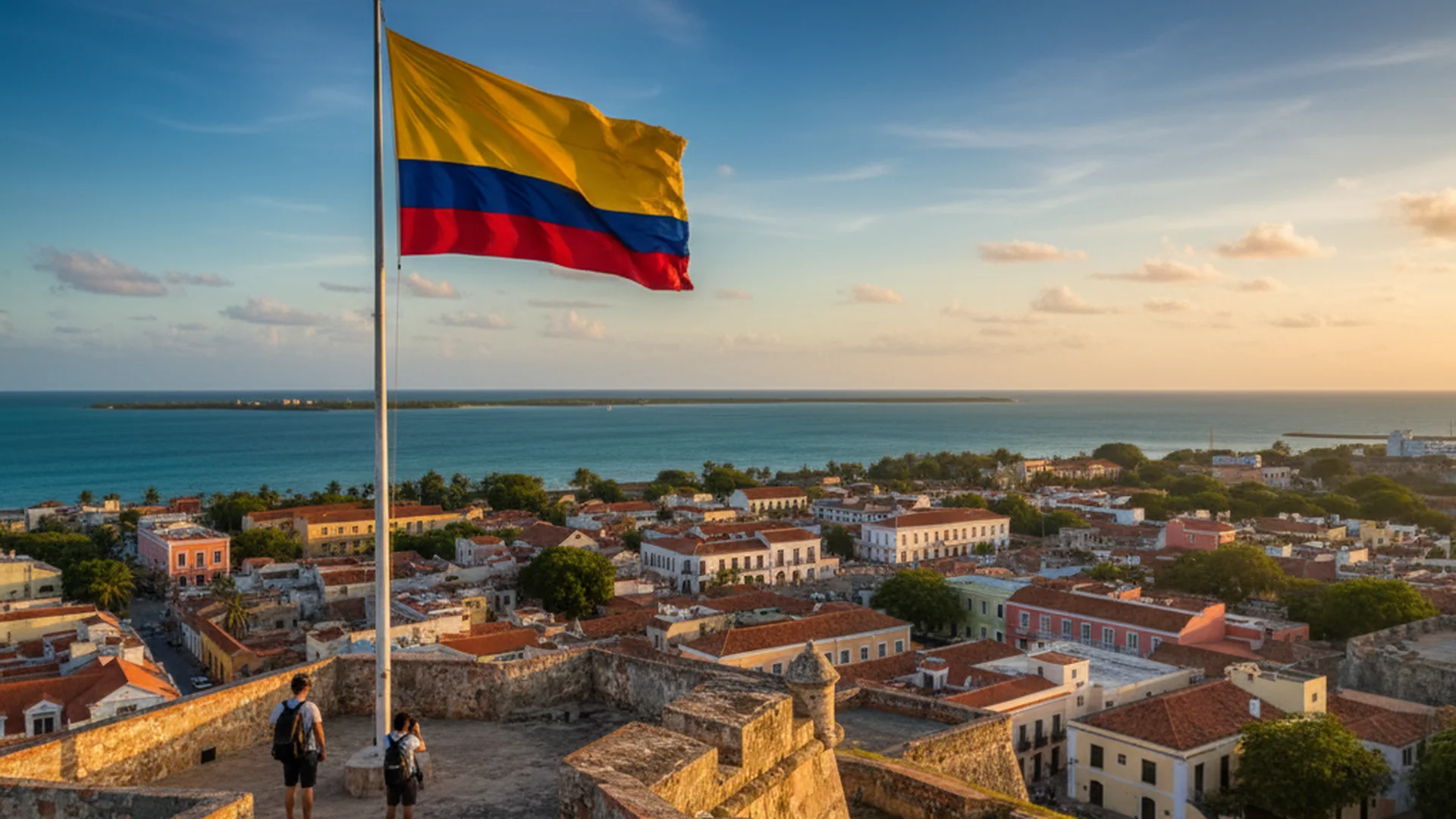
This guide is a long one, and deliberately so. It was written for foreigners who have already decided to apply for Colombian citizenship by naturalization, who have the time in country to qualify, and who now need to sit the Cancilleria's knowledge exam on Colombian history, geography, and the 1991 Constitution. The first part of the guide covers the practical side: who can apply, where, what you pay, and how long it takes. The second part, which is most of the page, is a complete narrative history of the country, the story you are supposed to know on the day of the exam. Read it as a book, not as a list.
Who this guide is for
Three kinds of people will get the most out of this page. The first is the foreigner who has lived legally in Colombia for five or more years on M or R visas and who is ready to start the naturalization file. The second is the foreigner married to a Colombian, or who has a Colombian child, who only needs two years of residency. The third is the citizen of any Latin American or Caribbean country, or of Spain, who qualifies under the reciprocity rule after one year. If you have no idea what any of the categories above mean, start with our full application guide, which covers eligibility in detail.
Everything below is in English. The exam itself is given in Spanish, and when you study, you should be studying Spanish terms, names, and dates. English is a scaffold. The official material is Spanish.
Who can apply for Colombian citizenship
Colombian nationality by adoption (the legal term for naturalization) is governed by Ley 43 de 1993, which implements Articles 96 through 98 of the 1991 Constitution. The core requirement is a continuous period of legal residency in Colombia on a qualifying visa:
- Five years of continuous legal residency for most applicants.
- Two years for nationals by birth of any Latin American or Caribbean country, and for Spanish nationals (under the Spain-Colombia reciprocity agreement).
- Two years for the spouse, registered permanent partner, or parent of a Colombian national.
- One year in limited discretionary cases for applicants with extraordinary contributions to Colombia in science, sport, or culture.
Time as a tourist on a PIP or PTP stamp does not count. The clock starts on the issue date of your first qualifying visa (typically M or R). Continuous means that absences of more than two years in total during the qualifying period can reset the clock. Keep your travel records.
Beyond the residency clock, applicants must show: clean Colombian and home-country criminal records; provable means of support (employment, pension, business income, or savings); domicile in Colombia on application day; functional Spanish and basic knowledge of Colombian geography, history, and the Constitution; and valid legal status (passport plus cedula de extranjeria, nothing expired).
Colombia has permitted dual citizenship since the 1991 Constitution. You do not have to renounce your original nationality to become Colombian; whether your country of origin lets you keep its passport is a separate question.
Where and how to apply
Naturalization is administered by the Ministerio de Relaciones Exteriores (the Ministry of Foreign Affairs, usually just called the Cancilleria), specifically its Grupo Interno de Trabajo de Nacionalidad. Final approval is signed by the President through a resolucion.
The application is filed in person. You book an appointment at one of the Cancilleria's sedes:
- Bogota (the main office, Avenida 19 No. 98-03, Torre 100).
- Regional sedes in Medellin, Cali, Barranquilla, Cartagena, and Bucaramanga handle some intake but usually forward files to Bogota for review.
The complete application file typically includes: the Cancilleria's application form and signed declaration; your valid passport and cedula de extranjeria; copies of every Colombian visa you have held and your Migracion movement history; your birth certificate from your country of birth (apostilled and translated into Spanish by an officially recognized translator); criminal-record certificates from every country where you have lived for more than 12 months since age 18 (apostilled, translated, usually valid for 90 days); proof of economic means (employment letter, pay stubs, tax filings, pension certificate, business accounts, or bank statements covering the last six to twelve months); proof of Colombian residence (utility bills, lease or deed, EPS card); four passport-style photos; a letter of intent addressed to the Cancilleria; and, where applicable, a marriage certificate or Colombian birth registration of your child, plus school or university certificates if you qualify for an exam waiver.
Foreign documents must carry an apostille (or consular legalization, for countries outside the Hague Convention) and be translated into Spanish by a traductor oficial registered with the Ministry.
Fees and timeline
The government fee for a naturalization application, published annually by the Cancilleria and adjusted with the SMMLV (Colombia's monthly minimum wage), has in recent years run on the order of COP 1,000,000 to COP 1,600,000 (roughly USD 250 to USD 400 at an exchange rate of 4,000:1), depending on category. Reciprocity-category applicants pay less. Check the tasa on the Cancilleria's website the week you submit; the figure moves with the SMMLV and with occasional policy adjustments. Your apostilles, translations, and criminal-record certificates are additional out-of-pocket expenses; budget another USD 300 to USD 800 there, depending on your country of origin.
Processing time varies. A complete file, with no documentation gaps, moves from intake through interview and presidential resolucion in roughly 12 to 18 months on average. Missing documents, lost files, and periods of administrative slowdown are common; count on two years as a realistic worst-case. Once the president signs your resolucion de naturalizacion, you are summoned to the Cancilleria to swear the oath of loyalty to the Constitution and to receive your Carta de Naturaleza. That document, together with your original passport, entitles you to apply at the Registraduria for your Colombian cedula de ciudadania, the final proof that the process is complete.
What the exam actually tests
Most applicants take an oral interview-style exam administered by a Cancilleria functionary. Exemptions are granted to: applicants aged 65 or older; applicants who completed primary or secondary school in Colombia; applicants with a Colombian university degree; and some spouse-and-parent-of-Colombian-national cases, on a case-by-case basis. You must bring the supporting document to claim any of these waivers.
For everyone else, the exam covers four areas:
- Spanish comprehension. The officer speaks Spanish throughout. You will be asked to read a short passage aloud or to answer a conversational question. Functional Spanish, not academic Spanish.
- Colombian geography. The six natural regions, the three Andean ranges, the main rivers, the country's five land borders, and the 32 departments and their capitals.
- Colombian history. Independence (1810), the Battle of Boyaca (1819), Simon Bolivar and Francisco de Paula Santander, the main figures and episodes of the 19th and 20th centuries, and the contemporary peace process.
- Constitution of 1991. The structure of the state, the three branches of government, the main fundamental rights, the accion de tutela, and the national symbols.
The exam is pass/fail. Most applicants who have worked through the Cancilleria's official study booklet, Cartilla "Colombia, Nuestra Casa" (a free PDF guide produced by the Ministerio de Relaciones Exteriores with the Universidad Nacional, covering geography, history, civics, symbols, and cultural identity for the Ley 2332 de 2023 knowledge exam), and who can hold a conversation in Spanish, pass on the first try. If you fail, you can retake after a waiting period of 30 to 90 days at the functionary's discretion. A sensible preparation plan: four weeks of serious study for candidates with B1 or higher Spanish, starting with geography, then history, then the Constitution, then the symbols.
The day of the exam
Bring your original passport and your original cedula de extranjeria, a printout of your exam appointment, and a pen. Photocopies will not always be accepted as primary ID at the door. Arrive 20 minutes early. Dress smart-casual; you are meeting a government official.
During the interview, if you do not understand a question, ask the officer to repeat or rephrase it: "Disculpe, puede repetirme la pregunta?" or "No comprendi, puede reformular?". They are examining your knowledge, not your accent, and will generally accommodate. If you do not know an answer, say so, then offer whatever related information you do know: "No lo recuerdo en este momento, pero se que...". Silence is worse than a partial answer.
You will not get a certificate on the day. The officer signs a form that goes into your naturalization file, and the process continues as described above. If you fail, ask the officer at the end of the interview which topics to study before your retake; many will give specifics.
That is the procedural side. The rest of this guide is the material you are meant to know. It is long because the country has a long history, and because the exam expects you to know it in outline. Read it at your own pace; each chapter stands alone. At the end of every chapter there is a Key Facts box summarizing the points most likely to appear on the exam.
Part Two
The Story of Colombia
Prologue: A Country Shaped Like a Question
If you open a map of South America and find the place where the continent meets the Caribbean Sea on one side and the Pacific Ocean on the other, the corner pinched between two oceans and draped across the Equator, you are looking at Colombia. It is the only country in South America with coastlines on both the Caribbean and the Pacific. Everything about it, the history, the cuisine, the accent of its people, the strange political habits, begins with that simple geographical fact.
Colombia borders five countries. To the northwest, across the jungled Darien Gap, sits Panama, a country that was once a Colombian province until, in 1903, the United States helped it walk away. To the east, the plains roll into Venezuela, with which Colombia shares a long, porous, frequently troubled border. To the southeast, the rainforest bleeds into Brazil. To the south, it touches Peru along the Amazon River. To the southwest, the Andes carry it down into Ecuador. Look at the map long enough and you begin to see why Colombians joke that their country is shaped like a question mark. It is a place that has been asking itself, for five hundred years, who it is.
The land is not one land but six. Tradition divides Colombia into six natural regions: the Andean region, the Caribbean region, the Pacific region, the Orinoquia (the eastern plains, the Llanos), the Amazonia (the southern rainforest), and the Insular region (the islands: San Andres and Providencia in the Caribbean, Malpelo and Gorgona in the Pacific). Each region is, in many ways, its own country. A coastal Cartagenero and a mountain Bogotano share a passport and a language and not much else: different food, different music, different humor, different complexion. This is not a unified nation but a federation of climates.
The mountains themselves split Colombia three ways. The Andes, arriving from Ecuador as a single range, fork inside Colombian territory into three parallel spines: the Cordillera Occidental in the west, the Cordillera Central in the middle, and the Cordillera Oriental on the east. Between them run Colombia's two great rivers, the Cauca and the Magdalena, the valleys through which, for centuries, goods and armies and ideas have traveled. A fourth mountain stands apart from the Andes entirely: the Sierra Nevada de Santa Marta, on the Caribbean coast, which is the highest coastal mountain range in the world and contains Colombia's tallest peak, Pico Cristobal Colon, at 5,700 meters.
Because the Equator passes through southern Colombia, the country has no true seasons, only dry and wet months, and temperature here is a function of altitude rather than calendar. Colombians speak of the tierra caliente (hot country, below 1,000 meters), the tierra templada (temperate, 1,000 to 2,000), the tierra fria (cold country, 2,000 to 3,000), the paramo (the high wet moorland, above 3,000), and the nevado (snow, above 4,500). A Colombian can drive four hours in any direction and need a different wardrobe for arriving.
The country is large, about 1,141,748 square kilometers on land, the fourth largest in South America, and home to roughly 52 million people, which makes it the second most populous Spanish-speaking nation in the world, behind only Mexico. Its capital is Bogota, a city of about 8 million people perched on a high Andean plateau at 2,640 meters above sea level.
History, in Colombia, is never separate from geography. So we start with the land.
Key Facts
- Colombia is the only South American country with coastlines on both the Caribbean Sea and the Pacific Ocean.
- It borders five countries: Panama (NW), Venezuela (E), Brazil (SE), Peru (S), and Ecuador (SW).
- Six natural regions: Andean, Caribbean, Pacific, Orinoquia, Amazonia, Insular.
- Three Andean ranges: Cordillera Occidental, Cordillera Central, Cordillera Oriental.
- Main rivers: Magdalena, Cauca, Amazonas, Orinoco, Atrato, Meta, Putumayo.
- Sierra Nevada de Santa Marta: highest coastal mountain range in the world; contains Pico Cristobal Colon (5,700 m), Colombia's highest peak.
- Capital Bogota: altitude 2,640 m, population ~8 million.
- Area: ~1,141,748 km² (4th largest in South America). Population: ~52 million.
- The Equator passes through southern Colombia.
Chapter One: The Land Itself
To understand what kind of country Colombia became, it helps to walk across it, at least in the mind, from north to south and east to west, and meet each of its six regions in turn.
The Caribbean Region
Picture the country from above. Along its northern edge, lapped by the warm green water of the Caribbean, runs a lowland of sand, swamp, savannah, and mangrove. This is the Caribbean region. It contains eight mainland departments: La Guajira, Magdalena, Cesar, Atlantico, Bolivar, Sucre, Cordoba, and parts of northern Antioquia (Uraba) and northern Choco. The people here are costenos, and they carry a lighter, quicker, more African-inflected culture than the interior. Here grew cumbia, vallenato, and champeta, the sound of accordion and drum and maraca. Here stand the great port cities: Santa Marta, founded in 1525 and the oldest surviving Spanish city on the South American mainland; Barranquilla, industrial and boisterous, home to the country's second-largest Carnival; and Cartagena de Indias, walled and gold-trimmed, founded in 1533.
Rising from the Caribbean plain is the Sierra Nevada de Santa Marta, an isolated snow-capped pyramid sacred to the Tayrona and still home to four indigenous peoples: the Kogi, Arhuaco, Wiwa, and Kankuamo. La Guajira, the country's northernmost department, is a desert peninsula inhabited by the Wayuu, the largest indigenous group in Colombia. The Caribbean coast has also long been the gateway for contraband, cocaine, and, in colonial times, the African slave trade; Cartagena was one of only three authorized slave ports in the Spanish Americas.
The Andean Region
Walk south from the coast and the land begins to rise. Three mountain ranges fork like the fingers of a hand: Occidental, Central, Oriental. Between them the Cauca and Magdalena rivers cut their long valleys. This is the Andean region, and it is where most Colombians live, roughly three-quarters of the population, and where the country's political and economic weight has always been concentrated.
Here are the great inland cities. Medellin, capital of Antioquia, sits in a narrow Andean valley at 1,500 meters; the paisas who live there are famously industrious, Catholic, and entrepreneurial, and they built the country's first great industrial base. Cali, capital of Valle del Cauca, lies lower and warmer in the Cauca valley and is the capital of salsa music. Manizales, Pereira, and Armenia (the three capital cities of the Eje Cafetero, or Coffee Axis) cluster on the middle slopes of the central range, where the soil and altitude combine to produce some of the finest arabica in the world. And at the top of the eastern range, on a high savanna 2,640 meters up, sits Bogota: colder, grayer, wordier, the political capital.
Other Andean cities matter too: Bucaramanga (Santander), Cucuta (Norte de Santander, on the Venezuelan border), Tunja (Boyaca), Ibague (Tolima), Neiva (Huila), Popayan (Cauca), and Pasto (Narino, near the Ecuadorian border). If you trace the Andean region on a map you will find most of the country's history written inside it.
The Pacific Region
Cross the western range. The slope down to the Pacific is one of the wettest places on Earth. Choco, the northern Pacific department, receives as much as 10,000 millimeters of rain a year. Dense rainforest covers the region from Panama down to Ecuador. The population is overwhelmingly Afro-Colombian, descendants of Africans who in colonial times escaped or were freed from the mines of the interior and built maroon communities along the rivers. The region's main port is Buenaventura, Colombia's largest Pacific port, in Valle del Cauca. Tumaco, in Narino, is the second. Culturally the Pacific is distinct: the marimba de chonta, the currulao, the alabaos sung at funerals, and the Festival Petronio Alvarez in Cali each August are its best-known expressions. Economically, the region is the poorest of the six. It is also home to Malpelo and Gorgona islands, some of the finest diving in the world, and the whales that migrate up from Antarctica every July to calve in its warm bays.
The Orinoquia: the Llanos
East of the Andes, beyond Bogota, the land drops suddenly into an immense flatness. These are the Llanos Orientales, the Orinoquia region, named for the great Orinoco River that forms part of the Venezuelan border. The Llanos are cattle country, grassland stretching to the horizon, hot and alternately flooded and dry. The cowboy of the Llanos, the llanero, is Colombia's gaucho. It was from the Llanos that Simon Bolivar launched his 1819 crossing of the Andes to liberate New Granada. The region contains four departments: Meta (Villavicencio), Casanare (Yopal), Arauca (Arauca), and Vichada (Puerto Carreno). Together they cover a quarter of the country but hold only a small fraction of its population. Under the grass lies much of Colombia's oil.
The Amazonia
Continue east and south, past the Llanos, and the grassland gives way to the world's largest rainforest. Colombia's Amazon region covers about a third of the country and contains six departments: Amazonas (Leticia, on the triple border with Brazil and Peru), Caqueta (Florencia), Putumayo (Mocoa), Guainia (Inirida), Guaviare (San Jose del Guaviare), and Vaupes (Mitu). The Amazonia holds the bulk of Colombia's indigenous linguistic diversity (roughly 65 distinct indigenous languages are spoken in the country, most of them here) and is home to peoples such as the Ticuna, Huitoto, Yagua, Cubeo, and Tukano. It is the least populated of Colombia's regions but, in many ways, the most ecologically important. Colombia is the second most biodiverse country on Earth, and the Amazon is the heart of that biodiversity.
The Insular Region
Finally, the islands. In the Caribbean, far off the coast of Nicaragua, lies the Archipelago of San Andres, Providencia, and Santa Catalina: a chain of coral islands whose people are largely Afro-Caribbean, English-speaking (they speak San Andres Creole, and many speak Spanish as a second language), and Protestant rather than Catholic. The islands are a Colombian department and their capital is the town of San Andres. In the Pacific, Colombia owns Malpelo and Gorgona, both national nature reserves. The insular region is tiny in area but huge in maritime significance: the waters around San Andres give Colombia much of its Caribbean exclusive economic zone, and have been the subject of long-running disputes with Nicaragua.
Rivers, Mountains, Borders
A few facts about the skeleton of the country are worth fixing in the mind. The Magdalena River is Colombia's longest and most important river, running about 1,540 kilometers from its source in the Paramo de las Papas (Huila) to the Caribbean Sea near Barranquilla; it was the colonial highway from the coast to Bogota and remains the country's main inland waterway. The Cauca is the second great river, flowing roughly parallel to the Magdalena between the Cordillera Central and Occidental. The Atrato, in Choco, drains the Pacific slope into the Gulf of Uraba. The Amazonas, Putumayo, and Caqueta carry the southern rainforest's rain toward Brazil. The Meta, the Guaviare, and the Vichada carry the eastern plains into the Orinoco.
The three Andean ranges are the Occidental (shortest and lowest), the Central (highest, volcanic, containing Nevado del Huila, Nevado del Ruiz, and Nevado del Tolima), and the Oriental (widest and longest, containing the savanna of Bogota and the Sierra Nevada del Cocuy). The isolated Sierra Nevada de Santa Marta contains the country's highest peak. Colombia's land borders stretch about 6,342 kilometers. With Venezuela alone the border runs 2,219 kilometers, the longest. Brazil comes next, at about 1,645. Peru shares 1,626 along the Amazon. Ecuador and Panama are shorter: 586 and 266 respectively.
A Political Geography
Administratively, Colombia is divided into 32 departments plus the Capital District of Bogota. A department is the Colombian equivalent of a state or province. Each has its own capital, its own elected governor (elected by popular vote since the 1991 Constitution), and its own assembly. Below the department sits the municipality; there are more than 1,100 of them, each led by an elected mayor (alcalde). Some municipalities with special status are called distritos: Bogota, Cartagena, Santa Marta, Barranquilla, and Buenaventura, among others. The full list of departments and their capitals lives in the reference section of this guide, and is worth memorizing in full; the exam will test you on several of them. The country's official language is Spanish, but its Constitution (Article 10) recognizes the 65-plus indigenous languages, the two Creole languages (San Andres Creole and Palenquero), and the Romani language as official in the territories where they are spoken.
Key Facts
- 32 departments plus 1 Capital District (Bogota).
- Coffee Axis (Eje Cafetero): Caldas (Manizales), Quindio (Armenia), Risaralda (Pereira); UNESCO Cultural Landscape.
- Largest Pacific port: Buenaventura. Largest Caribbean tourist/historic port: Cartagena.
- Largest indigenous group: Wayuu (La Guajira).
- San Andres archipelago: Caribbean, English-based Creole, Afro-Caribbean majority.
- Constitution Article 10: Spanish is the official language; indigenous and Creole languages co-official in their territories.
- Colombia is the 2nd most biodiverse country in the world.
Chapter Two: Before the Spaniards
The story that the Colombian state tells about itself begins in 1810. But the land under that state had been occupied, farmed, worshipped, and fought over for at least 16,000 years before any European ship reached the Caribbean. A citizenship exam will not ask you to list the flint tools of the paleo-Indian hunters. But it will ask you about the civilizations that the conquistadors found when they arrived, and it is impossible to understand the Spanish colony (or the present-day country) without meeting those civilizations first.
A Patchwork of Peoples
Unlike the Incas of Peru or the Aztecs of Mexico, the indigenous peoples of what is now Colombia were never unified into a single empire. They lived in chiefdoms (cacicazgos), loose confederations of villages organized around a cacique. Colombia on the eve of the Spanish arrival was a patchwork. Archaeologists identify a number of distinct cultures, but seven are worth knowing by name: the Muisca, the Tayrona, the Quimbaya, the Zenu, the Calima, the San Agustin culture, and the Tierradentro culture.
The Muisca
The most politically developed culture at the time of the conquest was the Muisca, who inhabited the high savanna of the Cordillera Oriental (the altiplano cundiboyacense), the area where Bogota now sits. The Muisca were part of the Chibcha linguistic family, farmed maize and potatoes at high altitude, and organized themselves into a loose federation dominated by two great rulers: the Zipa (seated at Bacata, in the Bogota region) and the Zaque (seated at Hunza, which the Spanish renamed Tunja).
The Muisca are most famous for two things. The first is gold. They were among the finest goldsmiths of the pre-Columbian Americas, producing the delicate votive figures called tunjos, many of which now fill the Museo del Oro in Bogota (which, with more than 34,000 gold objects, holds the world's largest collection of pre-Hispanic goldwork). The second is the ceremony at Lake Guatavita, the origin of the El Dorado legend. When a new Zipa was crowned, he was covered in gold dust and paddled on a raft to the center of the sacred lake, where he offered gold and emeralds to the goddess of the waters by plunging in and washing them off. The legend of a golden king in a golden land drew Europeans into the Colombian interior for two centuries.
The Tayrona
On the northern slopes of the Sierra Nevada de Santa Marta lived the Tayrona. Their civilization was urban: stone-terraced towns, rock-paved paths, elaborate hydraulic works. The best-preserved example is Ciudad Perdida (the Lost City), high in the Sierra, which was founded around the year 800 CE, more than six centuries before Machu Picchu. The Tayrona also worked gold. Their descendants, the Kogi, Arhuaco, Wiwa, and Kankuamo, still live in the Sierra Nevada and still consider it the heart of the world.
The Quimbaya
In the middle Cauca valley, in what is now the Eje Cafetero, lived the Quimbaya. Their great gift was metallurgy. The Quimbaya Treasure (Tesoro Quimbaya), a set of exquisite gold pieces given, controversially, by the Colombian president to Spain in 1893, is regarded as one of the finest pre-Columbian goldwork collections in the world. Their technique of tumbaga, an alloy of gold and copper, was so advanced that 19th-century European chemists initially refused to believe it was pre-Columbian work.
The Zenu
In the Caribbean lowlands, across modern Cordoba, Sucre, and parts of Antioquia and Bolivar, lived the Zenu. Their greatest achievement was hydraulic: across roughly 500,000 hectares of low-lying floodplain, the Zenu built a vast network of canals designed to channel floodwaters, drain fields, and supply fish. It remains one of the largest pre-Columbian hydraulic works ever found in the Americas.
San Agustin and Tierradentro
Further south, in the upper Magdalena valley (modern Huila), the San Agustin culture flourished between the 1st and 8th centuries CE and left behind hundreds of large stone statues (some four meters tall) of fanged gods and ceremonial figures, scattered across burial mounds. The Archaeological Park of San Agustin is today a UNESCO World Heritage Site. Not far away, in Cauca, lies Tierradentro, also a UNESCO site. The Tierradentro people dug elaborate underground tombs (hypogea), some more than seven meters deep, with painted walls and chambers where they buried their dead. Neither culture survived long enough to meet the Spaniards.
How Many Were There?
Estimates of the pre-conquest population vary wildly, but most historians now put the number of indigenous people in what became New Granada between three and five million at the time of the Spanish arrival. By 1650, after a century and a half of disease, forced labor, and war, that number had fallen by perhaps 90 percent. Colombia's 2018 census counted roughly 1.9 million people who identify as indigenous, belonging to 115 recognized peoples. The 1991 Constitution recognizes their collective land rights, their traditional authorities, and the teaching of their languages.
Key Facts
- Main pre-Columbian cultures: Muisca, Tayrona, Quimbaya, Zenu, Calima, San Agustin, Tierradentro.
- Muisca lived on the altiplano cundiboyacense; language family: Chibcha.
- Muisca rulers: Zipa (seat Bacata, modern Bogota) and Zaque (seat Hunza, modern Tunja).
- El Dorado legend originates in the Muisca coronation ceremony at Lake Guatavita.
- Museo del Oro in Bogota: world's largest pre-Hispanic gold collection.
- Tayrona descendants: Kogi, Arhuaco, Wiwa, Kankuamo.
- San Agustin (Huila) and Tierradentro (Cauca): UNESCO World Heritage archaeological sites.
- Colombia today: approximately 1.9 million indigenous people, 115 recognized peoples.
Chapter Three: The Conquest
On his third voyage, in 1498, Christopher Columbus sighted the northern coast of South America for the first time. He did not actually set foot on what is now Colombia; he glimpsed the Peninsula of Paria in modern Venezuela. But the following year a lieutenant of his, Alonso de Ojeda, sailing with Juan de la Cosa and the young Florentine Amerigo Vespucci, pushed farther west, made landfall at Cabo de la Vela in what is now La Guajira, and became the first European to stand on Colombian soil. The year was 1499.
The First Settlements
In 1509, Alonso de Ojeda and Diego de Nicuesa founded the settlement of Santa Maria la Antigua del Darien on the Gulf of Uraba, the first European town on the South American continent, though it did not last. By 1524 it had been abandoned. Vasco Nunez de Balboa, crossing the isthmus in 1513, had already given the Spanish their first glimpse of the Pacific Ocean.
The real founding of Spanish Colombia came in 1525, when Rodrigo de Bastidas planted a settlement on a sheltered bay at the foot of the Sierra Nevada. He called it Santa Marta, and it survives as the oldest continuously inhabited Spanish city on the South American mainland. Eight years later, in 1533, Pedro de Heredia founded Cartagena de Indias on another sheltered bay further west. Cartagena's deep natural harbor and defensible position led the Crown, over the next two centuries, to build it into the greatest fortified port of the Spanish Empire in the Americas.
The Conquistador of the Interior
Santa Marta and Cartagena were coastal outposts. In 1536, a lawyer and soldier from Granada named Gonzalo Jimenez de Quesada was dispatched from Santa Marta with a force of some 700 men, under orders to follow the Magdalena River south and find the rumored El Dorado. He would not find El Dorado, but he would find the Muisca. The expedition was a horror. Starting with 700 Spaniards, Jimenez de Quesada arrived, ten months later, on the high savanna of the Cordillera Oriental with 166 survivors. The rest had died of disease, hunger, caimans, snakes, and ambushes. By 1538, Jimenez de Quesada had defeated the Zipa at Bacata and the Zaque at Hunza, seized their gold, and declared the territory a new Spanish kingdom.
On August 6, 1538, on the site of the old Muisca town of Bacata, he founded the city he called Santa Fe. The adjective de Bogota was added later, and would eventually swallow the name Santa Fe entirely. He named the surrounding territory Nuevo Reino de Granada, the New Kingdom of Granada, after his own home region in Spain.
Almost simultaneously, from two different directions, other expeditions converged on the same highland. Sebastian de Belalcazar, a captain of Pizarro's Peruvian forces, advanced north from Quito, founding Popayan and Cali along the way, and arrived in 1539. From the east, a German expedition led by Nicolaus Federmann crossed the Andes from the Llanos. The three conquistadors met on the savanna of Bogota in 1539 in one of the strangest conferences of the conquest; they settled their dispute by sailing together back to Spain, where the Crown eventually awarded primacy to Jimenez de Quesada.
The City-Founding Fever
What followed was a generation of explosive city founding. Between 1525 and 1560 the main Spanish cities of modern Colombia were established: Santa Marta (1525), Cartagena (1533), Cali (1536), Popayan (1537), Santa Fe de Bogota (1538), Tunja (1539), Pasto (1540), Santa Fe de Antioquia (1541), Ibague (1549), Mompos (1550).
The Encomienda and the Collapse
The Spaniards came not to colonize but to extract. The legal instrument through which they did this was the encomienda, a royal grant by which a conquistador was given the right to demand tribute and labor from a defined group of indigenous people in exchange for instructing them in Christianity. In practice it was a system of forced labor indistinguishable from slavery, and from the 1520s onward it shattered indigenous communities. Disease did the rest. The indigenous population of the New Kingdom of Granada fell, by some estimates, from roughly three million in 1500 to around 200,000 by 1650.
To replace the lost labor, the Spanish began importing enslaved Africans. Cartagena de Indias became, along with Veracruz and Portobelo, one of the three legal slave ports of the Spanish Americas. Between 1580 and 1640 hundreds of thousands of enslaved Africans were brought through Cartagena, destined for the gold mines of Choco and Antioquia, the sugar fields of the Cauca valley, and the great haciendas of the interior. A Jesuit priest, Pedro Claver, spent 40 years in Cartagena ministering to enslaved Africans; he was later canonized and is the patron saint of human rights and of slaves.
San Basilio de Palenque
In the early 17th century, a runaway slave named Benkos Bioho founded a maroon settlement in the jungle south of Cartagena. After decades of resistance, in 1713 the Spanish Crown formally recognized it as the first free African town in the Americas. The town, San Basilio de Palenque, still exists. Its people speak Palenquero, a Spanish-based Creole language with African lexical and grammatical elements, recognized by UNESCO as a Masterpiece of the Oral and Intangible Heritage of Humanity.
Key Facts
- 1499: Alonso de Ojeda first Europeans on Colombian soil (Cabo de la Vela, La Guajira).
- 1525: Rodrigo de Bastidas founded Santa Marta.
- 1533: Pedro de Heredia founded Cartagena de Indias.
- August 6, 1538: Gonzalo Jimenez de Quesada founded Santa Fe de Bogota on the Muisca town of Bacata.
- Territory named Nuevo Reino de Granada (New Kingdom of Granada).
- Three conquistadors converged on Bogota in 1539: Jimenez de Quesada, Belalcazar, Federmann.
- Encomienda: the Spanish system of forced indigenous labor and tribute.
- Cartagena: one of three authorized slave ports in Spanish America.
- Saint Pedro Claver: patron saint of enslaved Africans and human rights.
- San Basilio de Palenque: first free African town in the Americas, founded by Benkos Bioho, recognized 1713.
Chapter Four: New Granada
For nearly three hundred years, the territory that is now Colombia was not a country but a colony, a distant outpost of the Spanish Crown organized around two things above all: the extraction of gold and the saving of souls. The colonial period lasted, by conventional dating, from Jimenez de Quesada's founding of Santa Fe in 1538 until the Cry of Independence in 1810.
The Administrative Map
For most of the 16th and 17th centuries, what is now Colombia was governed as the Audiencia de Santa Fe (established 1550), subordinate to the Viceroyalty of Peru. Peru was far away, and by the early 18th century the Crown had begun to split its unwieldy American empire into smaller pieces. In 1717 it established the Viceroyalty of New Granada (Virreinato de la Nueva Granada), with its capital at Santa Fe de Bogota. It was briefly dissolved and then reestablished permanently in 1739. At its greatest extent, it included the territories of modern Colombia, Venezuela, Ecuador, and Panama, plus sections of northern Brazil, western Guyana, and northwestern Peru.
Beneath the viceroy sat the Real Audiencia, the supreme court and chief administrative council, and beneath the Audiencia sat a patchwork of provincial governors, alcaldes, corregidores, and cabildos (town councils). The last of these, the cabildos, would matter, eventually, very much: it was from within a cabildo, in 1810, that the Cry of Independence would be shouted.
A Society of Castes
The colonial population was stratified with bureaucratic precision into a system of castas organized around race and birthplace. At the top were the peninsulares: Spaniards born in Spain, who held the highest posts in church and state. Below them were the criollos: people of European ancestry born in the Americas. The criollos could grow rich, own land, and dominate the Church and universities, but they were barred from the highest positions. This exclusion would, by the late 18th century, turn them into the engine of independence.
Below the criollos came the castas proper: mestizos (Spanish and indigenous), mulatos (Spanish and African), zambos (indigenous and African). At the bottom of the formal hierarchy were the indigenous people (indios) and the enslaved Africans (negros). The caste system was not cosmetic: it determined who could hold public office, who could enter a university, who could carry a sword.
What the Colony Made
The economic engine of New Granada was gold. From the mines of Antioquia, Choco, Cauca, and Popayan, the colony produced perhaps one-third of the gold the Spanish Empire extracted from its American territories. Other exports: the emeralds of Muzo and Chivor in Boyaca, coveted across Europe and Asia; tobacco, grown in Ambalema and Giron; quinine, the bark of the cinchona tree, used against malaria; and sugar produced in the Cauca valley with African slave labor. Finished goods arrived from Spain; the colony imported them and exported raw materials. It was not allowed to manufacture.
The Church and the Mind
The Catholic Church was, alongside the Crown, the other great institution of the colony. The Archbishopric of Santa Fe de Bogota was established in 1562. The first university in the territory, the Universidad Santo Tomas, was founded in Bogota by the Dominicans in 1580. The Colegio Mayor del Rosario followed in 1653 and the Pontificia Universidad Javeriana in 1623.
The most important intellectual moment of the colonial period was the Royal Botanical Expedition (Real Expedicion Botanica del Nuevo Reino de Granada), established in 1783 under the direction of the Spanish priest and physician Jose Celestino Mutis. For nearly thirty years the expedition catalogued the plants, animals, and medicinal knowledge of the territory. Around Mutis gathered a generation of brilliant young criollos, among them Francisco Jose de Caldas, an astronomer and naturalist, and Camilo Torres, a lawyer who would, a generation later, lead the break with Spain.
The Comuneros
The first real tremor came from the common people. In March 1781, in the town of Socorro in what is now Santander, a mestiza woman named Manuela Beltran tore down the royal decree announcing a new tax. The Comuneros Revolt began. About 20,000 people marched on Bogota under the slogan Viva el Rey, muera el mal gobierno. They chose Juan Francisco Berbeo as their leader, forced the colonial authorities to sign a list of concessions called the Capitulaciones de Zipaquira, and dispersed. The Crown then repudiated the agreement, captured the movement's leaders, and hanged one of them, the indigenous leader Jose Antonio Galan, in the main square.
The Precursor
One name must be mentioned before we close the chapter: Antonio Narino. Born in Bogota in 1765 to a criollo family, Narino would become the intellectual precursor of Colombian independence. In 1794, he translated into Spanish the Declaration of the Rights of Man and of the Citizen and printed 100 copies on his own press. For this he was imprisoned and sent in chains to Spain. He escaped, wandered Europe, returned, was imprisoned again, and escaped again. By 1810, Narino had become, in the imagination of young criollos, a living martyr for the idea of liberty.
Key Facts
- Viceroyalty of New Granada: established 1717, re-established 1739; capital Santa Fe de Bogota.
- At its height it included modern Colombia, Venezuela, Ecuador, and Panama.
- Colonial castes: peninsulares, criollos, mestizos, mulatos, zambos, indios, negros.
- Main colonial exports: gold, emeralds (Muzo and Chivor), tobacco, quinine, sugar.
- First university: Universidad Santo Tomas (1580, Dominicans, Bogota).
- Jose Celestino Mutis led the Real Expedicion Botanica, founded 1783.
- 1781: Comuneros Revolt in Socorro, sparked by Manuela Beltran; led by Juan Francisco Berbeo; Jose Antonio Galan executed.
- Antonio Narino (El Precursor) translated the Declaration of the Rights of Man into Spanish in 1794.
Chapter Five: The Cry of Independence
In May 1808, Napoleon Bonaparte forced the King of Spain, Ferdinand VII, to abdicate in favor of Napoleon's brother Joseph. In Spanish cities from Madrid to Cadiz, local juntas rose up to reject the French usurpation and govern in the name of the captive king. That news reached the American colonies. If Spain itself was governing through local juntas, why could the American colonies not do the same? Caracas declared its own junta on April 19, 1810. Buenos Aires followed on May 25. Bogota's turn came on July 20.
The Flower Vase of Llorente
The pretext was absurd. On the morning of Friday, July 20, 1810, a group of criollo leaders hatched a plan: they would send one of them to borrow a flower vase from a Spanish merchant named Jose Gonzalez Llorente for a formal dinner. They knew Llorente, a peninsular of notoriously haughty temperament, would refuse or offend them, and the insult could be used as a spark. Llorente duly refused. The altercation moved into the streets. Word ran through the city that a Spaniard had insulted the American-born. A cabildo abierto was convened. By nightfall the criollo leaders declared the formation of a Junta Suprema de Santafe, which would govern the New Kingdom of Granada in the name of Ferdinand VII (officially preserving the fiction of loyalty, but effectively taking power out of Spanish hands).
July 20 is, for this reason, celebrated every year as Colombia's Independence Day: the Grito de Independencia. The flower vase still exists and is on display in the Museo de la Independencia on the Plaza de Bolivar in Bogota.
The Foolish Fatherland
What followed the Cry was less glorious. The new junta immediately split between centralists (who wanted a unified government) and federalists (who wanted autonomy for each province). In the provinces, cities declared themselves sovereign, writing their own constitutions, minting their own coins. Antonio Narino led the centralist side. Camilo Torres led the federalists. Instead of joining forces against Spain, they fought one another. This period, 1810 to 1816, is remembered as the Patria Boba, the Foolish Fatherland.
Reconquest and Terror
In 1815, Napoleon was defeated at Waterloo, Ferdinand VII returned to the Spanish throne, and his government turned its attention to its rebellious colonies. In April 1815, a fleet under Pablo Morillo, nicknamed El Pacificador, arrived in Cartagena with 10,000 troops. After a 106-day siege, Cartagena fell. Morillo marched inland, retook Bogota in May 1816, and began the Regimen del Terror: the systematic execution of the leadership of the Patria Boba. Among those shot or hanged between 1816 and 1819 were Camilo Torres, Francisco Jose de Caldas, Jorge Tadeo Lozano, and Policarpa Salavarrieta (La Pola), a 22-year-old seamstress who ran messages and funds for the rebels and who, before her execution, made the famous cry: Pueblo indolente! cuan distinta seria hoy vuestra suerte si conocierais el precio de la libertad!. Around 400 patriot leaders were executed during the Reconquest.
The Liberator
By the end of 1817, thousands of survivors had fled east into the Llanos, gathering around a Venezuelan general named Simon Bolivar, who had been driven out of his own country by the same Spanish army and was now regrouping in the plains. Bolivar, born in Caracas in 1783, had been fighting Spain on and off since 1810. His lieutenant, and eventually his great rival, was a New Granadan lawyer and soldier from Cucuta named Francisco de Paula Santander.
In the first months of 1819, Bolivar proposed a plan most considered suicidal: to march from the Llanos across the Andes, over the Paramo de Pisba, an exposed high-altitude wasteland where it rains and freezes year-round, to fall on the Spanish army in New Granada before they could be reinforced. In late May 1819 the army set out. They crossed the flooded Arauca plains, then the swollen rivers of Casanare, then climbed four thousand meters into the Paramo. Hundreds of soldiers died. But in early July the army emerged, battered but intact, into the valley of Sogamoso.
Pantano de Vargas and Boyaca
The first great battle came on July 25, 1819, at the Pantano de Vargas, a muddy plain near Paipa. Bolivar's army was nearly broken by the Spanish forces of Colonel Jose Maria Barreiro. At the critical moment, a colonel from the Llanos named Juan Jose Rondon charged at the head of 14 llanero lancers into the Spanish flank, a moment burned into Colombian memory by Bolivar's cry: Coronel, salve usted la patria. The Spanish line broke.
Two weeks later, on August 7, 1819, the two armies met again at the bridge over the Teatinos River in the valley of Boyaca, a few kilometers short of Tunja. The Battle of Boyaca lasted about two hours. Bolivar's army, reinforced by Santander's division, crushed the Spanish force, captured Barreiro, and opened the road to Bogota. The Battle of Boyaca is the single most important date in Colombian military history: it is the battle that created the country. August 7, not July 20, is the date stamped on the country's coinage and on its army. Three days later Bolivar entered Bogota. The Spanish viceroy, Juan Samano, had fled with the treasury.
Key Facts
- July 20, 1810: Grito de Independencia in Bogota. Pretext: Jose Gonzalez Llorente's refusal to lend a flower vase.
- 1810-1816: Patria Boba, civil war between centralists (Narino) and federalists (Camilo Torres).
- 1815-1819: Pablo Morillo's Reconquest and Regimen del Terror; around 400 patriot leaders executed.
- Martyrs of the Reconquest: Camilo Torres, Francisco Jose de Caldas, Policarpa Salavarrieta (La Pola).
- 1819: Bolivar's army crossed the Andes via the Paramo de Pisba.
- July 25, 1819: Battle of Pantano de Vargas, saved by Rondon's lancers.
- August 7, 1819: Battle of Boyaca, decisive victory over Spanish forces under Jose Maria Barreiro. National holiday.
- Key patriot leaders: Simon Bolivar (El Libertador), Francisco de Paula Santander (El Hombre de las Leyes), Jose Antonio Paez.
Chapter Six: Gran Colombia
The victory at Boyaca gave Bolivar not only New Granada but the confidence to imagine something larger. The only way the Spanish empire could be permanently broken was unity, and the individual provinces could not hold alone. Almost immediately after taking Bogota, Bolivar began promoting a single federation uniting the former Viceroyalty.
The Congress of Angostura and the Constitution of Cucuta
In December 1819, Bolivar convened a congress in the little river town of Angostura (now Ciudad Bolivar) in Venezuela. On December 17, 1819, the Congress of Angostura proclaimed the Republic of Colombia, a union of three departments: Venezuela, Cundinamarca, and Quito. This is what historians now call Gran Colombia. Bolivar was named president; Santander vice-president.
A full constitution was written at the Villa del Rosario in Cucuta in 1821, promulgated on August 30 of that year. The Constitution of Cucuta established a centralist republic, divided the country into departments, provided for the gradual abolition of slavery (through a free-womb law), and confirmed Bolivar and Santander in their offices. Because Bolivar spent most of his presidency at the front, it was Santander who actually governed Gran Colombia from Bogota. Bolivar gave him the nickname El Hombre de las Leyes (the Man of Laws).
The Liberation Continues
In June 1821 the battle of Carabobo ended Spanish power in Venezuela. In May 1822, at Pichincha, a young lieutenant named Antonio Jose de Sucre defeated the Spaniards on the slopes of Pichincha above Quito, liberating Ecuador. In the famous Entrevista de Guayaquil of July 1822, Bolivar met the Argentine general Jose de San Martin and agreed to finish the liberation of Peru. The two final battles of the South American war were fought in Peru. In August 1824 Bolivar's forces won at Junin; on December 9, 1824, Sucre won at Ayacucho, ending Spanish rule in South America for good. A new republic, Bolivia, was carved out of Upper Peru.
The Unraveling
By 1826 Gran Colombia was fraying. Venezuela (led by Jose Antonio Paez) resented Bogota's distance and centralism. The split between Bolivarians (who wanted a strong executive, even a monarchy) and Santanderistas (who wanted a strict constitutional order) deepened. In 1828 Bolivar declared himself dictator and suspended the constitution. On the night of September 25, 1828, a group of young officers and civilians burst into the presidential palace and tried to assassinate him. Bolivar, tipped off by his lover, the Ecuadorian patriot Manuela Saenz (who stayed behind in the bedroom and confronted the attackers at the door while he escaped out the window), survived. This night is remembered as the Noche Septembrina. Manuela Saenz earned the title La Libertadora del Libertador.
The Death of Bolivar
Gran Colombia did not survive. In 1830 Venezuela formally withdrew, followed by Ecuador. A broken and mortally ill Bolivar resigned the presidency in April 1830. On December 17, 1830, in a borrowed bed at the hacienda San Pedro Alejandrino outside Santa Marta, Bolivar died of tuberculosis at the age of 47. His last public statement was bitter: Those who have served a revolution have ploughed the sea.
What remained of Gran Colombia was a rump state. In 1831 it became the Republic of New Granada. It would be called New Granada from 1831 to 1858, the Granadine Confederation from 1858 to 1863, the United States of Colombia from 1863 to 1886, and the Republic of Colombia from 1886 onward. Santander was elected president of the new republic in 1832. The two great founding figures of Colombia (Bolivar the visionary and Santander the administrator) would, for the next two centuries, be remembered as rival patron saints of the two political currents that would shape the country: the Conservatives, who claimed Bolivar's legacy of order and strong central authority, and the Liberals, who claimed Santander's legacy of legality and federalism.
Key Facts
- December 17, 1819: Congress of Angostura proclaims the Republic of Colombia (Gran Colombia).
- Gran Colombia united Venezuela, Cundinamarca (modern Colombia), and Quito (Ecuador); Panama added later.
- 1821: Constitution of Cucuta (Villa del Rosario) established the centralized republic.
- Bolivar was president; Santander vice-president. Bolivar = El Libertador; Santander = El Hombre de las Leyes.
- Battles completing the liberation: Carabobo (1821, Venezuela), Pichincha (1822, Ecuador, won by Sucre), Junin (1824), Ayacucho (1824, won by Sucre).
- September 25, 1828: Noche Septembrina, assassination attempt on Bolivar; saved by Manuela Saenz.
- December 17, 1830: Bolivar died at Quinta de San Pedro Alejandrino, near Santa Marta, aged 47.
- Name changes: Nueva Granada (1831-1858), Confederacion Granadina (1858-1863), Estados Unidos de Colombia (1863-1886), Republica de Colombia (1886-present).
Chapter Seven: The Century of Civil Wars
The 19th century in Colombia was a long, unfinished argument between two groups of men, wearing roughly the same clothes, speaking roughly the same Spanish, invoking roughly the same saints, and willing to kill one another for reasons that, a hundred and fifty years later, can feel simultaneously clear and opaque. They were called Liberals and Conservatives. They fought at least nine major civil wars, killed perhaps 200,000 men, and wrote no fewer than eight constitutions between 1832 and 1886.
The Two Parties
The formal founding dates of the two parties are 1848 for the Liberal Party and 1849 for the Conservative Party, each coalescing around opposing political manifestos. The split went back further, to the rivalry between Bolivar (whose legacy the Conservatives claimed, emphasizing order, authority, centralism, and the alliance with the Catholic Church) and Santander (whose legacy the Liberals claimed, emphasizing legality, federalism, secular education, and a weaker Church). Conservatives drew their support from the landed aristocracy, the clergy, and the old cities of the Andean interior. Liberals drew theirs from the commercial class, the port cities (Cartagena, Barranquilla), the Afro-Caribbean and Afro-Pacific regions, and the growing towns of Santander and Antioquia.
A Parade of Constitutions
A short list of the main 19th-century constitutions: 1832 (first of New Granada, centralist); 1843 (Conservative, stronger executive); 1853 (Liberal, separated church and state, expanded suffrage); 1858 (Confederacion Granadina, partial shift to federalism); 1863 (Rionegro, radical federalist, created the Estados Unidos de Colombia); 1886 (Regeneration, centralist, Catholic, confessional, gave the country its current name, governed for 105 years).
Abolition and Rebellion
In 1851, under the presidency of Jose Hilario Lopez, the definitive abolition of slavery was decreed, to take effect January 1, 1852. Children of enslaved women had already been freed at birth in 1821; the 1851 law freed all the rest. In 1854, a mutiny by the Liberal general Jose Maria Melo produced the only successful military coup of the century; Melo's populist, artisan-friendly government lasted eight months before Liberals and Conservatives jointly overthrew him.
The Radical Republic
From 1863 to 1886, Colombia lived under the Constitution of Rionegro: a loose federation of nine states, each of which could, and often did, have its own civil war. Under their regime the Church's properties were expropriated (desamortizacion), Jesuits expelled, civil marriage introduced. It was a period of commercial expansion: the tobacco boom of the 1860s, coffee slopes beginning to be planted, steamboats on the Magdalena, the first railroads.
The Regeneration
In 1884, Rafael Nunez, a poet, lawyer, and politician from Cartagena, was elected president and began La Regeneracion. A new charter was written by Miguel Antonio Caro, a Conservative grammarian. The Constitution of 1886 was promulgated on August 5 of that year. It was confessional (declaring Catholicism the religion of the Nation), strongly centralist, and deeply authoritarian. In 1887 Nunez signed a Concordat with the Vatican that turned over to the Church the registration of births, marriages, and deaths, the control of public education, and significant civil jurisdiction in family matters. The Concordat would remain substantially in force until the 1991 Constitution.
A quieter development of the late 19th century: on the slopes of the Cordillera Central, from about 1850, farmers had begun to plant arabica coffee in earnest. By the 1890s it had surpassed tobacco and quinine as the country's main export. A hundred years later, coffee would still be Colombia's most famous product, and the region of its cultivation, the Eje Cafetero, would be declared a UNESCO Cultural Landscape.
Key Facts
- Liberal Party founded 1848; Conservative Party founded 1849.
- Conservatives traced to Bolivar (centralism, alliance with Church); Liberals to Santander (federalism, legality, separation of Church and state).
- 1851: Jose Hilario Lopez decreed abolition of slavery, effective January 1, 1852.
- 1863: Rionegro Constitution created the Estados Unidos de Colombia; period known as Olimpo Radical (1863-1886).
- August 5, 1886: Constitution of the Regeneration (Rafael Nunez, Miguel Antonio Caro). Country renamed Republica de Colombia; lasted 105 years.
- 1887: Concordat with the Vatican.
- Coffee became Colombia's dominant export late 19th century; Eje Cafetero is a UNESCO Cultural Landscape.
Chapter Eight: A Thousand Days, and the Loss of Panama
Between October 1899 and November 1902, a war of unprecedented savagery (the Guerra de los Mil Dias, the Thousand Days' War) ravaged the country. It killed between 60,000 and 130,000 people out of a population of perhaps four and a half million, bankrupted the treasury, and left the Conservative government too weak to defend the country's most valuable province from being torn away.
The War
The trigger was a narrow Conservative victory in the 1898 presidential election and the exclusion of moderate Liberals from power. On October 17, 1899, the Liberals rose in arms in Santander. Their leaders Rafael Uribe Uribe and Benjamin Herrera believed a rapid uprising could topple the government. They were wrong. The Conservatives had more men, more supplies, and the army. The war dragged on for three years. At the battle of Palonegro near Bucaramanga in May 1900, some 2,500 men died in two weeks of combat. The Liberals were effectively defeated on land. Benjamin Herrera opened a second front on the Pacific coast of Panama, and the war's final act was played out on the isthmus. It ended in exhaustion: Uribe Uribe signed the Treaty of Neerlandia (October 24, 1902) and Herrera signed on board the USS Wisconsin (November 21, 1902). Uribe Uribe himself, the most talented Liberal general of his generation, was assassinated in Bogota in 1914, hacked to death with an axe on the steps of the Capitolio Nacional.
The Loss of Panama
Panama had been part of New Granada since the conquest. Since the 1850s, its most valuable real estate had been the narrow strip of land connecting the Atlantic and Pacific oceans. A French company under Ferdinand de Lesseps had begun work on a canal in 1881; the project collapsed in 1889, with thousands of workers dead of yellow fever and malaria. By the turn of the century, the United States, under Theodore Roosevelt, was determined to build the canal itself.
The 1903 Hay-Herran Treaty would have leased the United States a 10-kilometer strip for 99 years in exchange for 10 million dollars. The Colombian Senate refused to ratify it. Roosevelt responded by backing a separatist movement. On November 3, 1903, a junta of Panamanian notables, supported by the French canal company's engineer Philippe Bunau-Varilla, declared Panama's independence. An American warship, the USS Nashville, was already in the harbor of Colon and prevented Colombian troops from crossing to suppress the rising. Within two weeks Bunau-Varilla, acting as Panama's ambassador in Washington, had signed the Hay-Bunau-Varilla Treaty, giving the United States the canal zone in perpetuity. Colombia was stunned and had neither the troops, the ships, nor the will to retake the isthmus.
Twenty years later, in 1922, the Thomson-Urrutia Treaty settled the dispute: the United States paid Colombia 25 million dollars and Colombia recognized Panama's independence. The canal was completed in 1914. For the rest of the 20th century, the loss of Panama would remain a sore point of Colombian nationalism.
Reconstruction: Rafael Reyes
From the wreckage came General Rafael Reyes, elected in 1904, who governed until 1909 as a modernizing autocrat. He reorganized the army, stabilized the currency, built roads and railroads, reformed the tax code. His foreign policy included the attempt (which failed) to negotiate a better deal over Panama. In 1909 popular protests forced him to resign. But his quinquenio had rebuilt the country's institutions.
The first decades of the 20th century saw Colombia's slow integration into the world economy. Coffee grew to dominate exports: by 1920 it made up roughly 70 percent. The first petroleum concessions were awarded: the Barco concession in Catatumbo and the De Mares concession in the middle Magdalena, which would, by the 1920s, produce the first major oil fields.
Key Facts
- 1899-1902: Thousand Days' War (Guerra de los Mil Dias) between Liberals and Conservatives; around 100,000 dead.
- Main Liberal commanders: Rafael Uribe Uribe and Benjamin Herrera.
- Ended by the Treaty of Neerlandia (October 24, 1902) and the Treaty of the USS Wisconsin (November 21, 1902).
- November 3, 1903: Panama declared independence from Colombia, supported by the U.S. under Theodore Roosevelt.
- Hay-Bunau-Varilla Treaty (1903) gave the U.S. rights to build the Panama Canal.
- 1922: Thomson-Urrutia Treaty; U.S. paid Colombia 25 million dollars in compensation.
- Panama Canal opened in 1914.
- 1904-1909: Quinquenio of General Rafael Reyes.
- Coffee reached roughly 70 percent of Colombian exports by 1920.
- Rafael Uribe Uribe assassinated in Bogota, 1914.
Chapter Nine: The Fragile Modernization
From the end of the Reyes government in 1909 until the assassination of Jorge Eliecer Gaitan in 1948, Colombia lived through four decades of uneven modernization: new industries, new political parties, new strikes, new schools, the first telephone and electric grids, the first real cities.
Conservative Hegemony
From 1886 to 1930, Colombia was governed without interruption by the Conservative Party. Historians call this the Hegemonia Conservadora, a forty-four-year run.
Coffee, Oil, and Bananas
The Federacion Nacional de Cafeteros de Colombia was founded in 1927 and became one of the most influential non-state institutions in the country. In the Caribbean department of Magdalena, on the broad plain between the Sierra Nevada and the sea, the United Fruit Company (UFCO) had, from about 1900, been buying land, building railroads, and planting bananas. Its agricultural methods were efficient; its labor relations were brutal.
The Banana Massacre
In November 1928, United Fruit's banana workers, some 25,000 of them, went on strike. Their demands were modest. The company refused. On the night of December 5-6, 1928, several thousand strikers and their families gathered in the plaza of the small town of Cienaga waiting for a rumored negotiation with the governor. Instead the army arrived. General Carlos Cortes Vargas had declared a state of siege. After reading a decree three times, the troops opened fire with machine guns. The official count of the dead was nine. Other estimates range from several dozen to more than a thousand. Many bodies were loaded onto trains and dumped at sea.
The Masacre de las Bananeras became a scar on the Colombian conscience. A young Liberal congressman named Jorge Eliecer Gaitan traveled to the zone to investigate and delivered in the Colombian Congress a long, damning speech (Los debates bananeros of 1929). The speech made Gaitan famous. The massacre discredited the Conservative government. Two years later, in 1930, the Conservative Party split in its presidential nomination, and for the first time in forty-four years a Liberal (Enrique Olaya Herrera) won the presidency.
The Liberal Republic
From 1930 to 1946, Colombia was governed by Liberals: Enrique Olaya Herrera (1930-1934), Alfonso Lopez Pumarejo (1934-1938 and 1942-1945), Eduardo Santos (1938-1942). The most important was Lopez Pumarejo, whose Revolucion en Marcha included a 1936 constitutional reform declaring Colombia a social state, allowing the expropriation of property for social reasons, introducing a progressive income tax, and adding protections for unions.
The Woman Voter
Women's right to vote in national elections was granted in 1954, under the military government of Gustavo Rojas Pinilla, and first exercised in the plebiscite of December 1, 1957.
Key Facts
- Conservative Hegemony: 1886-1930, an unbroken run of Conservative presidencies.
- Federacion Nacional de Cafeteros founded 1927; still regulates Colombian coffee.
- First major oil well: Infantas 2, near Barrancabermeja, 1921 (De Mares concession, Tropical Oil Company).
- December 5-6, 1928: Masacre de las Bananeras (Banana Massacre) in Cienaga, Magdalena.
- 1930-1946: Liberal Republic (Olaya Herrera, Lopez Pumarejo, Santos).
- Lopez Pumarejo's Revolucion en Marcha and 1936 constitutional reform introduced the social function of property.
- 1954: Women granted the right to vote (under Rojas Pinilla).
- 1957: Women voted for the first time, in the plebiscite that ended Rojas Pinilla's government.
Chapter Ten: La Violencia and the National Front
Every Colombian over a certain age remembers where they were when Gaitan was shot. The country has had many traumas, but the one that Colombians simply call la Violencia, The Violence, with the definite article, was a civil war fought mainly in the countryside, village by village, mainly with machetes, that killed between 200,000 and 300,000 people between 1948 and 1958.
The Bogotazo
Jorge Eliecer Gaitan, in spring 1948, was at the height of his power. A lawyer of mixed-race origin, an extraordinary orator, leader of the Liberal left, he was almost certainly the future president. That April, Bogota was hosting the Ninth International Conference of American States, at which the Organization of American States (OAS) would be founded.
At 1:05 p.m. on April 9, 1948, as Gaitan stepped out of his law office at 7th Avenue and Jimenez Street, a young unemployed man named Juan Roa Sierra fired three times and killed him. Roa Sierra was himself immediately killed by a crowd. Within an hour, central Bogota was on fire. Trolley cars were overturned. Shops were looted. The Bogotazo riots lasted two days, left more than 500 dead in the capital, and destroyed much of the old downtown. Among those caught in Bogota that afternoon was a young Cuban law student named Fidel Castro.
The Decade of Blood
The riots subsided. The violence in the countryside did not. Over the next decade, in hundreds of villages across Tolima, Boyaca, Santander, the Llanos, and the coffee country, Liberals and Conservatives turned on one another with machete, rifle, dynamite, and fire. Houses were burned, women were raped, children were tortured. The 1949 presidential election (which the Liberals boycotted) was won, uncontested, by the hardline Conservative Laureano Gomez, whose government (1950-1953) was openly authoritarian.
The General
On June 13, 1953, General Gustavo Rojas Pinilla, commander of the armed forces, seized power in a bloodless coup. It was the first, and so far only, successful military coup in 20th-century Colombia. His government (1953-1957) began with enormous popular support: Liberal guerrillas (led by figures like Guadalupe Salcedo in the Llanos) laid down their arms in exchange for amnesty; infrastructure projects were launched; women were granted the right to vote (1954); television was introduced (1954). But Rojas lost the elites. By early 1957 the two traditional parties had agreed on something remarkable: they would overthrow Rojas together and share power for the next generation. On May 10, 1957, Rojas resigned and fled the country.
The Frente Nacional
The Frente Nacional (National Front) was a political power-sharing agreement signed in July 1956 between the former Liberal president Alberto Lleras Camargo and the former Conservative president Laureano Gomez in Spain, and ratified by a plebiscite on December 1, 1957. The pact had two central provisions. First, the presidency would alternate between Liberal and Conservative every four years, for sixteen years. Second, all elected offices would be divided fifty-fifty between the two parties regardless of votes. The Frente Nacional ran from 1958 to 1974, with these four presidents in strict alternation:
- 1958-1962: Alberto Lleras Camargo (Liberal).
- 1962-1966: Guillermo Leon Valencia (Conservative).
- 1966-1970: Carlos Lleras Restrepo (Liberal).
- 1970-1974: Misael Pastrana Borrero (Conservative).
The Frente Nacional ended the Liberal-Conservative civil war. It also institutionalized political exclusion: by closing politics to anyone outside the two traditional parties, it shut out Communists, dissident factions, and new social movements of the 1960s. By the mid-1960s, some of those excluded had gone to the mountains and taken up arms.
The Armero Tragedy
Before we move to the guerrillas, one more moment deserves its place here. On November 13, 1985, the stratovolcano Nevado del Ruiz, in the Cordillera Central, erupted. The hot ash melted the glaciers, sending lahars down the mountain's flanks. One lahar reached the town of Armero, in Tolima, at about 11:30 p.m. The town, home to 28,000 people, was buried in a few minutes. About 25,000 died. A 13-year-old girl named Omayra Sanchez, trapped up to her neck in mud for three days, photographed and filmed alive until she was not, became the face of the catastrophe around the world. The Armero tragedy is the deadliest natural disaster in Colombian history.
Key Facts
- April 9, 1948: Jorge Eliecer Gaitan assassinated in Bogota; the riots that followed are called the Bogotazo.
- La Violencia (1948-1958) killed 200,000-300,000 people.
- June 13, 1953: Gustavo Rojas Pinilla's bloodless coup (the only successful 20th-century coup).
- Under Rojas Pinilla: women's right to vote (1954); television introduced (1954).
- May 10, 1957: Rojas Pinilla forced to resign.
- December 1, 1957: Plebiscite approved the Frente Nacional; women voted for the first time.
- Frente Nacional (1958-1974): Liberal/Conservative alternation.
- Four Frente Nacional presidents: A. Lleras Camargo (L), Leon Valencia (C), C. Lleras Restrepo (L), Pastrana Borrero (C).
- November 13, 1985: Nevado del Ruiz eruption; Armero tragedy, about 25,000 dead. Symbol: Omayra Sanchez.
Chapter Eleven: Guerrillas, Cartels, and Crisis
From the late 1960s to the early 1990s, Colombia passed through the worst decades of its modern history. At its worst, in the late 1980s, Colombia had the world's highest homicide rate.
The Birth of the FARC
The first and largest of the guerrillas was the Fuerzas Armadas Revolucionarias de Colombia, the FARC. Its origins lay in Liberal peasant self-defense groups of La Violencia. After the Frente Nacional shut those groups out of politics, some of them formed agrarian Marxist communities in the mountains of southern Tolima, Huila, and Cauca. The most famous was Marquetalia, in Tolima, founded by a peasant fighter named Pedro Antonio Marin, known as Manuel Marulanda Velez, or Tirofijo (Sureshot). In May 1964 the army attacked Marquetalia. The surviving fighters dispersed and on July 20, 1964 (the date chosen to coincide with the Cry of Independence) reconstituted themselves as the FARC. Marulanda led the FARC until his death, in the jungle, of natural causes in 2008.
The Other Guerrillas
Three other major guerrilla organizations emerged in rapid succession. The Ejercito de Liberacion Nacional (ELN) was founded in 1964 in San Vicente de Chucuri, Santander, inspired by the Cuban Revolution and by liberation theology. A Catholic priest, Camilo Torres Restrepo, joined the ELN and was killed in combat in February 1966. The Ejercito Popular de Liberacion (EPL) was founded in 1967, of Maoist inspiration. And the Movimiento 19 de Abril (M-19), founded after the disputed 1970 election (in which the populist former dictator Rojas Pinilla was believed by many to have been robbed of victory), was urban, nationalist, and preferred spectacular actions to rural warfare.
Three Spectaculars of the M-19
The M-19 specialized in symbolic theft. In January 1974 it stole the sword and spurs of Simon Bolivar from a Bogota museum. In 1979 it tunneled into the army's largest arsenal, the Canton Norte, and carried away 5,000 weapons. In February 1980 its commandos seized the Dominican Republic's embassy in Bogota, taking 16 ambassadors hostage (including the U.S. ambassador) for 61 days.
And in November 1985 came the most traumatic action of the M-19. At 11:40 a.m. on November 6, 1985, a 35-person M-19 commando unit assaulted and took over the Palacio de Justicia, the Palace of Justice, on the Plaza de Bolivar in Bogota. They took some 350 hostages, including all the sitting magistrates of Colombia's four supreme courts. They demanded that President Belisario Betancur appear before the Supreme Court. Betancur refused to negotiate. The army launched a counter-assault with tanks, bullets, and fire. The palace burned for twenty-eight hours. When it was over, on the afternoon of November 7, around 100 people were dead, including 11 of the 25 Supreme Court magistrates, among them Chief Justice Alfonso Reyes Echandia. Several of the cafeteria workers rescued alive were subsequently disappeared by the army. The Armero tragedy occurred a week later.
The Cartels
Parallel to the guerrillas grew a second catastrophe: cocaine. Two regional organizations came to dominate the traffic: the Cartel de Medellin (led by Pablo Escobar Gaviria, along with Jose Gonzalo Rodriguez Gacha and the Ochoa brothers) and the Cartel de Cali (led by the brothers Gilberto and Miguel Rodriguez Orejuela and Jose Santacruz Londono).
Pablo Escobar is the name that has traveled furthest. By the mid-1980s he was the most powerful narcotics trafficker in the world. He was a member of the Colombian House of Representatives (1982-1983). He distributed free housing and rebuilt neighborhoods in Medellin. He also ordered a systematic terror campaign: car bombs in Bogota and Medellin; the kidnapping and murder of magistrates, journalists, and politicians; and, in 1989, three defining acts: the assassination on August 18 of the leading Liberal presidential candidate Luis Carlos Galan in Soacha; the mid-air bombing on November 27 of Avianca Flight 203, killing all 107 aboard, an attempt on presidential candidate Cesar Gaviria (who was not on the flight); and the bombing on December 6 of the DAS intelligence service headquarters in Bogota, killing 63.
Three Candidates
The presidential campaign of 1990 is remembered as the campaign in which three leading candidates were murdered: Luis Carlos Galan (Liberal, August 1989), Bernardo Jaramillo (Union Patriotica, March 22, 1990, at the Bogota airport), and Carlos Pizarro Leongomez (the demobilized M-19 leader, running as AD M-19 candidate, April 26, 1990, aboard an Avianca flight). The election was nonetheless held, and Cesar Gaviria Trujillo, Galan's campaign manager, won it.
Paramilitaries
A third armed actor emerged in the 1980s and metastasized in the 1990s: the right-wing paramilitaries. By the mid-1990s they had consolidated under the name Autodefensas Unidas de Colombia (AUC), led by the brothers Carlos and Fidel Castano. The paramilitaries were responsible for a large share (more than half, according to the 2022 Truth Commission report) of civilian massacres during the conflict. The most notorious of their massacres (El Salado in 2000, Mapiripan in 1997, Bojaya in 2002) carried Colombia's civilian horrors to the front pages of the world.
Pablo Escobar's End
Escobar surrendered in June 1991 to a prison he had helped design (La Catedral in Envigado). In 1992 he escaped. The Bloque de Busqueda hunted him for a year and a half, aided by the U.S. DEA and by a vigilante group called Los Pepes (Perseguidos por Pablo Escobar) led by former Escobar lieutenants. On December 2, 1993, Escobar was shot dead on a Medellin rooftop.
The Demobilizations
On March 9, 1990, after almost two years of negotiations, the M-19 formally demobilized, handed over its weapons, and became a political party, AD M-19. In 1991, the EPL (most of it) and the Quintin Lame Armed Movement, drawn from the indigenous communities of Cauca, also demobilized. The only organizations that refused were the FARC and the ELN. The stage was now set for the two great events of the 1990s: the new constitution and the hardening of the war with the groups that had not laid down their arms.
Key Facts
- FARC: founded after the 1964 military attack on Marquetalia; led by Manuel Marulanda Velez (Tirofijo) until 2008.
- ELN: founded 1964 in San Vicente de Chucuri; the priest Camilo Torres Restrepo joined and was killed in 1966.
- EPL: founded 1967, Maoist-inspired.
- M-19: founded after the 1970 election; demobilized in 1990 and became AD M-19.
- November 6-7, 1985: M-19 took the Palacio de Justicia; army counter-assault left about 100 dead, including 11 Supreme Court magistrates.
- Cartel de Medellin led by Pablo Escobar; Cartel de Cali led by the Rodriguez Orejuela brothers.
- 1989: assassination of Luis Carlos Galan (Aug 18); Avianca Flight 203 bombing (Nov 27, 107 dead); DAS bombing (Dec 6).
- 1990: three presidential candidates assassinated (Galan, Jaramillo, Pizarro).
- AUC: main right-wing paramilitary umbrella, led by the Castano brothers.
- December 2, 1993: Pablo Escobar killed in Medellin.
- 1990-1991: M-19, most of EPL, and Quintin Lame demobilized. FARC and ELN did not.
Chapter Twelve: The 1991 Constitution
Of all the dates in modern Colombian history, July 4, 1991 belongs among the most important. On that day, after six months of deliberation by a specially elected constituent assembly, the National Constituent Assembly (Asamblea Nacional Constituyente) promulgated a new constitution for Colombia, replacing the 1886 charter that had governed the country for 105 years. The Political Constitution of Colombia of 1991 is the text under which you will become, if you pass your exam, a citizen.
Why a New Constitution
By 1990 the 1886 Constitution had been amended repeatedly but not rewritten, and it was badly showing its age. It was a confessional document of the 19th century. Beyond that, Colombia was in the throes of the cocaine wars. The ordinary political system was rotting.
The immediate trigger was a student movement. In March 1990, university students began circulating an unofficial ballot (the Septima Papeleta, the Seventh Ballot), to be added to the six official ballots, asking voters whether they supported the convening of a constituent assembly. Some five million Colombians voted yes. President Cesar Gaviria interpreted the vote as a mandate and used his emergency powers to authorize a binding referendum. On December 9, 1990, Colombians elected the members of the Asamblea Nacional Constituyente.
The assembly was remarkably plural: 70 members including Liberals, Conservatives, the former M-19 (which won the second-largest bloc and co-presided over the assembly through Antonio Navarro Wolff), indigenous representatives (Lorenzo Muelas of the Guambiano people and Francisco Rojas Birry from Choco), evangelical Protestants, and more. It was co-presided by Navarro Wolff, Alvaro Gomez Hurtado (Conservative), and Horacio Serpa Uribe (Liberal). It met from February to July 1991 and produced a new constitution of 380 articles plus 60 transitory articles. It was promulgated in the Plaza de Armas of the Capitolio on July 4, 1991.
What the 1991 Constitution Created
Five defining features deserve to be in your head on exam day.
1. A Social Rule-of-Law State. Article 1 opens: Colombia es un Estado social de derecho, organizado en forma de Republica unitaria, descentralizada, con autonomia de sus entidades territoriales, democratica, participativa y pluralista, fundada en el respeto de la dignidad humana, en el trabajo y la solidaridad. Three things: Colombia is a republic, unitary but decentralized; the state is expected not only to avoid violating rights but to actively protect and realize them (Estado social de derecho, not merely classical liberalism); and sovereignty resides in the people (Article 3) and is exercised both through representation and through direct participation (referenda, popular consultations, plebiscites, recall of elected officials, popular legislative initiative).
2. Fundamental Rights and the Accion de Tutela. Title II of the Constitution (Articles 11-82) enumerates rights in three categories: fundamental (Articles 11-41), social/economic/cultural (Articles 42-77), and collective/environmental (Articles 78-82). Article 11: El derecho a la vida es inviolable. No habra pena de muerte. Article 12 prohibits torture, forced disappearance, and cruel treatment.
The innovation that most changed daily life is Article 86: the accion de tutela. A rapid judicial action by which any person can demand, from any judge in the country, immediate protection of a fundamental right. The judge has 10 days to rule. The ruling is reviewable by the Constitutional Court. Colombians file more than 600,000 tutelas a year. The tutela has been used to obtain medicines from the health system, to reverse unjust firings, to protect conscientious objectors, to decriminalize same-sex civil unions, to permit euthanasia for the terminally ill, and to allow voluntary abortion in specified circumstances.
Related actions: accion de cumplimiento (Article 87, forces authorities to obey a law or administrative act); acciones populares y de grupo (Article 88, protect collective rights); habeas corpus (Article 30, for anyone unlawfully deprived of liberty; must be resolved within 36 hours).
3. Decentralization and Democracy. Governors, who had been appointed by the president since 1886, were to be elected by popular vote for four-year terms (no immediate re-election). Mayors had already been made elective in 1988. The president serves a four-year term; a 2015 reform reversed the 2005 amendment that had permitted consecutive re-election, restoring the original one-term rule. New mechanisms of participatory democracy were introduced: referenda, plebiscites, popular consultations, revocation of mandate, popular legislative initiatives, open cabildos. Article 40 enumerates political rights.
4. Pluralism and Recognition. The 1991 Constitution is pluralist to a degree unimaginable under the 1886 charter. Article 7 recognizes and protects the ethnic and cultural diversity of the Colombian nation. Article 8 declares protection of cultural and natural wealth. Article 10 makes Spanish the official language but recognizes the languages and dialects of ethnic groups as official in their own territories. Article 13 prohibits discrimination and orders affirmative action. Article 19 guarantees freedom of religion and equality of all religious faiths before the law. Article 40 reserves two Senate seats for indigenous peoples. Articles 329-330 create Indigenous Territorial Entities.
5. New Institutions. The three branches:
- Executive branch (rama ejecutiva): president (with a single vice-president), cabinet ministers, and the departmental and municipal administrations.
- Legislative branch (rama legislativa): Congress of the Republic. Senate with 108 members (single national constituency, with reserved seats for indigenous peoples and, post-2016, former FARC). House of Representatives with 188 members, elected by department, with special seats for Afro-Colombian, indigenous, diaspora, and peace-constituency representatives.
- Judicial branch (rama judicial): four high courts. Corte Constitucional (9 magistrates, rules on constitutionality, reviews tutelas), Corte Suprema de Justicia (civil/criminal/labor cassation, tries the president), Consejo de Estado (highest administrative court), Consejo Superior de la Judicatura (administers the judicial branch).
The Fiscalia General de la Nacion investigates and prosecutes crimes. Organs of control: Contraloria General de la Republica (audits public spending), Procuraduria General de la Nacion (disciplines public officials), Defensoria del Pueblo (defends human rights). Electoral organization: Consejo Nacional Electoral, Registraduria Nacional del Estado Civil (issues the cedula de ciudadania).
What You Should Take Away
The 1991 Constitution did not by itself end the armed conflict, eliminate corruption, or pacify politics. But it transformed the Colombian state. It gave ordinary people a rapid legal instrument (the tutela) to defend their rights. It decentralized power. It recognized ethnic and religious pluralism. It opened politics to groups that had never before had seats at the table. The Colombia you are preparing to join is, in constitutional terms, the Colombia the 1991 Assembly called into being.
Key Facts
- Political Constitution of Colombia of 1991 promulgated July 4, 1991, replacing the 1886 Constitution after 105 years.
- Drafted by the Asamblea Nacional Constituyente (70 members); co-presided by Antonio Navarro Wolff (M-19), Alvaro Gomez Hurtado (Conservative), and Horacio Serpa Uribe (Liberal).
- Triggered by the 1990 Septima Papeleta student movement.
- Article 1: Estado social de derecho, unitary republic, decentralized, democratic, participatory, pluralist.
- Article 3: sovereignty resides in the people.
- Article 11: right to life inviolable; no death penalty.
- Article 86: accion de tutela, 10-day protection of fundamental rights.
- Three branches: executive, legislative, judicial.
- Senate 108 members, House of Representatives 188 members.
- Four high courts: Corte Constitucional, Corte Suprema de Justicia, Consejo de Estado, Consejo Superior de la Judicatura.
- Fiscalia General de la Nacion investigates and prosecutes crimes.
- Organs of control: Contraloria, Procuraduria, Defensoria del Pueblo.
- Governors and mayors elected by popular vote; presidential term four years, no re-election (since 2015 reform).
- Article 10: Spanish official; indigenous and Creole languages co-official in their territories.
- Article 19: freedom of religion; all faiths equal before the law.
- Article 7: Colombia recognizes and protects ethnic and cultural diversity.
Chapter Thirteen: The Long Road to Peace
The 1991 Constitution gave Colombia a new legal order. It did not give the country peace. The FARC and ELN went on fighting for another quarter century. The paramilitary AUC went on killing until about 2006.
Pastrana and the Caguan
The Conservative president Andres Pastrana (1998-2002) came to office promising to negotiate peace with the FARC. In late 1998 he granted the FARC a demilitarized zone (Zona de Distension) of about 42,000 square kilometers in the south, centered on the town of San Vicente del Caguan. The talks lasted from January 1999 to February 2002 and produced almost nothing. The FARC used the zone as a platform for kidnappings, training, and coca-growing. In early 2002, after the FARC hijacked a commercial airliner and kidnapped Senator Jorge Eduardo Gechem Turbay, Pastrana broke off the talks. The Caguan is remembered as the emblem of how not to negotiate.
A parallel event of Pastrana's government was the launch of Plan Colombia in 2000: a multi-billion-dollar military and development cooperation agreement with the United States. Plan Colombia transformed the Colombian army. By the mid-2000s the Colombian armed forces were, by far, the most competent in South America.
Uribe and Democratic Security
In May 2002, Alvaro Uribe Velez was elected president by a first-round majority, a rare feat. Uribe ran under the slogan Seguridad Democratica. His presidency ran for eight years (2002-2010) after a 2005 constitutional amendment allowing re-election. Uribe's government produced real gains: kidnappings dropped from more than 3,000 a year to a few hundred; homicide rates fell; the FARC lost much of its senior leadership. In 2008, in Operation Phoenix, a raid into Ecuadorian territory killed the FARC's second-in-command, Raul Reyes. Later that year, on July 2, 2008, army intelligence operators tricked FARC captors into handing over 15 hostages in Operation Jaque, including the French-Colombian presidential candidate Ingrid Betancourt and three American military contractors.
The Uribe years also produced serious human rights abuses. The most notorious were the falsos positivos scandal: the systematic murder of civilians by elements of the army, dressed as guerrillas and presented as combat casualties. The JEP has since counted at least 6,402 victims.
The paramilitary demobilization was the other central process of the Uribe years. Under the Ley de Justicia y Paz of 2005, more than 30,000 paramilitary fighters of the AUC formally demobilized between 2003 and 2006.
Santos and Havana
In 2010, Uribe's chosen successor, Juan Manuel Santos, was elected. Santos had been Uribe's Defense Minister during Phoenix and Jaque. His victory was understood as continuity. Instead, Santos turned in the opposite direction: he opened secret talks with the FARC. The opening became public in September 2012.
The formal peace talks in Havana ran from November 2012 to August 2016, organized around six negotiation points: rural reform, political participation, ceasefire, illicit drugs, victims' rights, and implementation. Cuba and Norway were guarantors; Chile and Venezuela accompanied. The government was represented by Humberto de la Calle (chief negotiator); the FARC delegation was led by Ivan Marquez and Timoleon Jimenez (Timochenko), who had succeeded Alfonso Cano (killed in 2011) as commander.
On June 23, 2016, the two delegations signed a bilateral and definitive ceasefire. On August 24, 2016, they announced that the full text of the Final Agreement had been reached. On September 26, 2016, in Cartagena, Santos and Timochenko signed the Acuerdo Final para la Terminacion del Conflicto y la Construccion de una Paz Estable y Duradera.
The Plebiscite
Santos submitted the accord to a popular vote. The plebiscite was held on October 2, 2016. Despite expectations, the No vote won by a narrow margin: 50.21 to 49.78 percent, with turnout of only 37 percent. The accord was technically dead. Santos and Timochenko returned to negotiate, incorporating many of the critics' demands, and on November 24, 2016, signed a revised agreement in the Teatro Colon in Bogota. Congress ratified it on November 30.
On October 7, 2016, between the two signings, Juan Manuel Santos received the Nobel Peace Prize.
Implementation
The FARC demobilized between 2016 and 2017. Some 13,000 combatants passed through the process. The FARC received, under the accord, ten guaranteed seats in Congress (five senators, five representatives) for two legislative terms. A transitional justice court, the Jurisdiccion Especial para la Paz (JEP), was created.
Implementation has been slow. Dissident FARC factions returned to arms. The ELN entered open conflict again in 2019 after a bombing at the General Santander Police Academy that killed 22 cadets. More than 400 former FARC combatants have since been murdered. Hundreds of social leaders and human rights defenders have also been killed. The peace is real but partial.
Key Facts
- 1998-2002: Andres Pastrana opened peace talks with the FARC in San Vicente del Caguan; talks collapsed February 2002.
- 2000: Plan Colombia launched.
- 2002-2010: Alvaro Uribe Velez (Seguridad Democratica); re-elected after 2005 amendment.
- July 2, 2008: Operation Jaque rescued Ingrid Betancourt and others.
- 2003-2006: AUC paramilitary demobilization under Ley de Justicia y Paz (2005).
- Falsos positivos scandal: JEP counted at least 6,402 victims.
- 2010-2018: Juan Manuel Santos; Havana peace talks (2012-2016).
- September 26, 2016: First peace accord signed in Cartagena.
- October 2, 2016: Plebiscite on the accord; No won 50.21 to 49.78 percent.
- November 24, 2016: Revised accord signed in the Teatro Colon.
- October 7, 2016: Santos awarded the Nobel Peace Prize.
- Accord created the JEP, the Truth Commission, and the Unit for the Search for Missing Persons.
- ~13,000 FARC demobilized; FARC political party received 10 guaranteed congressional seats for two terms.
- FARC dissidents and the ELN remain active.
Chapter Fourteen: Colombia Today
We arrive, finally, at the country you are preparing to join.
Duque and the Protest Wave
In June 2018, Ivan Duque Marquez of the Centro Democratico party defeated Gustavo Petro in a runoff presidential election. Duque's government (2018-2022) was characterized by slower-than-promised peace implementation, a cooler relationship with Venezuela, and a deepening crisis of Venezuelan migration: by 2022 Colombia was hosting nearly two million Venezuelan refugees, the largest migration crisis in recent Latin American history.
Duque governed through two waves of mass protests (the 2019 paro nacional and the much larger 2021 paro), triggered initially by proposed pension, labor, and tax reforms. The COVID-19 pandemic reached Colombia in March 2020 and killed more than 140,000 Colombians before vaccines became widely available.
The Leftist Turn
In June 2022, Colombia elected its first left-wing president in its history: Gustavo Petro, a former M-19 guerrilla who had spent three decades as a lawyer, economist, senator, and mayor of Bogota. His running mate, Francia Marquez Mina, is an Afro-Colombian lawyer and environmental activist from Cauca, and became Colombia's first Afro-Colombian vice-president and the second woman to hold the position.
Petro has pursued a mixed agenda. Its 2022 tax reform (targeting oil companies and high-income individuals) was approved. Its health reform has faced sustained opposition. Its pension reform passed Congress in 2024 but was partially struck down by the Constitutional Court in mid-2025. Its Paz Total policy (total peace) has opened multiple negotiation tables with the ELN, FARC dissidents, paramilitary successors, and urban criminal gangs, with varying and mostly disappointing results.
A Few Facts Worth Carrying
- Currency: the Colombian peso (COP).
- Main exports: petroleum, coffee, coal, flowers (Colombia is a global leader in cut-flower exports, especially roses and carnations), bananas, avocados, emeralds.
- Population: approximately 52 million.
- Urban population: about 81 percent.
- Main religious affiliation: Roman Catholic (roughly 70 percent, down from over 95 percent in 1990); evangelical Protestants about 17 percent; other faiths and unaffiliated making up the rest.
- Official language: Spanish; recognition of indigenous languages, Palenquero, and San Andres Creole in their territories.
- International memberships: UN, OAS, Pacific Alliance, Andean Community (CAN), OECD (since 2020).
Key Facts
- 2018-2022: Ivan Duque (Centro Democratico); 2019 and 2021 paros nacionales.
- COVID-19 reached Colombia March 2020; >140,000 dead.
- August 2022-2026: Gustavo Petro (first left-wing president); Francia Marquez first Afro-Colombian VP.
- Petro's framework: Paz Total.
- Currency: Colombian peso (COP). Population ~52 million. Urban ~81 percent.
- Main exports: oil, coffee, coal, flowers, bananas, emeralds.
- Colombia joined the OECD in 2020.
- Memberships: UN, OAS, OECD, CAN, Pacific Alliance.
- Venezuelan migration: ~2 million in Colombia in recent years.
Chapter Fifteen: The Symbols, the State, and the Citizen
You have come to the most practical chapter. If a citizenship exam question can be predicted with any confidence, it concerns one of three things: the national symbols (flag, coat of arms, anthem), the structure of the state (who does what and how they are chosen), or the rights and duties of citizens.
The Flag
The Colombian flag is a horizontal tricolor: yellow, blue, red, top to bottom. The yellow band occupies the upper half; blue and red each occupy a quarter. Proportions 2:1:1. Designed by the Venezuelan general Francisco de Miranda, first raised aboard his ship the Leander in 1806. Miranda conceived the colors as gold of the Americas (yellow), ocean separating the Americas from Spain (blue), and blood of heroes (red). School textbook version: yellow for the nation's riches and sovereignty, blue for seas, rivers, and sky, red for the blood of patriots. The current design was formally adopted on November 26, 1861.
The Coat of Arms
At the center of the escudo, on a blue field, stands a golden pomegranate, referencing the colonial name Nuevo Reino de Granada. Above, two cornucopias: one spilling gold and silver coins, the other tropical fruits. On a red lower band, a Phrygian cap atop a spear (the emblem of liberty). At the base, the Isthmus of Panama flanked by two seas, each bearing a ship. The shield is crowned by the Andean condor, wings spread, carrying in its beak an olive-branch wreath with the motto LIBERTAD Y ORDEN. Four Colombian flags frame the shield. The composition was officially adopted in 1834. The motto Libertad y Orden appears on all official government documents.
The National Anthem
The Himno Nacional was born as a patriotic composition by Rafael Nunez in 1850. The music was composed by an Italian-born opera conductor living in Bogota named Oreste Sindici, who set the words to music in 1887. The anthem was officially adopted by Law 33 of 1920.
The opening of the chorus is one of the most recognizable lines in Spanish: Oh gloria inmarcesible! / Oh jubilo inmortal! / En surcos de dolores, / el bien germina ya. The first verse opens: Ceso la horrible noche / La libertad sublime / Derrama las auroras / De su invencible luz. If you can sing the chorus and the first verse on exam day, you are ahead of most applicants.
Other National Symbols
National tree: palma de cera del Quindio (Ceroxylon quindiuense), the tallest palm in the world, growing in the Cocora Valley; declared national tree in 1985. National flower: the orchid Cattleya trianae, named after the Colombian botanist Jose Jeronimo Triana. National bird: the Andean condor. National sport: tejo, declared by Law 613 of 1971. Patron saint: San Luis Bertran; patroness: Our Lady of Chiquinquira.
The State in One Page
Executive Branch. The president of the Republic is head of state and head of government. Elected by popular vote for a four-year term; no re-election since 2015. Second-round runoff three weeks after the first round if no majority. A vice-president is elected on the same ticket. The president appoints ministers (typically 18), directs foreign policy, commands the armed forces, and has significant legislative powers. 32 departments, each governed by an elected governor; more than 1,100 municipalities, each governed by an elected mayor. Special districts: Bogota, Cartagena, Santa Marta, Barranquilla, Buenaventura, Cali.
Legislative Branch. The Congreso de la Republica is bicameral. Senate: 108 members (100 at-large, 2 indigenous, 5 FARC through 2026, 1 runner-up in presidential election). House of Representatives: 188 members (most from departmental constituencies; reserved seats for Afro-Colombian, indigenous, diaspora, and 16 Special Transitional Peace Constituencies). Four-year terms; re-election allowed. Ordinary sessions: July 20 to December 16 and March 16 to June 20.
Judicial Branch. Four high courts. Corte Constitucional: 9 magistrates, 8-year terms; rules on constitutionality, reviews tutelas. Corte Suprema de Justicia: 23 magistrates; highest ordinary court. Consejo de Estado: 31 councilors; highest administrative court. Consejo Superior de la Judicatura: administers the judicial branch.
Fiscalia General de la Nacion: autonomous body investigating and prosecuting crimes; Fiscal General elected by the Supreme Court from a shortlist of three names proposed by the president, four-year term.
Control Organs: Contraloria General de la Republica (audits public finances), Procuraduria General de la Nacion (disciplines officials), Defensoria del Pueblo (defends human rights).
Electoral Organization: Consejo Nacional Electoral (regulates parties, elections, campaigns) and Registraduria Nacional del Estado Civil (civil registry, issues cedula de ciudadania, runs elections).
Rights and Duties
Rights. Fundamental rights (Articles 11-41) include life (Art. 11, no death penalty), equality (Art. 13), free development of personality (Art. 16), freedom from slavery (Art. 17), freedom of conscience (Art. 18) and religion (Art. 19), freedom of expression (Art. 20), petition (Art. 23), movement (Art. 24), work (Art. 25), choice of profession (Art. 26), learning (Art. 27), personal liberty (Art. 28), due process (Art. 29), habeas corpus (Art. 30), inviolability of the home (Art. 32), privacy of correspondence (Art. 15), assembly (Art. 37), association (Art. 38), unionization (Art. 39), political participation (Art. 40). Social, economic, and cultural rights (Articles 42-77) include health, housing, social security, education, family. Collective and environmental rights (Articles 78-82).
Duties (Article 95). Respect the rights of others; strive for peace; defend human rights; participate in political, civic, and community life; protect the cultural and natural resources of the country; pay taxes; collaborate with the administration of justice; and others. Military service is in Article 216; the Constitutional Court has recognized conscientious objection.
How You Become a Citizen
Article 96 distinguishes two paths to Colombian nationality: by birth and by adoption (naturalization).
Nationality by birth: (1) natural-born children of a Colombian mother or father born on Colombian soil; (2) natural-born children of a Colombian mother or father born abroad, provided the child is later domiciled in Colombian territory or registered at a consulate; and (3) any person born on Colombian soil whose mother or father is a foreigner, provided one of them is domiciled in Colombia at the time of birth.
Nationality by adoption (your process) is granted through the Cancilleria procedure described in the opening section of this guide. Five years' continuous legal residency in general; two years for Latin American, Caribbean, and Spanish nationals, or for the spouse or parent of a Colombian national. Pass the exam, swear the oath, get the Carta de Naturaleza, and apply at the Registraduria for your Colombian cedula de ciudadania. From that day forward you are a Colombian: a citizen of the republic whose story you have just read.
A Last Word
Colombia has asked itself, for five hundred years, who it is. Every generation has answered a little differently. You are now about to add your answer. Read the short first articles of the Constitution once or twice. Listen to the anthem. Learn the flag. Memorize the departments and their capitals. And carry with you the sense that the country you are joining is not an abstract set of laws but a living, contested, astonishingly beautiful thing, whose story is now a little bit yours.
Buena suerte con el examen.
Key Facts
- Flag: horizontal tricolor, yellow (top half), blue (quarter), red (quarter); proportions 2:1:1. Designed by Francisco de Miranda; adopted November 26, 1861.
- Coat of arms: pomegranate, cornucopias, Phrygian cap, Isthmus of Panama with two seas and ships, Andean condor with LIBERTAD Y ORDEN motto. Adopted 1834.
- Anthem: lyrics Rafael Nunez (1850), music Oreste Sindici (1887); adopted by Law 33 of 1920.
- National tree: palma de cera del Quindio. National flower: Cattleya trianae. National bird: Andean condor. National sport: tejo.
- Patron saint: San Luis Bertran; patroness: Our Lady of Chiquinquira.
- Executive: president, four-year term, no re-election (since 2015).
- Senate: 108. House of Representatives: 188.
- Four high courts: Corte Constitucional, Corte Suprema de Justicia, Consejo de Estado, Consejo Superior de la Judicatura.
- Fiscalia General: investigates/prosecutes, four-year term.
- Control organs: Contraloria, Procuraduria, Defensoria.
- Electoral: Consejo Nacional Electoral; Registraduria Nacional del Estado Civil.
- Fundamental rights: Articles 11-41. Duties: Article 95.
- Citizenship by adoption via Cancilleria; 5 yrs general / 2 yrs married or parent or Latin American/Caribbean (reciprocity reduces to 1 yr in some cases).
- Colombia recognizes dual nationality since the 1991 Constitution.
Part Three
Reference material for exam day
The 32 Departments and Their Capitals
Colombia is divided into 32 departments plus the Capital District of Bogota. The exam will pull two or three names from this list. Note that Cundinamarca's departmental capital is Bogota itself, although Bogota functions as its own Capital District.
| Department | Capital |
|---|---|
| Amazonas | Leticia |
| Antioquia | Medellin |
| Arauca | Arauca |
| Atlantico | Barranquilla |
| Bolivar | Cartagena de Indias |
| Boyaca | Tunja |
| Caldas | Manizales |
| Caqueta | Florencia |
| Casanare | Yopal |
| Cauca | Popayan |
| Cesar | Valledupar |
| Choco | Quibdo |
| Cordoba | Monteria |
| Cundinamarca | Bogota (seat) |
| Guainia | Inirida |
| Guaviare | San Jose del Guaviare |
| Huila | Neiva |
| La Guajira | Riohacha |
| Magdalena | Santa Marta |
| Meta | Villavicencio |
| Narino | San Juan de Pasto |
| Norte de Santander | Cucuta |
| Putumayo | Mocoa |
| Quindio | Armenia |
| Risaralda | Pereira |
| San Andres, Providencia y Santa Catalina | San Andres |
| Santander | Bucaramanga |
| Sucre | Sincelejo |
| Tolima | Ibague |
| Valle del Cauca | Cali |
| Vaupes | Mitu |
| Vichada | Puerto Carreno |
| Bogota D.C. (Capital District) | Bogota (itself) |
Ten Dates Worth Memorizing
You will not be quizzed on every date in Colombian history. The exam pulls from a small set of national holidays and constitutional milestones, plus a couple of 20th-century turning points. These are the ten worth committing to memory; everything else lives in Part Two if you need to brush up on context.
- 1499 - Alonso de Ojeda reaches La Guajira; the first Europeans on Colombian soil.
- August 6, 1538 - Gonzalo Jimenez de Quesada founds Santa Fe de Bogota.
- July 20, 1810 - Grito de Independencia in Bogota; Colombia's Independence Day.
- August 7, 1819 - Battle of Boyaca; sealed independence and is a national holiday (Dia de la Batalla de Boyaca).
- December 17, 1819 - Congress of Angostura proclaims the Republic of (Gran) Colombia.
- December 17, 1830 - Simon Bolivar dies near Santa Marta.
- November 3, 1903 - Panama secedes from Colombia.
- April 9, 1948 - Jorge Eliecer Gaitan is assassinated; the Bogotazo triggers La Violencia.
- July 4, 1991 - Promulgation of the current Political Constitution of Colombia.
- November 24, 2016 - Final peace accord with the FARC signed at the Teatro Colon.
Practice Questions
Cover the answers, read the question, answer aloud in Spanish, then uncover and check.
Geography
- Which is the only South American country with coasts on both the Caribbean Sea and the Pacific Ocean? Colombia.
- Name Colombia's five land-border neighbors. Panama, Venezuela, Brazil, Peru, Ecuador.
- What is the longest river entirely within Colombia? The Magdalena, ~1,540 km.
- What is the highest peak and where is it? Pico Cristobal Colon, Sierra Nevada de Santa Marta, 5,700 m.
- Name Colombia's six natural regions. Andean, Caribbean, Pacific, Orinoquia, Amazonia, Insular.
- What are the three Andean ranges called? Cordillera Occidental, Central, Oriental.
- How many departments does Colombia have? 32, plus the Capital District of Bogota.
- Capital of Antioquia? Medellin. Valle del Cauca? Cali. Atlantico? Barranquilla. Bolivar? Cartagena. Amazonas? Leticia.
History
- Who founded Santa Fe de Bogota and on what date? Gonzalo Jimenez de Quesada, August 6, 1538.
- What was the Cry of Independence? The events of July 20, 1810, in which criollo leaders in Bogota declared a governing junta.
- When and where was the decisive battle of independence? August 7, 1819, at the bridge over the Teatinos River in the valley of Boyaca.
- Who is El Libertador? Simon Bolivar. Who is El Hombre de las Leyes? Francisco de Paula Santander.
- What was the Thousand Days' War? A civil war between Liberals and Conservatives, 1899-1902.
- When did Panama declare independence from Colombia? November 3, 1903.
- What was the Bogotazo? The riots of April 9, 1948, following the assassination of Gaitan.
- What was the Frente Nacional? The 1958-1974 power-sharing agreement between the Liberal and Conservative parties.
- When and where was the first FARC peace accord signed? September 26, 2016, Cartagena.
Constitution
- When was the current Political Constitution promulgated? July 4, 1991.
- Which constitutional action allows any person to demand immediate protection of a fundamental right? The accion de tutela, Article 86.
- How many magistrates sit on the Constitutional Court? Nine.
- How many members does the Senate have? 108. House of Representatives? 188.
- What does Article 1 declare? Colombia is a social rule-of-law state, organized as a decentralized unitary republic, democratic, participatory, and pluralist.
- What is the motto on the coat of arms? Libertad y Orden.
- Who are the four high courts? Corte Constitucional, Corte Suprema de Justicia, Consejo de Estado, Consejo Superior de la Judicatura.
Symbols
- Colors of the flag, top to bottom, and proportions? Yellow, blue, red; 2:1:1.
- Who designed the flag? Francisco de Miranda.
- Who wrote the anthem's lyrics and music, and when was it adopted? Lyrics Rafael Nunez (1850); music Oreste Sindici (1887); adopted by Law 33 of 1920.
- What is the national tree? The wax palm of Quindio.
- What is the national sport, by law? Tejo, declared by Law 613 of 1971.
Citizenship
- Which institution administers the citizenship-by-adoption process? The Ministry of Foreign Affairs, the Cancilleria.
- How many years of residence are generally required before an adult foreigner can apply for naturalization? Five; two if married to a Colombian or a parent of a Colombian child, or one for Latin American/Caribbean nationals under reciprocity.
- Does Colombia permit dual nationality? Yes, under the 1991 Constitution.
FAQ
Is the exam written or oral? Oral. An in-person interview in Spanish at the Cancilleria offices.
Do I need to know the whole anthem? You should be able to sing the chorus and the first verse. Examiners rarely ask for the whole anthem.
Can I take it in English? No. The exam is in Spanish. If your Spanish is weak, study Spanish first.
Is there a separate fee for the exam? Not typically. The naturalization process has government fees (published by the Cancilleria and updated annually), but the exam itself does not carry a separate fee.
How long does the interview take? 30 to 60 minutes, depending on how much the functionary probes.
Do I lose my original nationality? No. Colombia has recognized dual citizenship since the 1991 Constitution. Whether your country of origin lets you keep its citizenship is a separate question.
Does passing the exam guarantee citizenship? No. It is one of the requirements. Final approval is by presidential resolucion after the full file is reviewed.
What if I fail? You can retake after a waiting period, typically 30 to 90 days at the functionary's discretion. Ask the examiner which topics to study before your retake.
Further reading on this site
- How to Apply for Colombian Citizenship (2026 Guide) - the full application process.
- Colombia visas explained - the residency clock runs on M and R visas.
- Tax residency in Colombia - if you are resident long enough to naturalize, you are tax-resident too.
- Banking and money in Colombia - the cedula unlocks most of the banking system.
Informational only, not legal advice. Exam content, the Cancilleria's question bank, and published eligibility lists are updated periodically; verify at application time. The authoritative sources are the 1991 Constitution, Ley 43 de 1993, and current Cancilleria resoluciones. Last review: April 2026.