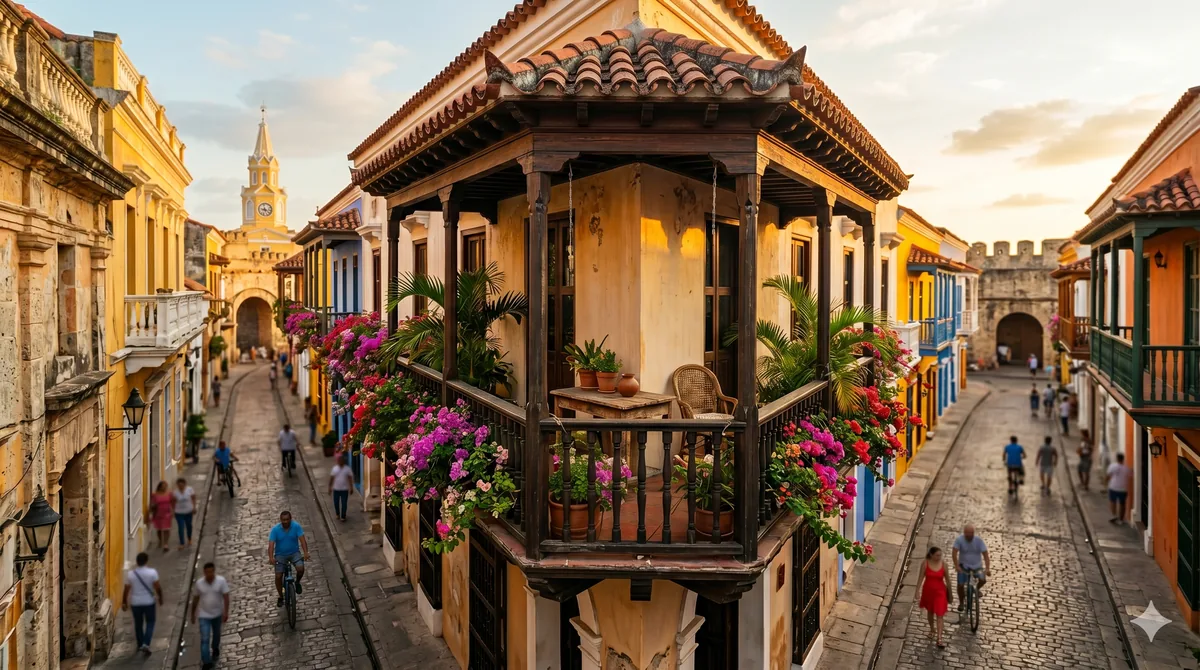
Colombia does not restrict foreigners from buying real estate, and that includes the towers of Bocagrande and the colonial houses inside the walls. You can hold property in your own name, with a Colombian spouse, or through a company, and the legal process is national, the same in Cartagena as anywhere else in the country. The local part is the market: a beach-condo economy priced partly in foreign demand, a heritage-restricted Walled City, and salt air that punishes buildings. This guide covers who can buy, the step-by-step, the closing costs, the foreign-investment registration that first-time buyers skip and regret, and an honest look at the Cartagena market.
A note before you start
This is informational, not legal or financial advice. Colombian property law, tax rules, and the foreign-exchange regulations referenced here change, and every purchase has its own facts. Hire your own Colombian real estate attorney and a contador (accountant) for your specific transaction. The figures here are rough 2026 guidance to set expectations, converted to Colombian pesos at roughly 4,000 pesos per US dollar where a dollar figure is the source.
Who can buy
Any adult foreigner with a valid passport can buy property in Colombia. You do not need a visa, a cedula, or residency. The deed (the escritura publica) is issued in your passport name, signed at a notaria, and then registered with the Oficina de Registro de Instrumentos Publicos, which is overseen nationally by the Superintendencia de Notariado y Registro.
The only real restriction is geographic and does not touch Cartagena city: Colombian law limits foreign ownership in narrow border zones and on certain islands. A condo in Bocagrande, a house in Manga, an apartment in Crespo, or a colonial property inside the Walled City are all open to foreign buyers.
The step-by-step purchase process
1. Offer and promesa de compraventa
Once you agree on price, your attorney drafts a promesa de compraventa, the binding purchase agreement. It fixes the price, the payment schedule, the transfer date, and the penalty if either side backs out. You typically deposit around 10 percent at signing. Do not sign a promesa someone else drafted without your own lawyer reading it.
2. Due diligence: the estudio de titulos
Your attorney runs an estudio de titulos, a title study, built around the Certificado de Tradicion y Libertad pulled from the Oficina de Registro (a few thousand pesos, roughly COP 23.000, around USD 6). This document is the chain of title: it shows every prior owner, mortgage, lien, embargo, and encumbrance over the last 20 years. Alongside it, verify:
- The property tax (predial) is current with the Cartagena district.
- HOA dues (administracion) are paid up, which matters a great deal in beach high-rises.
- Utilities (Afinia electricity, Acuacar water, Surtigas gas) are transferable and not in arrears.
- There is no pending litigation, inheritance dispute, or unregistered division.
- The building is properly constituted under Propiedad Horizontal, and for older Walled City properties, that any past renovation respected heritage rules.
3. Bring the funds in through a bank and declare them
Wire your purchase funds from your foreign account into Colombia through an authorized intermediario del mercado cambiario (a licensed Colombian bank or exchange house). The inbound transfer must be reported to the Banco de la Republica as foreign currency destined for real-estate investment. This channel declaration is the foundation that lets you later move money back out. Skipping it, or wiring foreigner-to-seller outside Colombia, orphans the investment. Your attorney or contador handles the paperwork.
4. Sign the escritura publica at the notaria
Both parties, or their powers of attorney, appear at a notaria. The notary reads the deed aloud, checks IDs and that the fiscal payments are made, and the parties sign. You pay the balance by certified bank check or direct transfer. The notary stamps the escritura and issues a certified copy. Cartagena has several notarias in the city center and Bocagrande area; the buyer customarily picks one with the seller.
5. Register at the Oficina de Registro
The signed escritura must be registered at the Oficina de Registro de Instrumentos Publicos within 60 days. Registration is what actually makes you the owner of record. You pay the impuesto de registro and the registration fee at this stage. The deed comes back to you with a registration stamp and barcode within a few weeks, and an updated Certificado de Tradicion y Libertad will then show your name.
6. Register the foreign investment with Banco de la Republica
Separate from the inbound wire declaration, you must register the investment itself as foreign direct investment with the Banco de la Republica, generally within six months of bringing the funds in. This is the step that lets you legally repatriate your capital and your profits in foreign currency when you sell. It is covered in its own section below because it is the costliest thing to get wrong.
Foreign-investment registration: the step people skip
This is the single most expensive mistake first-time foreign buyers make in Colombia, and it has nothing to do with Cartagena specifically. The logic is simple:
- When you bring foreign currency into Colombia for investment (real estate, a business, securities), the inbound transfer is declared through the exchange-market channel at your bank.
- The investment itself is then registered as foreign direct investment with the Banco de la Republica, typically within six months.
When you later sell, the proceeds can be legally converted and wired out of Colombia only up to your registered investment value plus declared gains. If you never registered the investment, your pesos are effectively stuck inside the country in foreign-exchange terms. They can only leave through the informal market at a meaningful discount.
Financing, and why most foreigners pay cash
On paper, Colombian banks such as Bancolombia, Davivienda, and BBVA offer mortgages to foreigners who hold a cedula de extranjeria and can show local income. In practice, very few foreign buyers qualify, for three reasons:
- Most foreigners have no Colombian-source income to document.
- Local mortgage rates are high, in the 12 to 16 percent range in 2026, which is punishing on a second home compared with rates back home.
- The paperwork (years of Colombian tax filings, local credit history) rarely exists for a recent arrival.
So the Cartagena reality is that the foreign-buyer market is overwhelmingly a cash market. The common workaround is to raise the money at home, often a home-equity line of credit on a property in your own country, then wire it in. Whatever the source, bring it in through a licensed Colombian bank and register the foreign investment within six months.
Pre-construction and the fideicomiso
A large share of new Cartagena supply, especially the towers pushing north along the beach toward La Boquilla and the high-rises in the Bocagrande corridor, sells off-plan before it is built. Reputable pre-construction projects in Colombia run the buyer money through a fideicomiso, a trust administered by a fiduciaria (a licensed trust company). Your payments sit in the trust and are only released to the developer as construction milestones are met, and the project usually has to hit a pre-sales threshold before it breaks ground at all.
A fideicomiso is a genuine protection, but it is not a guarantee that the building will be good, on time, or worth the price. Before buying off-plan, confirm the project is in a fideicomiso, check that the developer has actually delivered finished buildings before, and verify the construction license (licencia de construccion) with the Cartagena planning authority (the Curaduria Urbana). Heat, salt air, and rushed coastal construction are a hard combination; an unfinished or low-quality beach tower is a particular risk here.
Fees, taxes, and closing costs
Rough all-in closing costs on a standard residential purchase in 2026:
- Notaria (notary) fees, around 0,27 percent of the property value, split 50/50 between buyer and seller by custom.
- Impuesto de registro and registration fee, in the order of 1 percent of the property value, paid by the buyer at the Oficina de Registro.
- Attorney fees, roughly COP 2.000.000 to COP 6.000.000 (around USD 500 to USD 1.500) depending on complexity. The estudio de titulos is often included.
- Foreign-investment registration, roughly COP 500.000 to COP 1.500.000 (around USD 125 to USD 375) through a contador.
Budget all-in buyer closing costs of roughly 3 to 4 percent of the purchase price. Beyond closing, the recurring costs are where Cartagena bites: see predial, administracion, and estrato below.
Predial property tax and admin fees
Two ongoing costs matter more than buyers expect:
- Predial, the annual property tax, is charged by the Cartagena district and is calculated on the cadastral value of the property (not on estrato directly, though the two correlate). Budget on the order of 0,4 to 1 percent of cadastral value per year, billed by the Alcaldia de Cartagena.
- Administracion, the monthly HOA fee, can be substantial in beach high-rises. A tower with a pool, gym, lobby staff, elevators, and 24-hour security in Bocagrande, Castillogrande, or El Laguito can run a monthly administracion well above what an inland mid-rise in Manga or Crespo charges. For a beachfront tower it is realistic to see administracion of several hundred thousand pesos a month, sometimes COP 800.000 or more (over USD 200), and it tends to rise as the building ages and salt-air repairs mount.
Always read the building's administracion budget and reserve fund before buying. Coastal buildings with underfunded reserves hit owners with special assessments (cuotas extraordinarias) when the facade, elevators, or waterproofing finally need work, and on the coast they always do.
Estrato implications
Colombia classifies every urban dwelling by estrato, a 1 to 6 socioeconomic stratum attached to the home, not the person. It drives your utility rates: higher estrato pays surcharges, lower estrato pays subsidies. The expat-heavy Cartagena areas sit at the top end. Castillogrande and El Laguito are largely estrato 6, much of Bocagrande is estrato 5 to 6, and Manga and Crespo tend to be estrato 4 to 5. That means an air-conditioned apartment in an estrato 6 tower carries meaningfully higher monthly electricity and water bills than the same unit would in an estrato 4 building, and in this climate the air conditioning runs constantly. Factor it into your monthly carrying cost, and read our full explainer on the estrato system.
The Cartagena market, honestly
The legal process is national. The market is very local, and Cartagena is unlike Medellin or Bogota. A few honest observations, with no specific buildings, developers, or prices, because those move and naming them would be misleading.
Bocagrande, Castillogrande, and El Laguito: the high-rise condo market
This peninsula is the classic foreign-buyer zone: oceanfront and bayfront high-rises, doormen, pools, and views. Bocagrande is the dense, busy tourist and residential corridor; Castillogrande is the quieter, more residential waterfront; El Laguito is the narrow tip, heavy on towers and hotels. Prices here are partly set by foreign and out-of-town demand and by the short-term-rental economy, so they can sit above what local incomes alone would support. You are buying convenience, security, amenities, and resale liquidity to other foreign and Colombian buyers, while accepting high administracion and serious salt-air maintenance.
The Walled City (Centro and Getsemani): premium and restricted
A restored colonial house inside the Ciudad Amurallada, or in adjacent Getsemani, is the trophy Cartagena property and is priced accordingly. Two things to understand before falling in love with one. First, it carries a real premium, both to buy and to maintain. Second, the historic center is heritage-protected, so what you can do to a property is restricted: facades, structure, materials, and even some interior elements can be governed by heritage rules and require permits from the relevant cultural-heritage authority. A "renovation" can be slow, expensive, and tightly controlled. Verify that any prior restoration on the property was properly permitted, because an unpermitted change can become your problem.
Manga, Crespo, and beyond
Manga is a historic residential island between the Walled City and Bocagrande, a mix of grand old homes and newer mid-rise, popular with people who want space and quiet near the center. Crespo is the calm residential strip between the airport and the sea, increasingly favored by foreigners for value. These areas trade at lower estrato and lower carrying costs than the Bocagrande peninsula, and are worth a serious look if a beachfront-tower lifestyle is not the goal.
The short-term-rental angle, and the RNT rule
A lot of foreign purchases in Cartagena are bought as short-term-rental investments, and the city's tourism demand is genuinely strong year-round. Two cautions. First, operating a short-term tourist rental in Colombia legally requires registration in the Registro Nacional de Turismo (RNT), and the rules around tourist rentals have been tightening; many buildings also restrict or prohibit short-term rentals in their Propiedad Horizontal bylaws (the reglamento), so read the reglamento before you count on Airbnb income. Second, because so much of the Bocagrande condo market is priced on that rental thesis and on foreign demand, the numbers can be optimistic. Run conservative occupancy and after-cost figures, not the developer's brochure projection.
Heat, salt air, and HOA realities
Cartagena's climate is hard on buildings in a way inland Colombian cities are not. Constant heat, humidity, and salt-laden air corrode rebar, eat metalwork, blister paint, and stress air-conditioning systems. For a beachfront high-rise this is not a side note, it is a core ownership cost. It shows up as higher administracion, recurring special assessments for facade and waterproofing work, and shorter lifespans for appliances and finishes. When you evaluate a building, weight its maintenance and reserve discipline heavily, look for visible signs of deferred repair on facades and common areas, and assume your own unit will need more upkeep than the equivalent would in a dry climate.
Holding in personal name vs a Colombian company
Two common ownership structures:
- Personal name. The simplest, and the right call for the large majority of foreign buyers. Your passport number goes on the escritura, it sells cleanly, and capital gains are taxed at a reduced rate once you have held the property for the required period. Keep your foreign-investment registration in order and this path is clean.
- SAS (Sociedad por Acciones Simplificada), the Colombian equivalent of an LLC. Worth considering if you are buying several units, running a real short-term-rental business, or planning to develop. It brings monthly accounting and annual filings, so it carries ongoing cost, but it can separate liability and enable business deductions.
For a single home or vacation apartment, personal name is almost always right. For a portfolio of several rental units, talk to a tax advisor before the first purchase. If you will be in Colombia long enough that residency and tax matter, read our tax residency guide before you structure anything.
Common mistakes
- Wiring foreigner-to-seller outside Colombia. This bypasses the exchange-market channel and orphans your investment. Always bring funds into Colombia through a licensed bank or exchange house.
- Skipping the foreign-investment registration. The expensive one. It is what lets you take your money and profits back out legally.
- Using the seller's attorney. Always hire your own. A good Cartagena real estate attorney is a rounding error against the size of the deal.
- Buying off-plan from an unknown developer. Confirm the fideicomiso, check the developer's delivered track record, and verify the construction license before you commit.
- Ignoring the administracion budget and reserve fund. On the coast, an underfunded reserve becomes special assessments, and the salt air guarantees the work will come.
- Assuming you can short-term rent. Check the building's reglamento and the RNT requirement before you buy on a rental thesis.
- Underweighting estrato and utilities. An estrato 6 tower with the A/C running all day costs real money every month.
FAQ
Can a foreigner really buy property in Cartagena? Yes. No visa, cedula, or residency is required. Your passport name goes on the deed.
Can I buy without visiting? Technically yes, through an apostilled power of attorney registered in Colombia. Not recommended for a first purchase. Come and walk the buildings and the salt damage yourself.
Can I pay in US dollars? No. Colombian real estate closes in pesos. Dollars arrive by wire, are converted to pesos through a licensed intermediary, and the peso amount funds the closing.
How long does closing take? Roughly 3 to 6 weeks from promesa to registered title if funds and due diligence are ready. Pre-construction tracks to the delivery date instead.
Does buying property give me residency? A real-estate investment above a set threshold can qualify you for a migrant (M-type) investment visa. The threshold is defined in minimum monthly wages and changes yearly; check current figures before relying on it.
What if I marry a Colombian? You can hold property jointly with a Colombian spouse, and ownership defaults to a 50/50 marital society unless you sign a prenup. Foreign funds you bring in still need the foreign-investment registration.
Is the Walled City really that restricted? Yes. The historic center is heritage-protected, and what you can build or change can require permits from the cultural-heritage authority. Confirm any past renovation was properly permitted before you buy.
If you want a local attorney intro
Cartagena property has more legal tripwires than most Colombian cities: heritage restrictions in the Walled City, mixed-use rules in Bocagrande and Castillogrande, beach-zone limits in Barú and Tierra Bomba, and a short-term rental regime that is being tightened every year. The decision point is when you've narrowed it to one or two properties and need a Colombian attorney who has done foreign-investment closings in Cartagena specifically.
That's where we help. Mike (Canadian, lives in Medellín since 2011) and Santiago (paisa, born in Colombia) put this guide together with our Cartagena team. Our concierge Catalina keeps a short list of real estate attorneys in Cartagena who've handled foreign buyers, plus notaries who know the heritage paperwork. If you want a specific intro she'll set up the call, walk you through Form 4 and the Banco de la República steps in plain English, and double-check the building's short-term rental status before you sign anything.
Phone Catalina: coming soon (we're activating a Colombian number now). For now, chat at catalina.thecartagena.guide. She'll call you back on WhatsApp if you prefer voice.
We don't charge you. The attorney bills you direct at their normal rate (COP 3.000.000 to 8.000.000 on a typical Cartagena purchase, with heritage cases sometimes higher). If you also use a buyer's agent we introduce, that agent pays us only if you close. No email list, no upsells, no pressure.
Further reading on this site
Understanding Colombia's estrato system
Housing and renting in Cartagena
Banking and money in Cartagena
Tax residency in Colombia 2026
Informational only, not legal or financial advice. Closing costs, taxes, and the foreign-exchange and tourism-rental rules referenced here are set by national and local regulation and change over time. Hire your own Colombian attorney and contador and verify current figures for your specific purchase. Peso figures converted at roughly 4.000 pesos per US dollar. Last review: May 2026.
Still have questions?¿Todavía tienes preguntas?
Catalina is our concierge. Ask her about visas, neighborhoods, healthcare, prices, anything Cartagena. She answers in chat or WhatsApp, English or Spanish, free.Catalina es nuestra concierge. Pregúntale sobre visas, barrios, salud, precios, cualquier cosa de Cartagena. Responde por chat o WhatsApp, en inglés o español, gratis.
Chat with Catalina ›Habla con Catalina ›