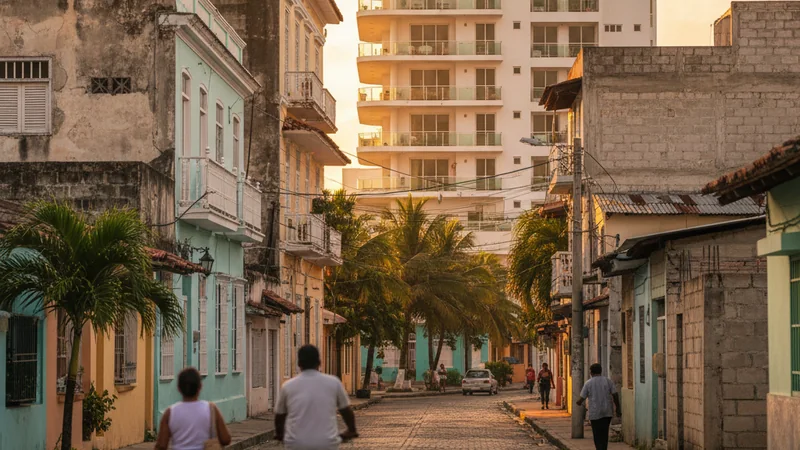

Driving in Colombia is not the disaster some expat forums make it out to be, but it isn't the same game as driving at home either. Cartagena has its own quirks on top of the national rules: brutal heat that bakes you and your engine, the historic Centro where much of the Walled City is restricted or pedestrianized and simply not built for cars, motos weaving on both sides, narrow colonial streets, and serious flooding when the rains come. This guide covers what you legally need to drive (foreign license windows, conversion, SOAT, tecnomecánica, RUNT), how pico y placa works in Cartagena in 2026, the traffic-ticket enforcement that actually matters, rental options for visitors, and the honest answer to whether you should own a car here at all.
Should you even have a car?
Start with the honest question. For most visitors and many residents in Cartagena, the answer is no. The city is compact, the tourist core is small, and a car is more of a liability than an asset in Centro, Getsemaní, and Bocagrande. Uber, Didi, and InDriver all work in Cartagena, regular yellow taxis are everywhere and cheap (negotiate or confirm the fare before you get in, most are unmetered), and gas is substantially more expensive than in the U.S. (COP 16,000 to 18,000 per gallon-equivalent in 2026, roughly USD 4 per gallon at about 4,000 COP to the dollar).
Cases where owning makes sense:
- You live long-term in an outer neighborhood with thinner ride-share coverage
- You have small children and hauling car seats into a taxi every trip is miserable
- You regularly do day trips to Barú, La Boquilla, Galerazamba, the Volcán del Totumo, or up the coast toward Santa Marta
- You have an unpredictable schedule somewhere not served well by taxis or apps
For everyone else, rent when you need to and ride-share or grab a taxi the rest of the time. Transcaribe (the city's BRT bus system) covers the main corridors if you want to skip cars entirely.
Driving on a foreign license
A foreigner visiting Colombia can legally drive on a valid license from their home country for the duration of their lawful stay as a tourist. Colombia's tourist permit (PIP) is issued on arrival for up to 90 days, extendable once (PTP) for a further 90 days, so a tourist stay can run up to roughly 6 months. During that full period, your home-country license is valid. A U.S., Canadian, or EU license plus your passport is sufficient at a traffic stop. An International Driving Permit (IDP) is not required but is very useful: it translates the license into Spanish and is recognized under the Vienna Convention. Get one at AAA (U.S.), CAA (Canada), or your national motoring club before you travel. They cost the equivalent of USD 20 to 30 and take five minutes.
Once you become a Colombian resident (you hold a visa and a Cédula de Extranjería), the rules change. You have a grace period, generally around 90 days after your CE is issued, to keep driving on your foreign license. After that, you are expected to hold a Colombian license. In practice enforcement varies, but at a traffic stop or after an accident, driving on a foreign license long after residency was granted can create liability and insurance problems.
Getting a Colombian driver's license
Whether you've never had a license or you're converting a foreign one, the process in Colombia is the same four-step sequence. Colombia has no true reciprocity program for most nationalities: your foreign license lets you drive legally as a visitor, but it does not convert directly. You go through the standard Colombian licensing process regardless of prior experience.
Step 1, register in the RUNT
The RUNT (Registro Único Nacional de Tránsito) is Colombia's national driver and vehicle database. You must be registered in it before you can obtain a Colombian license or register a vehicle. Registration requires your Cédula de Extranjería, so you need legal residency status first. A tourist visa does not qualify.
RUNT registration is done in person at a CAD (Centro de Atención de Tránsito) or through an authorized transit agency. The RUNT website (runt.gov.co) lets you look up your registration status, pay fees online, and find authorized offices. Phone: 018000930060 (free, 24/7).
Step 2, medical exam at a CRC
A CRC (Centro de Reconocimiento de Conductores) is a government-authorized medical center that issues the aptitude certificate required for licensing. The exam covers vision, hearing, physical coordination, and a brief psychological screen. It takes about an hour.
Cost: COP 120,000 to 180,000. To find an authorized CRC in Cartagena: go to runt.gov.co/directorio-actores, select "Centro de Reconocimiento de Conductores," and filter by Cartagena. Only use centers listed there. Unauthorized medical certificates are invalid and can constitute fraud.
Step 3, driving course and exam at a CEA
A CEA (Centro de Enseñanza Automovilística) is an authorized driving school. This is where both first-time drivers and license converters go. The school handles theory, practical instruction, and the official exam.
For a standard B1 license (private car or SUV), expect:
- First-time drivers: 20 to 30 hours of combined theory and practical instruction before you sit the exam. The CEA takes you from zero.
- Experienced drivers converting a foreign license: Many CEAs will credit prior experience and compress the course if you can demonstrate competence. Ask when you call. There is no enforced legal minimum for experienced drivers in practice.
- Cost: COP 1,200,000 to 2,200,000 all-in including the exam. Prices vary by school.
To find authorized driving schools in Cartagena: go to runt.gov.co/directorio-actores and select "Centro de Enseñanza Automovilística," filtered to Cartagena. Only schools on that list are authorized to issue valid certificates.
Step 4, pay the licensing fee and collect your license
Once you have your RUNT registration, medical certificate, and CEA exam results, pay the licensing fee at the local tránsito authority, the Departamento Administrativo de Tránsito y Transporte de Cartagena (DATT). Your license is issued with a validity of 10 years if you're under 60, 5 years between 60 and 80, and 1 year thereafter.
Total cost and timeline
Budget COP 1,500,000 to 2,500,000 total and 3 to 6 weeks from start to license in hand. The bottleneck is usually scheduling at the CEA. It's neither cheap nor fast, but it's a one-time process.
Scam warning: agencies offering to get you a license in days, or promising to bypass the CEA, are a recurring fraud in Colombia. Fraudulent licenses look legitimate but fail when the RUNT is checked at a traffic stop. The consequences are criminal charges plus automatic revocation.
Pico y placa in Cartagena
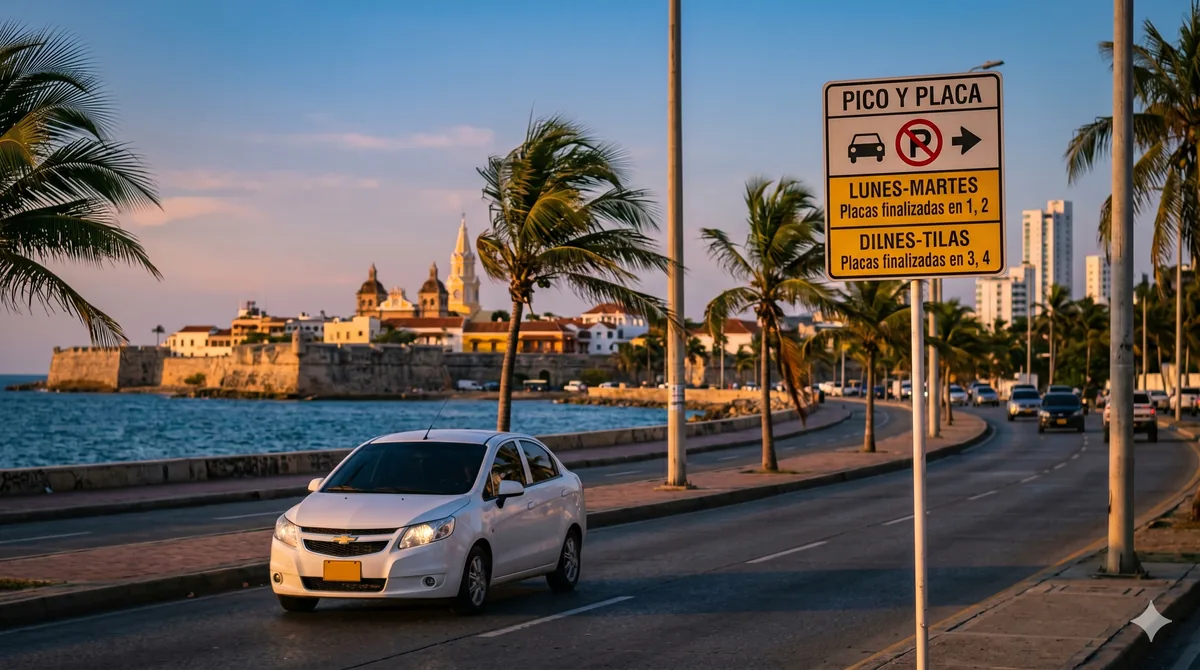
Pico y placa is Colombia's license-plate-rotation system, used to thin out traffic at peak times. In Cartagena it applies to private vehicles on specific days based on the last digit of the plate. The schedule is set and adjusted by the DATT through resolutions issued periodically, and the pattern in Cartagena is generally lighter than in Bogotá or Medellín. As of early 2026 the broad pattern is:
- Weekdays (Monday to Friday), peak hours: typically morning and evening rush windows. A set of plate-ending digits is restricted per day on a rotating weekly schedule.
- Weekends and public holidays: generally no pico y placa for private vehicles.
- Taxis and motorcycles: separate restriction schedules can apply. Check the official schedule for your vehicle type.
The single most important thing to know: the schedule changes by resolution, so do not assume last year's rotation still holds. Always verify the current resolution before you rely on it. The DATT publishes the active schedule, and during high season, Independence festivities in November, and other events, the rules can be modified or suspended. When in doubt, ask a local or check the day's posted restriction before driving.
"Disculpe, ¿sabe usted qué dígitos de placa están en pico y placa hoy?"
Excuse me, do you know which plate digits are restricted by pico y placa today?
Fines for violating pico y placa run roughly 15 SMDLV (salarios mínimos diarios legales vigentes), about COP 812,000 in 2026, plus possible vehicle impound. Enforcement is a mix of traffic police and photo cameras on major corridors, and tickets surface through the SIMIT system.
Required documents in the vehicle
Colombian law requires the following paperwork be in the car at all times (originals, not copies, for most):
- Driver's license (Colombian or foreign, valid)
- Tarjeta de propiedad (vehicle registration card)
- SOAT (Seguro Obligatorio de Accidentes de Tránsito), the mandatory accident insurance that covers third-party medical care and death. Annual premium COP 300,000 to 850,000 depending on the vehicle. It must be paid and current, and most drivers display the sticker on the windshield. Driving without SOAT is one of the more serious common offenses: 30 SMDLV (about COP 1,750,905) plus immediate impound of the vehicle.
- Revisión tecnomecánica (RTM), the annual roadworthiness and emissions inspection. It's required for vehicles over a few years old (new cars get a grace period before the first inspection is due). Cost COP 220,000 to 380,000. It must be current, with the same sanction as missing SOAT if it has lapsed. Find authorized inspection centers at runt.gov.co/directorio-actores (select "Centro de Diagnóstico Automotor," filter to Bolívar).
Many drivers also carry todo riesgo comprehensive insurance from providers like Sura, Mapfre, Seguros Bolívar, Allianz, and La Previsora (state-owned, often the cheapest for SOAT). Todo riesgo covers theft, collision, natural disasters (relevant here given Cartagena's flooding), and broader third-party liability. For a mid-range sedan, expect COP 2,500,000 to 5,000,000 per year. It's not legally required, but in a humid, flood-prone coastal city it's very much recommended.
The rules of the road, what's enforced
Colombian traffic law is comprehensive; enforcement is selective. The things that are actively enforced and that foreigners need to respect:
- DUI (alcoholemia): Any measurable alcohol is a violation, and thresholds escalate the penalties dramatically. A first offense at moderate levels means roughly a one-year license suspension, a fine around COP 18 million, and community service. Puestos de control are common on weekend nights, especially around the Bocagrande and Getsemaní nightlife strips and on roads back from Barú and La Boquilla on Sundays.
- Speeding on photo-enforced corridors: Fixed speed cameras are active on the main arterials and entry/exit points to the city. Fines for going over the limit run 15 SMDLV and up.
- Seatbelts: Mandatory for all occupants, front and rear.
- Child restraints: Children under 10 must ride in the rear seats with an age-appropriate car seat or booster.
- Motorcycles: Helmets are mandatory for driver and passenger, and the helmet must show the moto's plate number, a rule aimed at deterring robbery.
- Mobile phones: Using a handheld phone while driving is a sanctioned offense.
- Pico y placa: Active and photo-enforced.
Things that are technically illegal but less actively enforced on the arterials: lane discipline, signaling lane changes, following distance, and respecting pedestrian crossings. That does not mean you should drive how some locals drive. It means you should drive defensively and assume the worst at intersections and whenever motos are nearby.
Driving in the Walled City and the heat
Cartagena adds a few realities that the manuals don't mention. Take them seriously before you decide a car is worth it.
- El Centro is not built for cars. Much of the historic Walled City is narrow, one-way, congested, or outright pedestrianized, and some sections are restricted to residents or permit-holders. Parking inside the walls is scarce and expensive. For Centro and Getsemaní, walking plus the occasional taxi beats driving every time.
- The heat is hard on cars and drivers. Sustained 32 to 34 C with high humidity means you will run the A/C constantly (which is why fuel and battery wear add up), interiors bake, and tires and cooling systems work harder. Never leave anyone or a pet in a parked car here, not even for a few minutes.
- Flooding is real. In heavy rain, especially in the wetter months, low-lying streets and underpasses flood fast. Cartagena's drainage struggles with downpours. Do not drive through standing water of unknown depth; it can stall an engine or sweep a small car. Plan trips around the heaviest rain when you can.
- Moto traffic is relentless. Motorcycles filter on both sides, appear in blind spots, and don't always signal. Check mirrors and shoulders constantly, especially when turning or changing lanes.
The short version: most visitors do not need a car in Cartagena, and many who try one regret it for trips inside the city. A car earns its keep mainly for long-term residents, families, and day trips out of town.
Renting a car
Cartagena has a working rental market. The major international brands operate at Rafael Núñez International Airport (CTG), and several have city locations as well. It works broadly the same as renting elsewhere in Latin America, but there are a few Colombia-specific things worth knowing before you walk up to the counter.
Where to rent
The main international brands have desks at Rafael Núñez airport and city offices, typically clustered around Bocagrande and the airport corridor. For a live comparison of available cars and prices across all of them, an aggregator that filters by the CTG airport is the most useful starting point. Booking online a few days ahead routinely surfaces cars 20 to 30% below walk-up counter rates.
Daily rates: compact cars run the equivalent of USD 30 to 55 before insurance; mid-size SUVs USD 50 to 90. Book online 3 to 5 days ahead, since last-minute counter rates are meaningfully higher, especially in high season.
What you need to rent
- Passport
- Valid home-country driver's license (IDP recommended but rarely strictly enforced in practice)
- Credit card in the driver's name for the hold, usually the equivalent of USD 300 to 800 depending on car class. Debit cards are rarely accepted for deposits.
- Minimum age is usually 21 to 25, and young-driver surcharges apply under 25 at most agencies.
Insurance, what to know before you decline the CDW
SOAT (mandatory Colombian third-party liability) is included in the rental price by law. The CDW the agent offers covers damage to the car itself. Before you wave it off:
- Credit card coverage: Some travel cards (for example Chase Sapphire and Amex Platinum) provide primary or secondary CDW coverage in Colombia, but some cards exclude Colombia specifically. Verify with your issuer before travel.
- Home auto insurance: Most U.S. and Canadian personal policies do not extend to foreign rentals.
- Counter upsells: Agents will push "super CDW" or zero-deductible packages at significant daily cost. If your credit card provides primary coverage, these are usually unnecessary.
Long-term rentals
All the major agencies offer monthly rates, typically 30 to 50% below the equivalent daily rate for 30-plus-day commitments. For stays of six months or more, buying a used car often works out cheaper. See the Buying a car section below.
Renting a motorcycle
Motorcycle rentals in Cartagena run informally. There are no international brands with moto fleets here; the market is local shops and individual owners, mostly found through Facebook Marketplace (search "alquiler moto Cartagena") and WhatsApp referrals.
What to expect:
- Daily rates: COP 80,000 to 150,000 for a standard 125 to 200cc commuter (Honda, Yamaha, AKT, and Bajaj are the common makes).
- Deposit: Usually COP 500,000 to 1,000,000 or your passport as collateral. Most shops prefer cash.
- Helmet: Colombian law requires a helmet displaying the motorcycle's plate number. Any reputable rental should provide a compliant one. Confirm before leaving the deposit.
- Insurance: Comprehensive coverage on rental bikes is rarely available. SOAT covers third-party liability only. You ride at your own financial risk for damage to the bike.
- Heat and rain: Riding a moto in Cartagena's heat and sudden downpours is its own challenge. Sun exposure is intense and wet roads get slick fast.
For experienced riders staying long-term, a moto can be a practical, cheap way to move around. For everyone else, the heat, the rain, and the moto-heavy traffic make a car the safer choice.
Parking
Shopping centers and malls (Mall Plaza El Castillo, Caribe Plaza, La Serrezuela, Bocagrande's centers) have covered parking, typically COP 3,000 to 5,000 for the first hour and COP 1,500 to 3,000 per additional hour, with some validating against a purchase. High-end condo buildings in Bocagrande, Castillogrande, and Manga include tenant parking.
On-street parking is informal in most of Cartagena. You'll be approached by a "cuidacarros," a freelance parking attendant who will watch your car for COP 2,000 to 5,000. It's not strictly regulated, but paying is customary, it's the cheapest car security you'll get, and refusing tends to invite trouble. Inside or near the Walled City, on-street parking is scarce and a nice car left on the street after dark without a watchman is asking for problems. Garaged parqueaderos in commercial areas run COP 3,000 to 8,000 per hour.
Traffic tickets and fines
Fines are calculated in SMDLV (daily minimum wage units). The 2026 SMDLV is roughly COP 47,450 (1/30 of the monthly SMMLV of about COP 1,750,905). The comparendo is the formal traffic citation. Common fine levels:
- Running a red light: 16 SMDLV (about COP 866,000)
- No SOAT or expired: 30 SMDLV (about COP 1,750,905)
- Pico y placa violation: 15 SMDLV (about COP 812,000)
- DUI (minor): from 30 SMDLV with ascending penalties by blood-alcohol level
- Speeding over the limit: 15 to 30 SMDLV depending on the overage
- No seatbelt: 8 SMDLV (about COP 433,000)
Check your fines in the national SIMIT system using your license or tarjeta de propiedad. Unpaid comparendos accrue interest and block renewal of SOAT, tecnomecánica, and vehicle transfers. They don't go away by ignoring them; they surface at the worst moment, like selling the car or renewing your license.
Early-payment discounts: paying within 11 days of notification typically cuts the fine by 50%, and paying within 20 days cuts it by 25%. Pay via the tránsito website or at any bank with a valid reference.
Accidents
If you're in an accident with injuries, even minor ones:
- Don't move the vehicles unless blocking traffic creates further risk
- Call 123 (the unified emergency line), or directly 132 for the fire department (Bomberos) and 125 for Cruz Roja ambulance. SOAT covers immediate medical treatment for all parties regardless of fault.
- Photograph the scene, the other vehicles, plates, driver's licenses, tarjetas de propiedad, and SOAT stickers
- Wait for the traffic officer (agente de tránsito) to file the report (croquis). This is the legal document for insurance claims.
- Exchange information in writing. Do not agree to leave without a police report for anything beyond minor paint contact.
- Report to your insurer within the notice window specified in your policy (usually 2 to 5 days)
For non-emergency tránsito matters, the Departamento Administrativo de Tránsito y Transporte de Cartagena (DATT) is the local authority. For property-only minor collisions, some drivers prefer to settle on the spot. Do this only if you're fully comfortable, the damage is minimal, and you can photograph everything. When in doubt, call tránsito.
"Buenas tardes. Aquí están mis documentos: licencia de conducción, tarjeta de propiedad y SOAT. Prefiero que hagamos el reporte oficial."
Good afternoon. Here are my documents: driver's license, vehicle registration, and SOAT. I prefer that we file the official report.
Buying a car (if you decide to)
Used cars are the sensible path for most foreigners. New cars are expensive in Colombia (high import duties), and depreciation is less aggressive than in the U.S., so used vehicles hold value. The main search platforms are OLX Colombia and Mercado Libre Autos. Both show private and dealer listings with prices and photos and let you filter by city (Cartagena) and price range. Mid-size used sedans (Chevrolet Onix, Mazda 2, Renault Stepway, Kia Picanto) run COP 45M to 85M. Mid-range SUVs (Mazda CX-3, CX-30, Kia Seltos, Renault Duster) run COP 75M to 140M. An inspection at a reputable mechanic before purchase is essential, and in a salt-air coastal city it's worth checking specifically for corrosion and flood history. Verify the car's record in RUNT for outstanding fines, pledges, or accident reports; you can query any plate or chassis number for free.
Registering the transfer (traspaso) happens at a tránsito agency and requires both the buyer's and seller's presence (or notarized power of attorney), payment of the traspaso tax, all documents paz y salvo, and a vehicle inspection. Allow a full morning and budget COP 400,000 to 900,000 in tax and fees.
FAQ
Can I drive in Colombia with just my home-country license?
Yes, as a tourist. Once you become a resident (you hold a Cédula de Extranjería), you have a grace period and should convert to a Colombian license within roughly 90 days.
Do I need an IDP?
Not legally required in Colombia, but highly recommended. It translates your license into Spanish, costs about USD 20 at AAA or your national equivalent, and takes the stress out of a traffic stop. Bring it plus your original license, not one in place of the other.
What if I get pulled over?
Be calm and hand over your license, tarjeta de propiedad, and SOAT. Uniformed traffic officers (agentes de tránsito) can legally stop you and write comparendos. Requests for cash "to resolve it on the spot" are illegal; politely decline and say you'd prefer to pay the official fine. Note the officer's name and number. If anything feels off, a dashcam helps.
Is it safe to drive at night?
In Cartagena proper, yes, on well-lit arterials. Avoid unlit secondary roads in unfamiliar neighborhoods. For intercity driving (Cartagena to Barranquilla or Santa Marta), daylight-only is the conservative rule. Night driving on Colombian highways adds moto, livestock, and lane-discipline risks that aren't worth it.
Do I really not need a car in the Walled City?
Correct. Centro and Getsemaní are best walked, with the odd taxi for longer hops. Much of the historic core is narrow, one-way, congested, or pedestrianized, and parking is scarce and pricey. A car inside the walls is a liability, not a convenience.
Can I rent a car without a credit card?
Most major agencies require a credit card for the deposit. A debit card is accepted by some but usually with a larger hold. Cash-only bookings are rare at the major brands.
How do I know today's pico y placa?
The schedule is set by DATT resolution and changes periodically, so always check the current resolution rather than assuming. Confirm the day's restricted plate digits before you drive, especially during high season and the November festivities, when the rules can be modified or suspended.
What's the scam at traffic checkpoints?
A small minority of officers at informal checkpoints will claim you've committed an offense and suggest paying COP 50,000 to 200,000 to avoid a formal ticket. Refuse, ask to be written the formal comparendo, and have your documents ready. Formal tickets are cheaper and legally defensible; on-the-spot payments are bribes with no receipt. If the officer is uniformed and identified and you actually committed an offense, pay the formal fine through proper channels.
Further reading
- Understanding Colombia's estrato system
- Visas for Colombia
- Banking and money in Cartagena
- Travel insurance for Cartagena
- All how-to guides
This guide is informational and reflects Colombian traffic law, Cartagena-specific regulations, and market conditions as of early 2026. Pico y placa schedules change by DATT resolution, SMDLV-linked fines adjust annually, and insurance premiums shift over time. Verify current rules with the DATT and check your insurer's policy documents before relying on any specific figure here.
Still have questions?¿Todavía tienes preguntas?
Catalina is our concierge. Ask her about visas, neighborhoods, healthcare, prices, anything Cartagena. She answers in chat or WhatsApp, English or Spanish, free.Catalina es nuestra concierge. Pregúntale sobre visas, barrios, salud, precios, cualquier cosa de Cartagena. Responde por chat o WhatsApp, en inglés o español, gratis.
Chat with Catalina ›Habla con Catalina ›