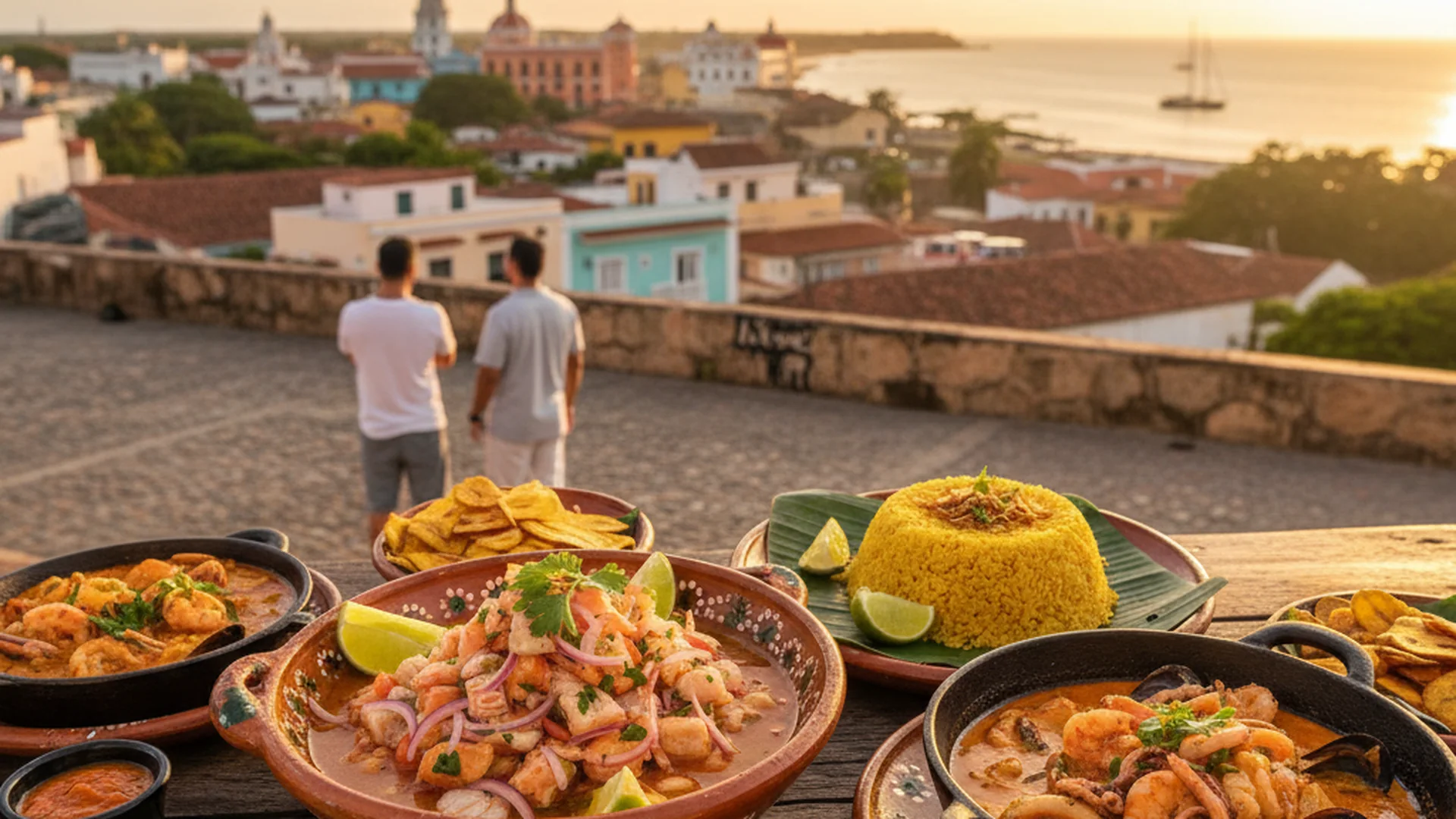
The History of Cartagena's Food: Costeño Cuisine Decoded
La historia de la comida de Cartagena: Gastronomía costeña descodificada
Why Cartagena eats coconut rice, fried egg arepas, and slow-cooked posta negra, a deep-dive on the African, Indigenous, Spanish, and Levantine roots of costeño cuisine.
Mike Chartrand
April 2026 · 10 min read
Specific question while you read? Ask Catalina, the Cartagena Guide concierge.¿Pregunta específica mientras lees? Pregúntale a Catalina, la concierge de Cartagena Guide.Chat with Catalina ›Habla con Catalina ›
If you arrive in Cartagena expecting Colombian food to mean bandeja paisa, the mountain of beans, chicharrón, rice, and fried egg that defines Medellín, you will be confused by lunch on day one. There are no beans. There is barely any pork. The rice is dark and tastes faintly of caramel. The fish is whole, head and tail, drowning in coconut. There is fried dough everywhere. And the woman selling you a cassava fritter on the corner is speaking Spanish that sounds, to a Bogotano ear, almost like a different language.
This is costeño food, the cuisine of Colombia's Caribbean coast, and it has almost nothing to do with the Andean cooking that English-speaking visitors usually associate with the country. Cartagena's plate is a Caribbean plate, shaped by four centuries of forced and voluntary migration, by a port that once received more enslaved Africans than anywhere else in Spanish South America, and by the geography of a hot, flat, salty coast where the sea provides and the inland provides differently. Understanding what's on your table here is one of the more honest ways to understand the city itself.
A coast, not a country
Colombian food is not one thing. The country has at least six distinct culinary regions, and the gulf between them is vast. The interior, Bogotá, Boyacá, the coffee belt, eats potatoes, beans, pork, ajiaco soup, hot chocolate with cheese floating in it. The Pacific coast eats coconut and fish but with a different hand, leaning on smoked seafood and herbs like chillangua (culantro). The Amazon eats river fish and yuca. The Llanos eats grilled beef on giant skewers.
Cartagena belongs to La Costa, the Caribbean. The region runs from the Darién Gap east to La Guajira, and its cooking shares more DNA with Cuba, the Dominican Republic, and parts of West Africa than with anything served in the Andes 600 kilometers south. When paisas from Medellín visit Cartagena, they usually love the food and almost never cook it at home. It belongs to the coast.
If you want to taste the parallel logic of another Caribbean city, barranquilla.guide covers the food culture two hours up the coast, same broad palette, slightly different accent, more Lebanese influence in the classic kibbeh and stuffed grape leaves you'll find in Barranquilla's old downtown.
What was here first: the Calamarí and the Zenú
Long before Pedro de Heredia arrived in 1533 and founded a Spanish city on top of the village of Calamarí, two Indigenous groups had already shaped what could be eaten on this coast. The Calamarí (sometimes written Kalamari), a Caribe-language people, lived on the bay where the Walled City now stands. Inland, in the river valleys of the Sinú, San Jorge, and Cauca, the Zenú had built one of the most sophisticated agricultural civilizations in pre-Columbian South America, a system of canals covering some 500,000 hectares that controlled flooding and made the floodplains farmable from roughly 200 BCE onward.
What did they eat? Corn, above all. Cassava (yuca). Sweet potato. Ahuyama (a kind of squash). River fish. Iguana, manatee, turtle. Wild fruits. The technique of grinding corn and cooking it on a hot clay disc, what would later be called the arepa, is Indigenous and pre-Columbian. The whole-fish cooking culture is Indigenous. The reliance on yuca as a starch staple is Indigenous. Strip the African and Spanish influences out of a costeño plate and you still have an Indigenous skeleton.
What Spain brought, and what it changed
The Spanish arrived with cattle, pigs, chickens, rice, sugar cane, plantains (originally from Asia, brought via West Africa), citrus, garlic, onions, olive oil, wheat, and the technique of slow-braising meat in wine and spices. They also brought a Catholic calendar that organized when people ate fish (Lent, Fridays) and when they slaughtered (Christmas, Easter), and a class system that determined who ate the cuts.
The most visible Spanish footprint on the Cartagena plate today is posta cartagenera, the slow-cooked beef in dark sauce that is the city's signature dish. Posta is essentially a Spanish-style braise: a tough cut of beef (usually muchacho or eye of round), marinated, seared, and simmered for hours. What makes it cartagenera is the sauce: panela (unrefined cane sugar), tomato, onion, garlic, sometimes a glug of Coca-Cola in modern recipes, sometimes red wine, and a long enough cook that the sugars caramelize black. The result is dense, sweet-savory, and unmistakably tropical. Pair it with white rice and patacones (smashed fried plantains), and you have the dish that defines lunch in old Cartagena.
A good plate of posta at a sit-down restaurant in the Walled City runs around COP 45,000-65,000 in 2026. At a corrientazo, the workers' lunch counters where locals actually eat, you can find it for COP 18,000-25,000 with a juice. La Cevichería gets the tourist attention, but if you want the dish in its working form, walk to Restaurante La Mulata in the Centro [verify current operating status] or any of the lunch counters along Calle 33 in Getsemaní.
What Africa brought, and why it dominates the plate
Between 1573 and 1640, port officials recorded more than 73,000 enslaved Africans disembarking in Cartagena. The historian David Wheat, working from licensed shipping registers alone, has documented 463 slave ships in that period. The actual number is higher; smuggling was constant, and the trade continued until the early 19th century. By any honest accounting, Cartagena was the primary slave port in Spanish South America, and the people who arrived in those holds, most of them from Upper Guinea, the Bight of Benin, the Kongo, and Angola, are the reason the city's food tastes the way it does.
They brought, or knew how to use: coconut, plantain, okra, ñame (yam), the technique of frying in deep oil, the technique of cooking rice in coconut milk until it caramelizes (titoté), the use of smoked or salted fish in stews, palm oil, and an entire grammar of one-pot cooking that had no real Spanish equivalent.
Arroz con coco is the cleanest example. White rice cooked first in fresh coconut milk, then in the grated coconut solids until they brown into a sticky, sweet, slightly burnt crust at the bottom of the pot. That bottom layer is the titoté and it is, in a serious cook's kitchen, the entire point. The technique is West African. The rice is Asian via Spain. The coconut is Indigenous-tropical. Three continents in a single pot, and the result is the most quintessentially Cartagena thing on a plate.
Cazuela de mariscos, the creamy seafood stew of shrimp, octopus, fish, and crab in a coconut-tomato base, descends from the same lineage. So does sancocho de pescado (fish sancocho), the watery, herbaceous stew made with whole fish, plantain, yuca, and corn. Sancocho is the Sunday meal of the coast, the dish you eat after the beach with a beer in your hand and your shirt off.
Fried things, the working person's food
Cartagena's street food is overwhelmingly fried, and almost all of it descends from African deep-frying traditions adapted to local ingredients.
Arepa de huevo is the cult favorite. A disc of pre-cooked corn dough is partially fried, slit open, an egg is cracked inside, the dough is sealed back up, and the whole thing is finished in hot oil until the egg cooks inside its corn pocket. It comes from somewhere on the coast, Cartagena and Barranquilla both claim it [verify exact origin city; both cities have legitimate claims and the question is genuinely unsettled]. You eat it for breakfast at a stall, hot, with your hands, while it leaks yolk down your wrist. Around COP 4,000-6,000 each at a street vendor.
Carimañola is the cassava-dough cousin: boiled yuca mashed into a dough, stuffed with seasoned ground beef or cheese, formed into a torpedo, deep-fried. Eaten with suero costeño, the thick, salty, fermented cream of the coast.
Bollo is older and weirder. A dense corn or yuca paste wrapped in a corn husk or banana leaf and boiled. Bollo limpio is plain. Bollo de mazorca is sweet, made from young corn. Bollo de yuca is starchy and savory. They are sold from buckets carried on heads or from coolers on the back of bicycles, and they are, more than almost anything else, the food of the African diaspora preserved intact on the Colombian coast.
Fish, and how the coast handles it
The Caribbean here is warm and shallow, and the historic catch was pargo (red snapper), róbalo (snook), sierra (Spanish mackerel), and small reef fish. The dominant cooking approach is whole and fried. A fried whole snapper with coconut rice, patacones, and a small salad of cabbage, tomato, and lime is the totemic beach lunch from Bocagrande to Playa Blanca. Expect to pay COP 45,000-80,000 depending on the fish and where you are.
For cazuela de mariscos, La Cevichería in the Walled City is the famous tourist-priced version (around COP 70,000-90,000). For something closer to the working version, head to Mercado de Bazurto, the chaotic, sprawling local market where Anthony Bourdain filmed an episode and where fish goes from boat to plate in under an hour.
If you want the cleanest, most uncompromising Cartagena seafood lunch, hire a boat to Isla Grande in the Rosario Islands and let a local cook make you the catch of the morning over a wood fire. The food on a Rosario beach is, in a real sense, the food of the coast before it was prettified for tourists.
The Levantine layer
In the late 19th and early 20th centuries, waves of Lebanese, Syrian, and Palestinian immigrants, often called turcos because their Ottoman passports said Turkey, settled along Colombia's Caribbean coast. They settled most heavily in Barranquilla, but Cartagena got a meaningful population too, and their food crossed over.
You will find kibbeh (sometimes spelled quibbe) on costeño menus. You will find tabouleh-adjacent salads, stuffed grape leaves, and a faint Levantine spice profile in some of the older Cartagena kitchens. Shakira's family, she's from Barranquilla, is Lebanese-Colombian, which is the cultural shorthand most foreigners eventually learn. The Lebanese influence on Cartagena cuisine is smaller than in Barranquilla, but it's there, and it explains why some lunch counters in the Centro will quietly serve you a plate of kibbeh next to coconut rice without comment.
What you can actually try today
If you have one week and want to taste the historical layers honestly, here is the short list:
For posta cartagenera: La Mulata (Calle Quero, Centro) for the proper sit-down version; El Boliche Cebichería for a refined take; any corrientazo in Getsemaní for the working version.
For arroz con coco at its best: Restaurante Donde Olano in the Walled City, or, better, anywhere on Playa Blanca or in the Rosario Islands where it's cooked in a pot over wood.
For street food: walk Plaza de la Trinidad in Getsemaní in the early evening. Arepa de huevo, carimañola, bollo, and butifarra (a small fried sausage) are all sold by competing vendors. You can eat your way through the historical playbook for under COP 30,000.
For sancocho de pescado: it's a weekend dish. Find it on a Saturday or Sunday at a beachside kiosco in La Boquilla, the Afro-Colombian fishing village just north of the city.
For Bazurto Market: go with a guide if it's your first time. The market is chaotic, hot, occasionally pickpocketed, and the most authentic food experience in Cartagena. Bazurto food tours run around COP 150,000-250,000 per person and are worth it.
Why this all matters
Costeño cuisine is one of the few places where Cartagena's full history lives on a plate without editing. The corn is Calamarí. The braising is Spanish. The coconut technique is West African. The kibbeh is Lebanese. None of it is hidden. The food remembers the people who made it in a way the city's marketing materials sometimes do not. (For a deeper read on that, see our piece on the African influence on Cartagena and the palenqueras of San Basilio de Palenque, the women whose ancestors carried so much of this food into the city in the first place.)
Eat slowly. Ask what's in the pot. Tip the woman behind the counter. The plate has been four hundred years in the making and it is, when you understand what you're looking at, the best history book in the city.
Specific question while you read? Ask Catalina, the Cartagena Guide concierge.¿Pregunta específica mientras lees? Pregúntale a Catalina, la concierge de Cartagena Guide.Chat with Catalina ›Habla con Catalina ›
Si llegas a Cartagena esperando que la comida colombiana signifique bandeja paisa, esa montaña de frijoles, chicharrón, arroz y huevo frito que define a Medellín, te confundirá el almuerzo del primer día. No hay frijoles. Hay casi nada de cerdo. El arroz es oscuro y sabe levemente a caramelo. El pescado es entero, cabeza y cola, ahogado en coco. Hay masa frita por todas partes. Y la mujer que te vende una arepa de yuca en la esquina habla un español que suena, para un bogotano, casi como un idioma distinto.
Esta es la comida costeña, la cocina de la costa Caribe de Colombia, y casi no tiene nada que ver con la cocina andina que los visitantes de habla inglesa suelen asociar con el país. El plato de Cartagena es un plato caribeño, formado por cuatro siglos de migración forzada y voluntaria, por un puerto que alguna vez recibió más africanos esclavizados que cualquier otro lugar en América del Sur española, y por la geografía de una costa caliente, plana y salada donde el mar provee y el interior provee de manera distinta. Entender qué hay en tu mesa aquí es una de las formas más honestas de entender la ciudad misma.
Una costa, no un país
La comida colombiana no es una sola cosa. El país tiene al menos seis regiones culinarias distintas, y el abismo entre ellas es vasto. El interior, Bogotá, Boyacá, el eje cafetero, comen papas, frijoles, cerdo, ajiaco, chocolate caliente con queso flotando. La costa Pacífica come coco y pescado pero con otra mano, inclinándose hacia los mariscos ahumados y hierbas como el chillangua (cilantro). El Amazonas come pescado de río y yuca. Los Llanos comen carne asada en brochetas gigantes.
Cartagena pertenece a La Costa, el Caribe. La región va desde el Darién al este hasta La Guajira, y su cocina comparte más ADN con Cuba, la República Dominicana y partes de África Occidental que con cualquier cosa que se sirva en los Andes a 600 kilómetros al sur. Cuando los paisas de Medellín visitan Cartagena, casi siempre aman la comida y casi nunca la cocinan en casa. Pertenece a la costa.
Si quieres probar la lógica paralela de otra ciudad caribeña, barranquilla.guide cubre la cultura de comida dos horas hacia arriba en la costa, la misma paleta amplia, un acento un poco distinto, más influencia libanesa en el kibbeh clásico y las hojas de uva rellenas que encuentras en el centro antiguo de Barranquilla.
Lo que fue primero: los Calamarí y los Zenú
Mucho antes de que Pedro de Heredia llegara en 1533 y fundara una ciudad española encima del pueblo de Calamarí, dos grupos indígenas ya habían moldeado lo que se podía comer en esta costa. Los Calamarí (a veces escrito Kalamari), un pueblo de lengua Caribe, vivían en la bahía donde ahora está la Ciudad Amurallada. Tierra adentro, en los valles fluviales del Sinú, San Jorge y Cauca, los Zenú habían construido una de las civilizaciones agrícolas más sofisticadas de la América del Sur precolombina, un sistema de canales que cubría alrededor de 500.000 hectáreas y controlaba las inundaciones haciendo arables las llanuras aluviales desde aproximadamente el 200 a.C.
¿Qué comían? Maíz, sobre todo. Yuca. Papa dulce. Ahuyama. Pescado de río. Iguana, manatí, tortuga. Frutas silvestres. La técnica de moler maíz y cocinarlo en un disco de arcilla caliente, lo que después se llamaría la arepa, es indígena y precolombina. Toda la cultura de cocina de pescado entero es indígena. La dependencia de la yuca como almidón principal es indígena. Quítale las influencias africana y española a un plato costeño y todavía tienes un esqueleto indígena.
Lo que España trajo y lo que cambió
Los españoles llegaron con ganado, cerdos, pollos, arroz, caña de azúcar, plátanos (originalmente de Asia, traídos vía África Occidental), cítricos, ajo, cebollas, aceite de oliva, trigo, y la técnica de estofar la carne lentamente en vino y especias. También trajeron un calendario católico que organizaba cuándo la gente comía pescado (Cuaresma, viernes) y cuándo sacrificaban (Navidad, Pascua), y un sistema de clases que determinaba quién comía qué cortes.
La huella española más visible en el plato cartagenero hoy es la posta cartagenera, la carne de res cocida lentamente en salsa oscura que es el plato distintivo de la ciudad. La posta es esencialmente un estofado al estilo español: un corte duro de res (usualmente muchacho o cadera), marinado, sellado y cocido a fuego lento durante horas. Lo que la hace cartagenera es la salsa: panela, tomate, cebolla, ajo, a veces un chorrito de Coca-Cola en recetas modernas, a veces vino tinto, y una cocción lo suficientemente larga para que los azúcares se caramelicen negro. El resultado es denso, agridulce, e inconfundiblemente tropical. Acompáñalo con arroz blanco y patacones (plátano frito aplastado), y tienes el plato que define el almuerzo en la Cartagena antigua.
Un buen plato de posta en un restaurante para sentarse en la Ciudad Amurallada cuesta alrededor de COP 45.000-65.000 en 2026. En un corrientazo, los contadores de almuerzo de trabajadores donde la gente local realmente come, puedes encontrarlo por COP 18.000-25.000 con un jugo. La Cevichería recibe la atención turística, pero si quieres el plato en su forma trabajadora, camina hasta el Restaurante La Mulata en el Centro [verifica estado operativo actual] o cualquiera de los contadores de almuerzo a lo largo de la Calle 33 en Getsemaní.
Lo que África trajo y por qué domina el plato
Entre 1573 y 1640, los funcionarios portuarios registraron más de 73.000 africanos esclavizados desembarcando en Cartagena. El historiador David Wheat, trabajando solo a partir de registros de envíos licenciados, ha documentado 463 barcos negreros en ese período. El número real es mayor; el contrabando era constante, y el comercio continuó hasta principios del siglo XIX. Por cualquier cuenta honesta, Cartagena fue el puerto de esclavos principal en América del Sur española, y la gente que llegó en esas bodegas, la mayoría de ellos de Guinea Superior, el Golfo de Benín, el Congo y Angola, es la razón por la que la comida de la ciudad tiene el sabor que tiene.
Trajeron, o sabían cómo usar: coco, plátano, okra, ñame, la técnica de freír en aceite profundo, la técnica de cocinar arroz en leche de coco hasta que se carameliza (titoté), el uso de pescado ahumado o salado en guisos, aceite de palma, y toda una gramática de cocina de una sola olla que no tenía equivalente español real.
Arroz con coco es el ejemplo más limpio. Arroz blanco cocinado primero en leche de coco fresco, luego en los sólidos de coco rallado hasta que se doran en una costra pegajosa, dulce y ligeramente quemada en el fondo de la olla. Esa capa inferior es el titoté y es, en la cocina de un cocinero serio, todo el punto. La técnica es africana occidental. El arroz es asiático vía España. El coco es tropical indígena. Tres continentes en una sola olla, y el resultado es lo más quintesencialmente Cartagena que hay en un plato.
Cazuela de mariscos, el guiso cremoso de camarones, pulpo, pescado y cangrejo en una base de coco y tomate, desciende de la misma línea. También lo hace sancocho de pescado, el guiso acuoso y herbáceo hecho con pescado entero, plátano, yuca y maíz. El sancocho es la comida del domingo en la costa, el plato que comes después de la playa con una cerveza en la mano y la camisa desabrochada.
Las cosas fritas, la comida del trabajador
La comida callejera de Cartagena es abrumadoramente frita, y casi toda ella desciende de tradiciones de fritura profunda africana adaptadas a ingredientes locales.
Arepa de huevo es la favorita de culto. Un disco de masa de maíz precocida se fríe parcialmente, se abre, se cracks un huevo adentro, la masa se cierra de nuevo, y todo se termina en aceite caliente hasta que el huevo se cocina dentro de su bolsillo de maíz. Viene de algún lugar de la costa, Cartagena y Barranquilla ambas lo reclaman [verifica ciudad de origen exacta; ambas ciudades tienen reclamaciones legítimas y la pregunta es genuinamente no resuelta]. Lo comes en el desayuno en un puesto, caliente, con las manos, mientras se te corre la yema por la muñeca. Alrededor de COP 4.000-6.000 cada una en un vendedor callejero.
Carimañola es la prima de masa de yuca: yuca hervida amasada en una pasta, rellena de carne molida sazonada o queso, formada en torpedo, frita profundamente. Se come con suero costeño, la crema espesa, salada y fermentada de la costa.
Bollo es más antiguo y más raro. Una pasta densa de maíz o yuca envuelta en una hoja de maíz o plátano y hervida. Bollo limpio es simple. Bollo de mazorca es dulce, hecho de maíz joven. Bollo de yuca es harinoso y sabroso. Se venden en baldes llevados en la cabeza o en enfriadores en la parte trasera de bicicletas, y son, más que casi cualquier otra cosa, la comida de la diáspora africana preservada intacta en la costa colombiana.
Pescado y cómo la costa lo maneja
El Caribe aquí es cálido y poco profundo, y la pesca histórica fue pargo, róbalo, sierra y peces pequeños de arrecife. El enfoque de cocina dominante es entero y frito. Un pargo frito entero con arroz de coco, patacones, y una pequeña ensalada de repollo, tomate y lima es el almuerzo totémico de playa desde Bocagrande hasta Playa Blanca. Espera pagar COP 45.000-80.000 dependiendo del pescado y dónde estés.
Para cazuela de mariscos, La Cevichería en la Ciudad Amurallada es la versión famosa con precios turísticos (alrededor de COP 70.000-90.000). Para algo más cercano a la versión trabajadora, ve al Mercado de Bazurto, el caótico y extenso mercado local donde Anthony Bourdain filmó un episodio y donde el pescado va del barco al plato en menos de una hora.
Si quieres el almuerzo de mariscos de Cartagena más limpio y sin compromisos, alquila un barco a Isla Grande en las Islas del Rosario y deja que un cocinero local te haga la captura de la mañana sobre un fuego de leña. La comida en una playa del Rosario es, en un sentido real, la comida de la costa antes de que fuera embellecida para turistas.
La capa levantina
A finales del siglo XIX y principios del XX, olas de inmigrantes libaneses, sirios y palestinos, a menudo llamados turcos porque sus pasaportes otomanos decían Turquía, se establecieron a lo largo de la costa Caribe de Colombia. Se establecieron más pesadamente en Barranquilla, pero Cartagena recibió una población significativa también, y su comida cruzó.
Encontrarás kibbeh (a veces escrito quibbe) en menús costeños. Encontrarás ensaladas similares a tabulé, hojas de uva rellenas, y un perfil de especias levantino leve en algunas de las cocinas antiguas de Cartagena. La familia de Shakira, ella es de Barranquilla, es libanesa-colombiana, que es la abreviatura cultural que la mayoría de los extranjeros eventualmente aprenden. La influencia libanesa en la cocina de Cartagena es menor que en Barranquilla, pero está ahí, y explica por qué algunos contadores de almuerzo en el Centro te servirán silenciosamente un plato de kibbeh al lado del arroz con coco sin comentario.
Lo que realmente puedes probar hoy
Si tienes una semana y quieres probar las capas históricas honestamente, aquí está la lista corta:
Para posta cartagenera: La Mulata (Calle Quero, Centro) para la versión adecuada para sentarse; El Boliche Cevichería para un enfoque refinado; cualquier corrientazo en Getsemaní para la versión trabajadora.
Para arroz con coco en su mejor forma: Restaurante Donde Olano en la Ciudad Amurallada, o, mejor, en cualquier lugar de Playa Blanca o en las Islas del Rosario donde se cocina en una olla sobre leña.
Para comida callejera: camina por la Plaza de la Trinidad en Getsemaní al atardecer. Arepa de huevo, carimañola, bollo y butifarra (una pequeña salchicha frita) son vendidos por vendedores que compiten. Puedes comerte tu camino a través del libro de jugadas histórico por menos de COP 30.000.
Para sancocho de pescado: es un plato de fin de semana. Encuéntralo en un sábado o domingo en un kiosco en la playa en La Boquilla, el pueblo de pescadores afrocolombianos justo al norte de la ciudad.
Para el Mercado de Bazurto: ve con una guía si es tu primera vez. El mercado es caótico, caliente, ocasionalmente con carteristas, y la experiencia de comida más auténtica en Cartagena. Los tours de comida de Bazurto cuestan alrededor de COP 150.000-250.000 por persona y valen la pena.
Por qué todo esto importa
La cocina costeña es uno de los pocos lugares donde la historia completa de Cartagena vive en un plato sin edición. El maíz es Calamarí. El estofado es español. La técnica de coco es africana occidental. El kibbeh es libanés. Nada está oculto. La comida recuerda a la gente que la hizo de una manera que los materiales de marketing de la ciudad a veces no lo hacen. (Para una lectura más profunda sobre eso, ve nuestro artículo sobre la influencia africana en Cartagena y las palenqueras de San Basilio de Palenque, las mujeres cuyos ancestros llevaron tanta de esta comida a la ciudad en primer lugar.)
Come lentamente. Pregunta qué hay en la olla. Dale propina a la mujer detrás del mostrador. El plato ha estado cuatrocientos años en la elaboración y es, cuando entiendes lo que estás mirando, el mejor libro de historia en la ciudad.