Pets in Cartagena: The Complete Mascotas Guide (2026)Mascotas en Cartagena: La guía completa (2026)
Mike Chartrand
By Mike Chartrand · Updated May 2026
Specific question while you read? Ask Catalina, the Cartagena Guide concierge.¿Pregunta específica mientras lees? Pregúntale a Catalina, la concierge de Cartagena Guide.Chat with Catalina ›Habla con Catalina ›
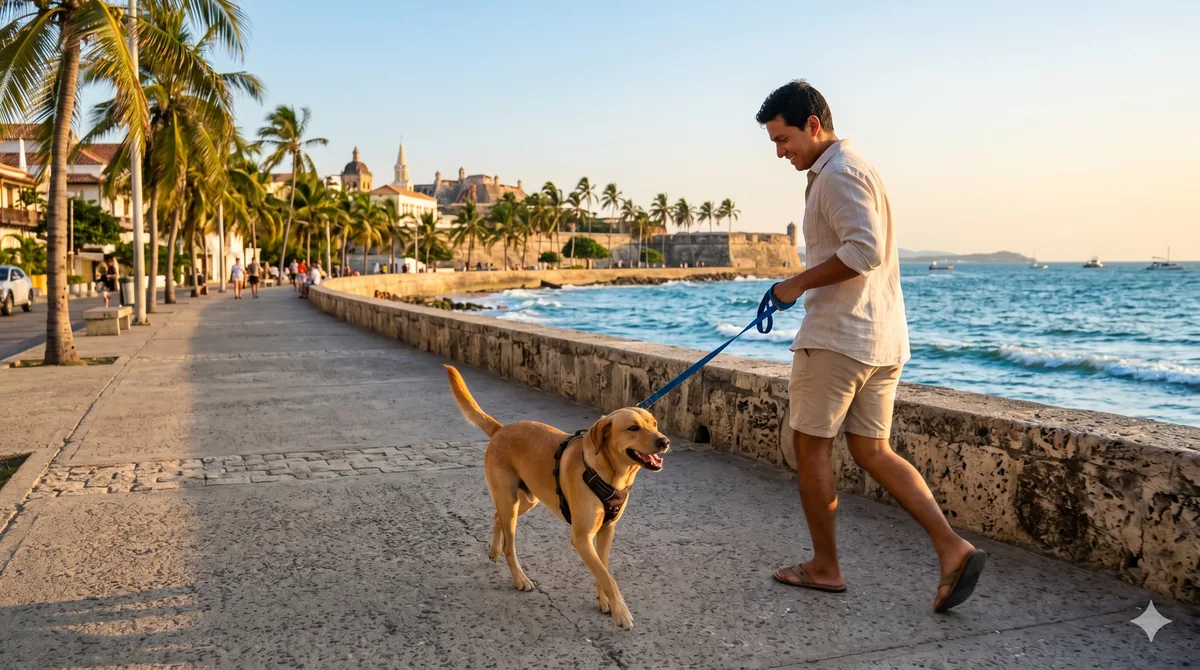
Last updated: May 2026. Cartagena is a pet-friendly city if you respect one thing above all else: the heat. People here treat dogs as family, you will see them on the Bocagrande seawall at dusk, in café doorways in the walled city, and riding the elevators of high-rise towers. But the tropical climate, the high-rise apartment living, and the import paperwork all reward owners who plan ahead. Here is what we have learned about getting a pet into Cartagena, caring for one here, and taking one out again.
This guide covers the part most people get wrong: the climate. Cartagena sits at sea level on the Caribbean coast, hot and humid year round, hotter than Medellín or Bogotá by a wide margin. A thick-coated dog from a cold country is not built for it, and the most common mistakes expat owners make here all trace back to underestimating that. We will get to the heat in detail. First, the paperwork to bring an animal in.
Bringing a pet into Colombia from the US or Canada
The good news: Colombia is one of the easier countries to import a cat or dog into, and the process has gotten smoother in recent years. There is no quarantine for pets arriving from rabies-controlled countries, which includes the United States, Canada, and most of Europe. What you do need is a short stack of documents, assembled in the right order and on the right timeline.
For a cat or dog you will need:
A microchip (ISO standard, 15-digit). Have it implanted before the rabies shot so the vaccination record ties to the chip number.
A current rabies vaccination, given at least 30 days before travel and still valid (under 12 months old, or within the multi-year validity stated on the certificate).
Core vaccines up to date (distemper, parvovirus, hepatitis for dogs; the standard feline panel for cats).
A health certificate from a USDA-accredited (US) or CFIA-accredited (Canada) veterinarian, issued within 10 days of travel.
Government endorsement of that health certificate: USDA APHIS in the US, or CFIA in Canada. This is the step people forget. The vet signs the certificate, then it has to be endorsed by the federal authority, which is increasingly done online but still takes a few business days. Do not leave it to the last week.
An ICA import permit. ICA (Instituto Colombiano Agropecuario) is the agency that clears live animals into Colombia. The permit is free and is usually issued within a couple of business days when you apply in advance through the ICA online portal (ica.gov.co). Apply at least two weeks before travel, and carry a printed copy alongside the endorsed health certificate. Do not rely on showing a phone screen at the inspection; Colombian officials want printed originals.
The ICA application asks for your flight details, the animal's species, breed, age, microchip number, and vaccine dates. Having the endorsed health certificate in hand before you apply makes the form straightforward. If your documents are in English, ICA accepts them as long as the key fields (dates, vaccine names, microchip number) are legible.
Bring printed originals of everything, plus a photocopy set. Colombian officials want paper, not a phone screen. Budget a real chunk of time on arrival for the inspection (more on the Cartagena airport below).
Say this at the ICA inspection window on arrival
Buenos días. Traigo a mi mascota con permiso de importación del ICA. Aquí están el permiso, el certificado de salud con endoso, el carné de vacunación, y el número de microchip.
Good morning. I am bringing my pet with an ICA import permit. Here are the permit, the endorsed health certificate, the vaccination record, and the microchip number.
Airline policies and the flight itself
Colombia itself does not ban any breeds, but airlines do, and their rules are stricter than the country's. Snub-nosed breeds (bulldogs, pugs, Persians, and similar) are often barred from cargo holds, and sometimes from the cabin, because they overheat and struggle to breathe. Larger dogs that exceed the in-cabin weight limit (usually around 8 kg including the carrier) must fly as checked baggage or cargo, which carries real heat risk on a tropical route. Confirm the specific airline's pet policy in writing before you book, and book the pet slot early because most flights cap the number of animals allowed.
A practical note for Cartagena specifically: most foreign pets do not arrive on a direct international flight, because direct international service into Cartagena is limited. Many owners fly into Bogotá and connect, or fly into Bogotá and continue domestically. If you connect domestically, the international ICA clearance generally happens at your first Colombian point of entry, so factor that into your layover time.
Flying into Cartagena with a pet
Cartagena's airport is Rafael Núñez International (airport code CTG), in the Crespo neighborhood, unusually close to the city, about ten minutes from Bocagrande. If your animal arrives here as an international entry, you clear ICA at the airport. Have the import permit, the endorsed health certificate, the vaccination records, and the microchip number all together in one folder. The inspector verifies the chip, checks the paperwork against the permit, and confirms the rabies date.
The process is usually straightforward when the documents are in order, but it is not fast. Plan for one to a few hours, and do not schedule anything tight right after landing. If you are arriving on a hot afternoon (most of them are), keep the animal hydrated and out of direct sun while you wait. The terminal is air-conditioned; the walk from the aircraft and the ramp area is not.
From CTG it is a short ride to Bocagrande, Castillogrande, Manga, or the walled city. Standard taxis and ride apps will usually take a leashed or crated pet, but it is the driver's call. Ask before you load, and have your carrier or crate visible so the driver can see the animal is contained.
Say this before loading your pet into a taxi or ride-app car
Disculpe, ¿le molesta si subo con mi perro? Está en su cargador y no ensucia.
Excuse me, do you mind if I get in with my dog? It is in its carrier and won't make a mess.
Finding a vet and emergency care
Cartagena has solid veterinary care, and it costs a fraction of what you would pay in North America or Europe. A routine consultation runs roughly COP 50.000 to 90.000 (USD $13 to $23 at 4.000 to 1). Vaccinations, dental cleanings, bloodwork, and routine surgeries are all available from clinics with modern equipment, and most expat-area vets are used to foreign owners and a bit of English.
A few practical points instead of specific names, since clinics open and close and the right one depends on where you live:
Pick a clinic close to home. In Cartagena heat, a 40-minute cross-town drive with a sick animal is its own hazard. There are well-regarded clinics in and around Bocagrande, Manga, and the northern Crespo and Marbella corridor. Ask neighbors and your building's portero, they will know which one people actually use.
Sort out emergency care before you need it. Not every clinic runs 24/7. When you choose your day-to-day vet, ask them directly: where do I go at 2am? Save that number and address in your phone now, not during the emergency.
Specialty care is thinner here than in a big inland city. Cardiology, dermatology, and orthopedic surgery exist but are concentrated in a handful of clinics, sometimes by referral. For something complex, owners occasionally travel to Barranquilla or Medellín.
Pet insurance is not really a thing locally. Most expat owners self-insure, setting aside the difference between Cartagena vet costs and back-home costs. Given the price gap, that math usually works out fine.
Say this when registering your pet with a new vet in Cartagena
Hola, soy nuevo en Cartagena y acabo de llegar con mi perro. Quisiera registrarlo como paciente y hacer un chequeo general. También necesito saber qué antiparasitarios recomienda para el clima de aquí, porque venimos de un clima más frío.
Hello, I just arrived in Cartagena with my dog. I would like to register him as a patient and get a general checkup. I also need to know which antiparasitics you recommend for this climate, because we come from a colder one.
A quick first visit when you arrive, before anything goes wrong, serves two purposes. It establishes the animal's record at the clinic and lets the vet flag anything the move or the climate change may have stressed. It also gives you a clear answer on which flea, tick, and heartworm products are available locally and at what dose, since product names and formulations sometimes differ from back home.
Whatever clinic you choose, get your animal on year-round tick, flea, and heartworm prevention immediately. Monthly or quarterly chewables and topicals are sold at every vet and pet store, and on this coast these are not optional. Heartworm and tick-borne disease are present year round.
The heat, the thing that actually matters
If you read one section, read this one. Cartagena's climate is the single biggest factor in keeping a pet healthy and comfortable here, and it is the thing newcomers most consistently underestimate. Heatstroke in dogs is real, fast, and sometimes fatal.
Walk early morning and after sunset, never midday. Between roughly 10am and 4pm the sun is brutal. Shift your walks to dawn and dusk, when the city itself comes alive and the pavement has cooled.
Check the pavement for paw burns. Bocagrande's concrete and the walled city's stone absorb heat all day. Press the back of your hand flat on the ground for five seconds; if you cannot hold it, it will burn your dog's paw pads. Stick to shade and grass, or walk when the ground is cool.
Hydration is constant, not occasional. Carry water on every outing. Many cafés will happily bring a water bowl if you ask.
Never leave a pet in a parked car. Ever. In Cartagena heat a closed car becomes lethal in minutes, even in shade, even with the windows cracked. There is no safe version of this.
Watch the thick-coated breeds. Huskies, shepherds, and other cold-climate dogs struggle most. A summer cut, fans, air conditioning, and shorter outings all help, but be honest with yourself about whether a heavy double-coated dog will thrive at sea level on the Caribbean.
Know the warning signs. Heavy panting, drooling, wobbliness, bright red gums, or collapse mean get the animal cool and to a vet now. Wet them down with cool (not ice-cold) water and move to shade or air conditioning immediately.
Say this if you need emergency vet help urgently in Cartagena
Es una emergencia. Mi perro tiene signos de golpe de calor: jadea mucho, está muy decaído y las encías se ven rojas. Necesito atención urgente ahora.
It is an emergency. My dog has signs of heatstroke: heavy panting, very lethargic, and the gums look red. I need urgent attention right now.
Temperature reality check. Cartagena's average daily high runs 30 to 33°C (86 to 91°F) year-round, with humidity that pushes the feels-like temperature well above that in the middle of the day. Dogs begin to struggle above 25°C, and heatstroke can develop in minutes when a dog is active in direct sun on hot pavement. The rule is not just common sense; it is the single most important thing you can do to keep your animal alive and well here.
Beach and saltwater cautions
The beach is a Cartagena highlight, and dogs love it, but a few cautions. Do not let a dog drink seawater; the salt causes vomiting and dehydration, which is the last thing you want in this heat. Rinse the salt and sand off afterward to avoid skin irritation. Hot sand burns paws as badly as hot pavement, so the same early/late timing applies. Keep dogs out of seaweed piles and away from anything that has washed up, jellyfish and marine stingers turn up on these beaches. And remember that many of the city's marquee beaches are crowded, vendor-heavy, and not always dog-welcoming; the quieter stretches north toward La Boquilla and Manzanillo are usually easier with an animal.
High-rise apartment living and your pet
Much of expat Cartagena lives in towers, Bocagrande, Castillogrande, El Laguito, and increasingly the northern strip. High-rise life suits some pets and frustrates others, and it is worth thinking about honestly before you commit.
What works against you: there is little to no grass at street level in Bocagrande, so dogs often have to learn to relieve themselves on tile, a balcony pad, or artificial turf. Every walk means an elevator ride and a lobby crossing, which adds friction to the four-or-more daily trips a dog needs. High floors plus heat means a long way to the nearest patch of shade. What works for you: towers are air-conditioned, secure, and many have nearby seawall or boardwalk walks. A small, low-energy, heat-tolerant dog or an indoor cat can be perfectly happy in a Bocagrande apartment. A large, high-energy, cold-climate breed will find it harder, and you will both feel it.
Manga and the lower-rise residential pockets, with more ground-floor access and the occasional garden, are gentler for dog owners than the tightly packed Bocagrande high-rises. Match the animal to the building.
Finding a pet-friendly rental
Most modern Cartagena buildings allow pets, but almost all of them have rules, and the rules are enforced by the building administration, not the landlord. Common ones: size or weight limits (often around 20 kg), restrictions on so-called "potentially dangerous breeds," a requirement that pets ride the service elevator, and a leash-in-common-areas rule. Some older or stricter buildings ban pets outright.
The single most important step: get the pet policy in writing in the lease before you sign. A landlord's friendly "claro, no hay problema" means nothing when the building administration changes or a new council enforces a dormant rule. Ask to see the building's reglamento (the propiedad horizontal regulations) and confirm the pet clause in your contract. This is exactly the kind of detail our Cartagena housing and renting guide covers in more depth, read it alongside this one if you are still apartment hunting.
One more cost note: some buildings or landlords ask for an additional pet deposit. It is negotiable and not universal, but budget for the possibility.
Pet services: grooming, daycare, and food
Day-to-day pet supplies are easy to find in Cartagena. Here is the lay of the land by category:
Food. Premium kibble brands sold widely in Colombia (Royal Canin, Hill's Science Diet, Purina Pro Plan, Eukanuba) are stocked at large supermarkets, agro and farm-supply stores, and dedicated pet shops in the expat neighborhoods. Grain-free, fresh, and raw diets are rarer and pricier; if your animal is on a specialized diet, confirm availability before you move or plan to import it. A large bag of premium kibble runs roughly COP 120.000 to 280.000 (USD $30 to $70 at 4.000 to 1) depending on brand and size.
Grooming. Plentiful and affordable. A full wash-and-cut for a medium dog runs roughly COP 50.000 to 110.000 (USD $13 to $28 at 4.000 to 1). In this climate a regular groom is not vanity; keeping a heavy coat trimmed genuinely helps a dog cope with the heat. Many groomers offer pickup and drop-off.
Daycare and boarding. Guarderías (daycare) and boarding kennels operate in and around the city, useful when you travel or work long days. Quality varies, so visit in person, check that the space is air-conditioned or genuinely shaded, and ask how they handle the midday heat. Boarding runs roughly COP 40.000 to 90.000 per night (USD $10 to $23 at 4.000 to 1), more for full-service places.
Preventatives and accessories. Tick and flea collars, chewables, beds, carriers, and toys are all easy to buy locally and generally cheaper than in North America. Stock up on the heartworm and tick prevention here rather than carrying it in.
Taking your pet out of Colombia later
When the time comes to leave, or to take your pet on an international trip, the direction reverses but the logic is the same. You will need an export health certificate, and for an animal leaving Colombia that means a vet exam and an ICA export inspection. For Cartagena residents, the ICA office for export certification is at the Rafael Núñez airport (CTG); call ahead to confirm their current hours and the exact documents your destination country requires before you make the trip with your animal. The standard sequence: a recent vet checkup confirming the animal is healthy and vaccinations are current, then an ICA export certificate issued shortly before travel (typically within about 10 days of departure), then whatever the destination country requires on its end.
That destination side is where it gets country-specific. Returning to the US is relatively simple, with current rabies documentation. Canada is similar. The UK, the EU, and rabies-free islands have stricter import rules (titer blood tests, longer lead times, sometimes quarantine) that you have to start months in advance. The rule of thumb: figure out the destination country's import requirements first, because they drive the timeline, then work backward to schedule the Colombian-side ICA export certificate so it lands inside the destination's validity window. Keep every original document; you will hand them over on arrival.
The bottom line
Cartagena is a good city for a pet if you set up for the heat and stay on top of the logistics. The import process is genuinely manageable as long as you start the endorsement and ICA permit early. Vet care is strong and cheap. The seawall at dusk is a wonderful daily walk. The failure modes are predictable: underestimating the tropical climate, skipping year-round tick and heartworm prevention, putting a heavy cold-climate dog in a hot high-rise, and signing a lease before reading the building's pet rules. Handle those four and your animal will likely settle in faster than you do.
Further reading
Related guides for moving to Cartagena with a pet:
Catalina is our concierge. Ask her about visas, neighborhoods, healthcare, prices, anything Cartagena. She answers in chat or WhatsApp, English or Spanish, free.Catalina es nuestra concierge. Pregúntale sobre visas, barrios, salud, precios, cualquier cosa de Cartagena. Responde por chat o WhatsApp, en inglés o español, gratis.
Specific question while you read? Ask Catalina, the Cartagena Guide concierge.¿Pregunta específica mientras lees? Pregúntale a Catalina, la concierge de Cartagena Guide.Chat with Catalina ›Habla con Catalina ›
Última actualización: mayo de 2026. Cartagena es una ciudad amigable con las mascotas si respetas una cosa por encima de todo: el calor. La gente aquí trata a los perros como familia, los verás en el malecón de Bocagrande al atardecer, en las puertas de cafés en la ciudad amurallada, y subiendo en los ascensores de las torres. Pero el clima tropical, la vida en apartamentos de altura, y los trámites de importación todos recompensarán a los dueños que planifiquen con tiempo. Aquí está lo que hemos aprendido sobre cómo llevar una mascota a Cartagena, cuidarla acá, y sacarla de nuevo.
Esta guía cubre la parte que la mayoría de la gente falla: el clima. Cartagena está a nivel del mar en la costa caribeña, caliente y húmeda todo el año, más caliente que Medellín o Bogotá por un amplio margen. Un perro con pelaje grueso de un país frío no está hecho para esto, y los errores más comunes que cometen los dueños expatriados acá se deben todos a subestimar eso. Llegaremos al calor en detalle. Primero, los trámites para traer un animal.
Traer una mascota a Colombia desde Estados Unidos o Canadá
La buena noticia: Colombia es uno de los países más fáciles para importar un gato o perro, y el proceso se ha suavizado en años recientes. No hay cuarentena para mascotas que llegan de países con control de rabia, lo que incluye Estados Unidos, Canadá, y la mayoría de Europa. Lo que sí necesitas es un pequeño conjunto de documentos, armados en el orden correcto y en el cronograma correcto.
Para un gato o perro necesitarás:
Un microchip (estándar ISO, de 15 dígitos). Implántalo antes de la vacuna de rabia para que el registro de vacunación se ate al número del chip.
Una vacuna contra la rabia vigente, aplicada al menos 30 días antes del viaje y aún válida (menor a 12 meses de antigüedad, o dentro de la validez multianual indicada en el certificado).
Las vacunas básicas al día (moquillo, parvovirus, hepatitis para perros; el panel felino estándar para gatos).
Un certificado de salud de un veterinario acreditado por USDA (EE.UU.) o CFIA (Canadá), emitido dentro de 10 días del viaje.
Respaldo gubernamental de ese certificado de salud: USDA APHIS en EE.UU., o CFIA en Canadá. Este es el paso que la gente olvida. El veterinario firma el certificado, luego tiene que ser respaldado por la autoridad federal, lo que cada vez más se hace en línea pero aún toma algunos días hábiles. No lo dejes para la última semana.
Un permiso de importación del ICA. ICA (Instituto Colombiano Agropecuario) es la agencia que autoriza animales vivos en Colombia. El permiso es gratis y normalmente se emite en un par de días hábiles cuando solicitas con anticipación a través del portal en línea del ICA (ica.gov.co). Solicita al menos dos semanas antes del viaje, y lleva una copia impresa junto con el certificado de salud respaldado. No confíes en mostrar una pantalla de teléfono en la inspección; los funcionarios colombianos quieren originales impresos.
La solicitud del ICA te pide detalles del vuelo, la especie del animal, raza, edad, número de microchip, y fechas de vacunas. Tener el certificado de salud respaldado a mano antes de solicitar hace el formulario directo. Si tus documentos están en inglés, el ICA los acepta siempre que los campos clave (fechas, nombres de vacunas, número de microchip) sean legibles.
Trae originales impresos de todo, más un juego de fotocopias. Los funcionarios colombianos quieren papel, no una pantalla de teléfono. Presupuesta un tiempo real en la llegada para la inspección (más sobre el aeropuerto de Cartagena abajo).
Di esto en la ventanilla de inspección del ICA a la llegada
Buenos días. Traigo a mi mascota con permiso de importación del ICA. Aquí están el permiso, el certificado de salud con endoso, el carné de vacunación, y el número de microchip.
Good morning. I am bringing my pet with an ICA import permit. Here are the permit, the endorsed health certificate, the vaccination record, and the microchip number.
Políticas de aerolíneas y el vuelo mismo
Colombia mismo no prohíbe ninguna raza, pero las aerolíneas sí, y sus reglas son más estrictas que las del país. Las razas de hocico chato (bulldogs, pugs, gatos Persas, y similares) a menudo están prohibidas en la bodega de carga, y a veces en la cabina, porque se sobrecalientan y luchan por respirar. Los perros más grandes que superan el límite de peso en cabina (usualmente alrededor de 8 kg incluyendo el transportín) deben viajar como equipaje facturado o carga, lo que trae riesgo real de calor en una ruta tropical. Confirma la política específica de mascotas de la aerolínea por escrito antes de reservar, y reserva el espacio para mascota temprano porque la mayoría de vuelos limitan el número de animales permitidos.
Una nota práctica para Cartagena específicamente: la mayoría de mascotas extranjeras no llegan en un vuelo internacional directo, porque el servicio internacional directo a Cartagena es limitado. Muchos dueños vuelan a Bogotá y conectan, o vuelan a Bogotá y continúan domésticamente. Si conectas domésticamente, el desaduanamiento internacional del ICA generalmente sucede en tu primer punto de entrada colombiano, así que considera eso en tu tiempo de conexión.
Volar a Cartagena con una mascota
El aeropuerto de Cartagena es Rafael Núñez International (código CTG), en el barrio Crespo, inusualmente cerca de la ciudad, como a diez minutos de Bocagrande. Si tu animal llega acá como entrada internacional, desadúanas el ICA en el aeropuerto. Ten el permiso de importación, el certificado de salud respaldado, los registros de vacunación, y el número de microchip todos juntos en una carpeta. El inspector verifica el chip, chequea el papeleo contra el permiso, y confirma la fecha de rabia.
El proceso es usualmente directo cuando los documentos están en orden, pero no es rápido. Planifica de una a pocas horas, y no programes nada apretado justo después del desembarque. Si llegas en una tarde caliente (la mayoría lo son), mantén el animal hidratado y fuera de la luz solar directa mientras esperas. La terminal está aire acondicionada; la caminata desde el avión y la rampa no lo está.
Desde CTG es un corto viaje a Bocagrande, Castillogrande, Manga, o la ciudad amurallada. Los taxis estándar y las apps de viajes normalmente llevarán una mascota con correa o en jaula, pero es decisión del conductor. Pregunta antes de subir, y ten tu transportín visible para que el conductor vea que el animal está contenido.
Di esto antes de subir tu mascota a un taxi o auto de app
Disculpe, ¿le molesta si subo con mi perro? Está en su cargador y no ensucia.
Excuse me, do you mind if I get in with my dog? It is in its carrier and won't make a mess.
Encontrar un veterinario y cuidado de emergencia
Cartagena tiene cuidado veterinario sólido, y cuesta una fracción de lo que pagarías en Norteamérica o Europa. Una consulta rutinaria corre aproximadamente COP 50.000 a 90.000 (USD $13 a $23 a tasa 4.000 a 1). Vacunas, limpiezas dentales, análisis de sangre, y cirugías rutinarias están todas disponibles en clínicas con equipo moderno, y la mayoría de veterinarios en zonas de expatriados están acostumbrados a dueños extranjeros y algo de inglés.
Algunos puntos prácticos en lugar de nombres específicos, ya que las clínicas abren y cierran y la correcta depende de dónde vivas:
Elige una clínica cerca de casa. En el calor de Cartagena, un viaje de 40 minutos cruzando la ciudad con un animal enfermo es su propio peligro. Hay clínicas bien consideradas en y alrededor de Bocagrande, Manga, y el corredor norte de Crespo y Marbella. Pregunta a vecinos y al portero de tu edificio, ellos sabrán cuál es la que la gente realmente usa.
Ordena el cuidado de emergencia antes de necesitarlo. No todas las clínicas funcionan 24/7. Cuando elijas tu veterinario de día a día, pregúntales directamente: ¿a dónde voy a las 2am? Guarda ese número y dirección en tu teléfono ahora, no durante la emergencia.
El cuidado de especialidad es más delgado aquí que en una ciudad grande del interior. Cardiología, dermatología, y cirugía ortopédica existen pero están concentradas en un puñado de clínicas, a veces por referencia. Para algo complejo, los dueños ocasionalmente viajan a Barranquilla o Medellín.
El seguro de mascotas no es realmente una cosa localmente. La mayoría de dueños expatriados se autoseguran, apartando la diferencia entre costos veterinarios de Cartagena y costos de casa. Dada la brecha de precio, esa matemática normalmente funciona bien.
Di esto al registrar tu mascota con un nuevo veterinario en Cartagena
Hola, soy nuevo en Cartagena y acabo de llegar con mi perro. Quisiera registrarlo como paciente y hacer un chequeo general. También necesito saber qué antiparasitarios recomienda para el clima de aquí, porque venimos de un clima más frío.
Hello, I just arrived in Cartagena with my dog. I would like to register him as a patient and get a general checkup. I also need to know which antiparasitics you recommend for this climate, because we come from a colder one.
Una primera visita rápida cuando llegas, antes de que algo salga mal, sirve dos propósitos. Establece el registro del animal en la clínica y le permite al veterinario señalar cualquier cosa que el movimiento o el cambio climático haya estresado. También te da una respuesta clara sobre cuales productos contra pulgas, garrapatas, y filaria están disponibles localmente y a qué dosis, ya que los nombres de productos y formulaciones a veces difieren de casa.
Sea cual sea la clínica que elijas, pon tu animal en prevención año redondo de garrapatas, pulgas, y filaria inmediatamente. Las masticables mensuales o trimestrales y los tópicos se venden en todos los veterinarios y tiendas de mascotas, y en esta costa no son opcionales. La filaria y la enfermedad transmitida por garrapatas están presentes todo el año.
El calor, lo que realmente importa
Si lees una sección, lee esta. El clima de Cartagena es el factor singular más importante para mantener una mascota saludable y cómoda acá, y es lo que los recién llegados más consistentemente subestiman. Golpe de calor en perros es real, rápido, y a veces fatal.
Camina al amanecer y después del atardecer, nunca al mediodía. Entre aproximadamente las 10am y las 4pm el sol es brutal. Cambia tus caminatas a alborada y atardecer, cuando la ciudad misma cobra vida y el pavimento se ha enfriado.
Chequea el pavimento para quemaduras en las patas. El concreto de Bocagrande y la piedra de la ciudad amurallada absorben calor todo el día. Presiona la parte trasera de tu mano plana en el suelo durante cinco segundos; si no puedes mantenerla, quemará las almohadillas de las patas de tu perro. Quédate a la sombra y pasto, o camina cuando el suelo está frío.
La hidratación es constante, no ocasional. Lleva agua en cada salida. Muchos cafés felizmente traerán un cuenco de agua si pides.
Nunca dejes una mascota en un auto estacionado. Nunca. En el calor de Cartagena un auto cerrado se vuelve letal en minutos, incluso a la sombra, incluso con las ventanas abiertas. No hay versión segura de esto.
Observa las razas de pelaje grueso. Los huskies, pastores, y otros perros de clima frío luchan más. Un corte de verano, ventiladores, aire acondicionado, y salidas más cortas ayudan, pero sé honesto contigo mismo sobre si un perro de doble pelaje grueso prosperará a nivel del mar en el Caribe.
Conoce los signos de alerta. Jadeo pesado, babeo, tambaleo, encías rojo brillante, o colapso significan refrescar el animal y llevarlo a un veterinario ahora. Mójalo con agua fresca (no hielo) y muévelo a sombra o aire acondicionado inmediatamente.
Di esto si necesitas ayuda veterinaria de emergencia urgentemente en Cartagena
Es una emergencia. Mi perro tiene signos de golpe de calor: jadea mucho, está muy decaído y las encías se ven rojas. Necesito atención urgente ahora.
It is an emergency. My dog has signs of heatstroke: heavy panting, very lethargic, and the gums look red. I need urgent attention right now.
Control de realidad de temperatura. El máximo diario promedio de Cartagena corre 30 a 33°C (86 a 91°F) todo el año, con humedad que empuja la temperatura aparente bien por encima de eso en el medio del día. Los perros comienzan a luchar por encima de 25°C, y el golpe de calor puede desarrollarse en minutos cuando un perro está activo bajo el sol directo en pavimento caliente. La regla no es solo sentido común; es lo más importante que puedes hacer para mantener tu animal vivo y bien acá.
Precauciones de playa y agua salada
La playa es un punto culminante de Cartagena, y a los perros les encanta, pero algunas precauciones. No dejes que un perro beba agua de mar; la sal causa vómito y deshidratación, que es lo último que quieres en este calor. Enjuaga la sal y arena después para evitar irritación de la piel. Arena caliente quema las patas tan mal como el pavimento caliente, así que el mismo cronograma temprano/tarde se aplica. Mantén los perros fuera de montones de algas y lejos de cualquier cosa que haya llegado a la orilla, medusas y aguavivas marinas aparecen en estas playas. Y recuerda que muchas de las playas emblemáticas de la ciudad son concurridas, llenas de vendedores, y no siempre acogedoras para perros; los tramos más tranquilos hacia el norte hacia La Boquilla y Manzanillo usualmente son más fáciles con un animal.
Vida en apartamento de altura y tu mascota
Mucho de Cartagena expatriada vive en torres, Bocagrande, Castillogrande, El Laguito, e incrementalmente la franja norte. La vida en altura conviene a algunas mascotas y frustra a otras, y vale la pena pensar en ello honestamente antes de comprometerte.
Lo que funciona en tu contra: hay poco a ningún pasto a nivel de calle en Bocagrande, así que los perros frecuentemente tienen que aprender a relevarse en baldosa, una almohadilla de balcón, o pasto artificial. Cada caminata significa un viaje en ascensor y un cruce de lobby, lo que añade fricción a los cuatro o más viajes diarios que un perro necesita. Pisos altos más calor significa un camino largo hasta el parche de sombra más cercano. Lo que funciona para ti: las torres están aire acondicionadas, seguras, y muchas tienen caminatas de malecón o paseo cercanas. Un perro pequeño, de baja energía, tolerante al calor o un gato de interior puede ser perfectamente feliz en un apartamento de Bocagrande. Un perro grande, de alta energía, de clima frío encontrará más difícil, y ambos lo sentirán.
Manga y los bolsillos residenciales de menor altura, con más acceso a nivel de suelo y ocasional jardín, son más gentiles para dueños de perros que los rascacielos apretados de Bocagrande. Empareja el animal con el edificio.
Encontrar un alquiler amigable con mascotas
La mayoría de edificios modernos de Cartagena permiten mascotas, pero casi todos tienen reglas, y las reglas se aplican por la administración del edificio, no el dueño. Las comunes: límites de tamaño o peso (frecuentemente alrededor de 20 kg), restricciones en las llamadas "razas potencialmente peligrosas," un requisito de que las mascotas usen el ascensor de servicio, y una regla de llevar correa en áreas comunes. Algunos edificios más antiguos o estrictos prohíben mascotas completamente.
El paso más importante: obtén la política de mascotas por escrito en el arrendamiento antes de firmar. Un "claro, no hay problema" amigable del dueño no significa nada cuando la administración del edificio cambia o un nuevo consejo aplica una regla latente. Pide ver el reglamento del edificio (las regulaciones de propiedad horizontal) y confirma la cláusula de mascotas en tu contrato. Este es exactamente el tipo de detalle que nuestra guía de vivienda y alquiler en Cartagena cubre en más profundidad, léela junto con esta si aún estás buscando apartamento.
Una nota de costo más: algunos edificios o dueños piden un depósito adicional de mascotas. Es negociable y no universal, pero presupuesta la posibilidad.
Servicios de mascotas: peluquería, guardería, y comida
Los suministros diarios de mascotas son fáciles de encontrar en Cartagena. Aquí está el panorama por categoría:
Comida. Marcas de croquetas premium vendidas ampliamente en Colombia (Royal Canin, Hill's Science Diet, Purina Pro Plan, Eukanuba) están en stock en supermercados grandes, tiendas de agro y suministros de granja, y tiendas de mascotas dedicadas en los barrios de expatriados. Dietas sin granos, frescas, y crudas son más raras y costosas; si tu animal está en una dieta especializada, confirma disponibilidad antes de mudarte o planifica importarla. Una bolsa grande de croquetas premium corre aproximadamente COP 120.000 a 280.000 (USD $30 a $70 a tasa 4.000 a 1) dependiendo de marca y tamaño.
Peluquería. Abundante y asequible. Un baño completo y corte para un perro mediano corre aproximadamente COP 50.000 a 110.000 (USD $13 a $28 a tasa 4.000 a 1). En este clima una peluquería regular no es vanidad; mantener un pelaje grueso recortado genuinamente ayuda a un perro enfrentar el calor. Muchos peluqueros ofrecen recogida y entrega.
Guardería y cuidado de animales. Guarderías (guardería diurna) y kennels de cuidado operan dentro y alrededor de la ciudad, útil cuando viajas o trabajas días largos. La calidad varía, así que visita en persona, verifica que el espacio esté aire acondicionado o genuinamente sombreado, y pregunta cómo manejan el calor del mediodía. El cuidado corre aproximadamente COP 40.000 a 90.000 por noche (USD $10 a $23 a tasa 4.000 a 1), más para lugares de servicio completo.
Preventivos y accesorios. Collares contra pulgas y garrapatas, masticables, camas, transportines, y juguetes son todos fáciles de comprar localmente y generalmente más baratos que en Norteamérica. Compra la prevención de filaria y garrapatas acá en lugar de llevarla.
Sacar tu mascota de Colombia después
Cuando llegue el momento de partir, o de llevar tu mascota en un viaje internacional, la dirección se revierte pero la lógica es igual. Necesitarás un certificado de salud de exportación, y para un animal que sale de Colombia eso significa un examen veterinario y una inspección de exportación del ICA. Para residentes de Cartagena, la oficina del ICA para certificación de exportación está en el aeropuerto Rafael Núñez (CTG); llama con anticipación para confirmar su horario actual y los documentos exactos que tu país de destino requiere antes de hacer el viaje con tu animal. La secuencia estándar: un chequeo veterinario reciente confirmando que el animal está saludable y las vacunaciones están al día, luego un certificado de exportación del ICA emitido poco antes del viaje (típicamente dentro de aproximadamente 10 días de la salida), luego lo que el país de destino requiera de su lado.
Ese lado de destino es donde se pone país-específico. Volver a EE.UU. es relativamente simple, con documentación actual de rabia. Canadá es similar. El Reino Unido, la UE, e islas libres de rabia tienen reglas de importación más estrictas (pruebas de títulos de sangre, plazos más largos, a veces cuarentena) que tienes que empezar meses con anticipación. La regla general: descubre los requisitos de importación del país de destino primero, porque conducen el cronograma, luego trabaja hacia atrás para programar el certificado de exportación del ICA colombiano para que caiga dentro de la ventana de validez del destino. Guarda cada documento original; los entregarás a la llegada.
La conclusión
Cartagena es una buena ciudad para una mascota si te preparas para el calor y mantienes al día la logística. El proceso de importación es genuinamente manejable siempre que inicies el respaldo y permiso del ICA temprano. El cuidado veterinario es sólido y barato. El malecón al atardecer es una caminata diaria maravillosa. Los modos de fallo son predecibles: subestimar el clima tropical, saltarse la prevención año redondo de garrapatas y filaria, poner un perro de clima frío grueso en una torre caliente de altura, y firmar un arrendamiento antes de leer las reglas de mascotas del edificio. Maneja esos cuatro y tu animal probablemente se adaptará más rápido que tú.
Lectura adicional
Guías relacionadas para mudarse a Cartagena con una mascota:
Catalina is our concierge. Ask her about visas, neighborhoods, healthcare, prices, anything Cartagena. She answers in chat or WhatsApp, English or Spanish, free.Catalina es nuestra concierge. Pregúntale sobre visas, barrios, salud, precios, cualquier cosa de Cartagena. Responde por chat o WhatsApp, en inglés o español, gratis.