Last updated: May 2026. Moving a household from the US or Canada to Cartagena is mostly a logistics problem with one big local advantage baked in. Cartagena is Colombia's main Caribbean container port, so sea-freighted goods arrive here directly. There is no inland trucking leg, no second port handoff, no extra round of fees that people moving to Medellín or Bogotá pay. This guide covers whether to ship at all, how the methods compare, the duty-free menaje doméstico regime, the customs broker's role, insurance, what not to ship, and realistic costs.
Should you ship, or rebuy locally
Before you price a single container, answer the honest question: is it cheaper to ship your stuff or to sell it at home and rebuild in Cartagena? For a lot of people the answer is rebuild, and that is not a defeat.
The case for shipping:
- You own genuinely good furniture, art, instruments, or tools that would cost far more to replace than to move.
- You have a full house, where a 40-foot container amortizes better than buying everything new.
- You qualify for the menaje doméstico duty-free regime (covered below), which removes the import-tax penalty.
- You attach real value to your own things and don't want to start from scratch.
The case against shipping:
- You have a studio or a one-bedroom of mostly IKEA-grade furniture. The freight will cost more than the stuff is worth.
- Your big appliances are bulky and replaceable. Colombian retailers sell perfectly good fridges, washers, and stoves, often on installment plans.
- You don't qualify for menaje, in which case standard duties plus 19% IVA make whole-household shipping financially pointless.
One technical point that surprises people, and works in your favor: Colombia uses 110V/60Hz, the same as the US and Canada. Most North American small appliances and electronics run here without a converter, and outlet shapes accept US two-prong and three-prong plugs. The exceptions are 220V-only items (some electric dryers and ranges) and anything that depends on US-only services or region locks (cable boxes, certain smart TVs, some game consoles). Check the nameplate before you decide a heavy appliance is worth the container space.
The Cartagena port advantage
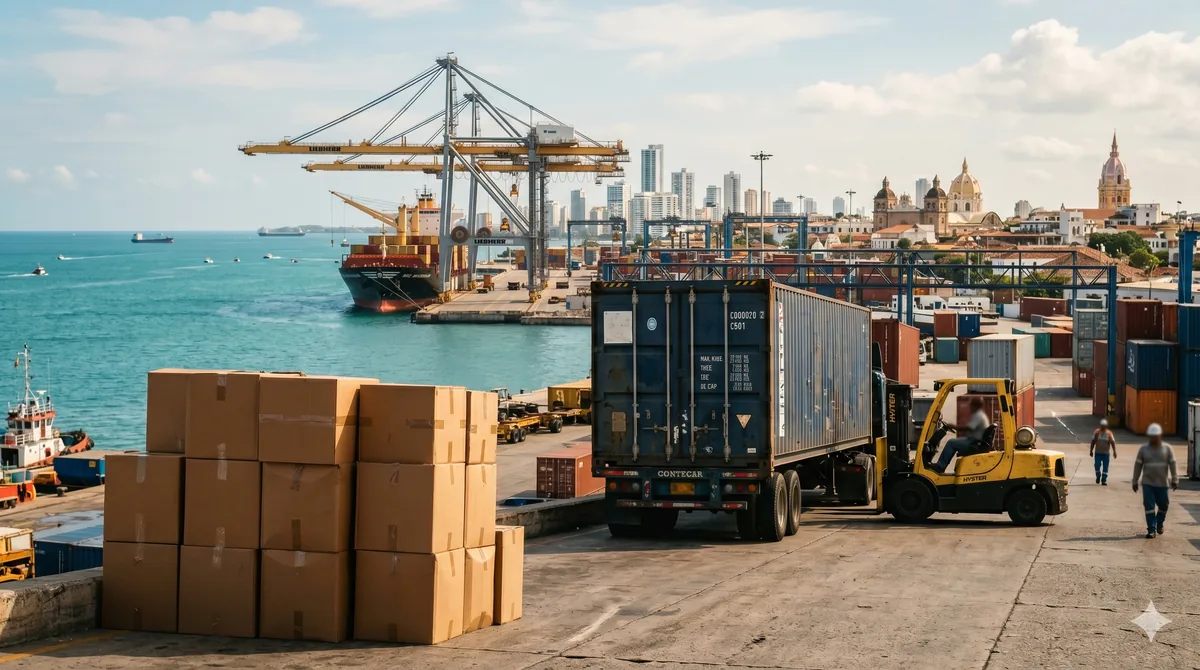
This is the part worth understanding before you read anything generic about shipping to Colombia. Cartagena is the country's principal container port on the Caribbean coast. When your household goods cross the water by sea, they come off the ship here, at the destination, not at a port hundreds of kilometers away.
Compare that with an inland move. Someone relocating to Medellín or Bogotá ships to a coastal port too (often Cartagena), then pays for the goods to be trucked inland over the mountains, plus a second round of handling, plus the time. If you are landing in Cartagena, you skip that entire leg. Your container clears customs at the port that is also your city, and the last-mile delivery is a short truck run across town instead of a multi-day haul.
In practical terms that means two things in your favor versus an inland destination:
- Lower cost. No inland trucking line item, no duplicated port and handling fees. On a full container that difference can be meaningful.
- Less time and less risk. Fewer handoffs means fewer chances for damage, delay, and lost paperwork. Your goods change hands fewer times between the ship and your door.
It also means you want a customs broker who clears at the Cartagena port directly, not one who routes your declaration through Bogotá. Clearing where your goods land is the whole point of the advantage. Ask any forwarder explicitly whether the customs clearance happens at the Cartagena port of arrival.
¿La declaración de importación y el desaduanamiento se realizan directamente en el puerto de Cartagena? ¿Su agente de destino opera localmente aquí, o lo manejan desde Bogotá?
Will the import declaration and customs clearance be handled directly at the port of Cartagena? Does your destination agent operate locally here, or do you manage it from Bogotá?
Shipping methods compared
Most relocations use a combination: sea freight for the bulk of the household, air freight for anything you need in the first month, and a courier for documents and small valuables. Here is how the methods stack up. Freight is usually quoted in USD, so those figures stay in USD with the conversion rate noted; Colombian-side costs are quoted in COP first.
Sea freight: LCL vs FCL into the Cartagena port
Sea freight is the workhorse for whole-home moves, and because it lands directly at the Cartagena port it is where the local advantage shows up most.
- FCL (Full Container Load). You pay for exclusive use of a 20-foot or 40-foot container. A 20-foot box holds roughly 28 to 30 cubic meters (a 2-bedroom apartment); a 40-foot box holds about 58 to 60 cubic meters (a 3- to 4-bedroom house with garage items). FCL is the most cost-efficient per cubic meter and the fastest at the port because nothing has to be unstuffed and re-sorted. Typical transit is around 18 to 35 days. Indicative cost for a 20-foot container runs USD $4,500 to $9,000 (at ~4,000 COP per USD) all-in, door-to-door.
- LCL (Less than Container Load). You share a container with other shippers and pay only for your share of the volume. Best for a studio, a one-bedroom, or a partial move. The trade-off is time: your goods wait for the container to fill (consolidation) and then get separated on arrival (deconsolidation), so transit runs longer, roughly 25 to 45 days. Indicative cost is USD $1,500 to $4,500 (at ~4,000 COP per USD). If you are between sizes, a reputable LCL consolidator is usually cheaper than half-filling a 20-foot box.
You will also see two pricing models. Port-to-port gets your container to the Cartagena port and leaves customs clearance, terminal handling charges, and onward trucking to you. Door-to-door covers pickup in North America, ocean transit, Colombian customs clearance, and delivery to your address. The door-to-door headline price is higher but the port-to-port one hides charges that surface after your goods are already at sea, when you have no leverage. Always demand an itemized breakdown either way.
Air freight via Rafael Núñez (CTG)
For smaller or urgent loads, air freight is the answer. Cartagena's Rafael Núñez International Airport (CTG) handles air cargo, so urgent personal effects can land in the city in 3 to 7 days rather than weeks. Air freight is priced on chargeable weight, the higher of actual weight or dimensional weight (length x width x height in cm divided by 6,000). A 30 kg box of pillows costs far more than 30 kg of books. The rule: send dense, valuable, urgent items by air; send bulky, light, non-urgent items by sea. Indicative air freight is USD $6 to $15 per kg (at ~4,000 COP per USD), with minimums.
One caveat to confirm in writing: some carriers route Cartagena-bound cargo through Bogotá and truck it down, which adds days and inland handling fees and quietly erases the direct-arrival advantage. Ask whether the cargo arrives at CTG directly.
Couriers for small shipments
For 1 to 5 boxes under roughly 50 kg total, an international courier is almost always the simplest choice. They bundle pickup, export, customs brokerage, duty prepayment, and last-mile delivery into one door-to-door rate. Indicative cost is USD $250 to $800 (at ~4,000 COP per USD) for a few 20 kg boxes. Watch the de minimis threshold (historically around USD $200 in declared value, but it changes, confirm at time of shipping); above it, standard duties and 19% IVA apply. Never under-declare to dodge duty; couriers increasingly flag suspiciously low values, and it is illegal.
The menaje doméstico customs regime
This is the single most important concept in the whole guide, and the one new arrivals most often get wrong. Colombian law lets qualifying residents import their used household goods and personal effects under a special customs regime called menaje doméstico (household goods), which can substantially reduce or eliminate the import duties on those goods. Get this right and shipping becomes worthwhile. Get it wrong and you pay full commercial import tax.
Who qualifies
The exemption is generally available to:
- Foreign nationals moving to Colombia with a valid resident visa (Migrante or Residente category, for example an M-visa or R-visa).
- Colombians returning to live in Colombia after at least two continuous years abroad.
- Diplomats and certain categories of workers under specific visas (a separate regime).
Tourist-visa holders and short-term visitors generally do not qualify. If you are entering on a visitor's permit, your household goods are treated as standard commercial imports and taxed accordingly, which usually makes shipping a whole household pointless. Sort your visa first; the menaje exemption is tied to your visa status. For the bigger picture on settling in, see relocating to Cartagena.
Timing and the arrival window
Menaje paperwork is tied to the date you establish residency in Colombia. The goods typically have to arrive within a narrow window (commonly a few months before or after your arrival, depending on the regime and visa type). Engage a customs broker and have the arrival notice filed before the container leaves North America. Waiting until the ship docks at the Cartagena port is how people end up with storage fees and a rejected exemption. The good news, again, is that because clearance happens at the port of arrival here, you are not also racing an inland-transit clock on top of the menaje window.
What counts, and what does not
The exemption covers used household items in quantities consistent with one family's personal use. Typical allowed items: furniture, mattresses, rugs, kitchenware, dishes and cutlery, used clothing and linens, books, artwork, hobby and sports equipment, one of each major appliance (one fridge, one washer, one dryer), personal electronics in reasonable quantities, and personal-use tools.
Excluded from the exemption:
- New items still in original packaging or with tags, treated as commercial imports.
- Duplicate appliances (two fridges, three TVs).
- Quantities inconsistent with personal use (10 laptops, 50 pairs of shoes in boxes).
- Vehicles, motorcycles, and boats (a separate regime, and used-vehicle imports are heavily restricted in Colombia).
- Commercial inventory or anything clearly for resale.
- Firearms and ammunition, alcohol and tobacco above personal allowance.
Buenos días. Soy extranjero con visa de migrante y me estoy radicando en Cartagena. Quiero importar mis enseres domésticos bajo el régimen de menaje doméstico. ¿Pueden manejar el trámite directamente en el puerto de Cartagena? ¿Cuáles documentos necesito y en qué tiempo debo tramitarlo?
Good morning. I am a foreigner with a migrant visa settling in Cartagena. I want to import my household goods under the menaje doméstico regime. Can you handle the process directly at the Cartagena port? What documents do I need and what is the timeline?
The inventory list (lista de empaque)
Your itemized packing list is the core document of the menaje process. A clean list is the single biggest factor in a smooth clearance at the port. It must:
- List every box by number.
- Describe the contents of each box in real detail, not just "miscellaneous".
- State an approximate value per box or major item in USD.
- Indicate condition (used) and rough age where relevant.
- Be in Spanish or bilingual. Your customs broker usually prepares the Spanish version from your English list, but start with an accurate English one.
- Match what is actually inside the boxes. Customs inspectors do spot-checks, and mismatches trigger a full inspection.
Photograph the serial numbers of electronics, appliances, and power tools before packing. Customs occasionally asks for them to confirm an item is used rather than newly bought, and it is far easier than digging through boxes at the port.
Mover vs forwarder vs DIY
Who you hire matters more than which shipping method you pick. There are three broad models, described here as categories rather than specific companies, because the right one depends on your situation and you should always get three itemized quotes.
- Full-service international mover. They pack your home, load the container, handle export, ocean transit, Colombian customs, and delivery to your Cartagena address. The most expensive and the least work for you. Worth it for a full household, fragile items, or anyone who wants one accountable contract. Most maintain or partner with a Colombian destination agent; ask who that agent is and confirm they clear at the Cartagena port.
- Freight forwarder. They arrange and manage the shipping (booking space, routing, paperwork) but you pack yourself. Cheaper than a full mover, and a good fit if you are comfortable boxing your own goods and producing a clean inventory list. You will typically engage a customs broker separately, or the forwarder will recommend one.
- DIY plus courier or LCL. For small loads, you pack the boxes and hand them to a courier, an unaccompanied-baggage service through your airline, or an LCL consolidator. Cheapest, most hands-on, and best when you are only moving a few boxes rather than a home.
Questions to ask every quote: Who is your destination agent in Cartagena, and do they clear at the Cartagena port? Is the quote port-to-port or door-to-door, and are destination port charges included? Is customs brokerage included or do I engage my own? How do you handle the menaje exemption, and what do you need from me? What insurance is included and what is the per-item limit? What happens if the ship is delayed or my visa is not issued on time? Can you give three recent references for Colombia shipments? Red flags: no written itemized quote, vagueness about the destination agent or broker, pressure to sign fast "before rates change", and cash-only payment.
The customs broker and clearing at the port
Every shipment into Colombia clears through DIAN, the national customs authority. For anything beyond a small courier parcel you will work through an agente de aduanas, a licensed customs broker. The broker files your import declaration, handles the menaje paperwork, pays any assessed duties and fees on your behalf, and gets the release order so your goods can leave the port.
Here is where the Cartagena advantage shows up one more time. Because Cartagena is your destination and the port of arrival, you can clear directly with a broker working at the Cartagena port. There is no need to route the declaration to a broker in another city, no inland in-transit customs bond, no second handling location. Pick a broker who operates at the Cartagena port and you keep the whole process local.
Ya llegó el contenedor. ¿Cuándo se inicia el proceso de levante? ¿En qué canal quedamos? Y ¿cuánto tiempo tenemos de almacenamiento gratuito antes de que empiecen los costos de bodegaje?
The container has arrived. When does the release process start? What channel were we assigned? And how many days of free storage do we have before storage fees begin?
Once the container lands, a free-storage clock starts (typically a few days), after which demurrage and storage fees accrue fast. A good broker has most paperwork pre-filed so clearance begins on arrival. DIAN then assigns your shipment a channel: canal verde (green, documentary review only, fastest release), canal amarillo (yellow, document scrutiny and possible questions), or canal rojo (red, physical inspection where the container is opened and contents verified). Clean documents and a matching inventory list keep you in the green or yellow channel. Common red-channel triggers: items in new condition with tags, duplicate appliances, a vague packing list, high-value items without proof of prior ownership, and any gap between declared and observed contents.
Insurance
Shipping insurance is not optional for anyone who would feel the loss. Sea freight involves ports, cranes, trucks, humidity, and the occasional theft; air freight is gentler but still has handling damage; courier liability is usually a flat per-kg figure that does not cover real value. Two coverage models:
- Total-value coverage. You declare the total value of the shipment and pay a premium, typically 2 to 4% of the insured value. Claims pay out up to the declared value, minus the deductible.
- Itemized high-value coverage. High-value pieces (art, instruments, heirlooms) are listed and valued individually, often with an appraisal, while standard household items sit under a blanket policy.
What usually is not covered: items you packed yourself (if you want full coverage, the mover packs it), internal electronics damage, items missing from the inventory, and sometimes mold and moisture damage. That last one matters in Cartagena specifically. The city is hot and humid year-round, and the port's sea-level Caribbean location means your container picks up moisture from the moment it leaves North America.
Before the crew arrives, photograph and video every room and every high-value item, and keep receipts and appraisals for anything over USD $1,000 (roughly COP 4,000,000). A five-minute walkthrough on your phone has saved countless claims.
What not to ship
Some things are prohibited, some are restricted, and some are simply not worth the container space:
- Hazardous materials. Aerosols, opened paint, solvents, propane tanks, pool chemicals, and large loose batteries. These cause container holds, fines, and sometimes seizure, and they are restricted in international freight generally.
- Food and agricultural products. Seeds, soil, fresh produce, meat, and dairy are prohibited or require ICA and Invima clearance. Houseplants need phytosanitary certificates and rarely justify the trouble. Give them away and rebuy in Cartagena.
- 220V-only large appliances. Some dryers and ranges run only on 220V and may not work on Colombia's 110V supply. Check the nameplate.
- Region-locked electronics. Cable boxes, certain smart TVs, and some game consoles depend on US-only services or carry region locks.
- Firearms, counterfeit goods, endangered-species products, and bulk used clothing. Prohibited or heavily restricted. Personal-quantity used clothing under menaje is fine; commercial quantities are not.
- Furniture that will not fit. Cartagena apartments, especially in the high-rise corridors, often have narrow stairwells and small elevators. Measure your doorway and elevator before shipping an oversized sectional.
Realistic timelines and costs
From packing day in North America to unpacked in Cartagena, budget roughly 8 to 14 weeks for sea freight, 3 to 5 weeks for air freight, and 1 to 2 weeks for a courier shipment. Because Cartagena clears at the port of arrival, the customs-to-doorstep tail tends to be shorter here than for an inland city, but still plan a few weeks between the ship docking and everything sitting in your apartment.
Indicative all-in costs at early-2026 market conditions (freight quoted in USD at ~4,000 COP per USD; always get three current quotes):
- Studio or 1-bedroom, LCL sea freight, door-to-door: USD $1,500 to $3,500.
- 2-bedroom apartment, 20-foot FCL, door-to-door: USD $4,500 to $7,000.
- 3- to 4-bedroom house, 40-foot FCL, door-to-door: USD $7,500 to $14,000.
- 5 to 10 boxes by air freight (around 500 kg): USD $3,000 to $6,000.
- 1 to 3 courier boxes (20 kg each): USD $250 to $800.
- Duties on non-menaje goods: typically 10 to 15% duty plus 19% IVA.
Two budgeting notes. First, an honest quote breaks out origin packing, export documentation, ocean or air freight, terminal handling charges, Colombian customs brokerage, duties and IVA (or a note that they do not apply under menaje), inland transport from port to residence, delivery and unloading, and insurance with its coverage limit. If those line items are not there, the quote is not complete. Second, keep a reserve of 10 to 15% of the quoted total for surprises: a slow clearance racking up storage, a red-channel inspection fee, stair-carry or shuttle fees at the last mile, and currency movement between quote and payment. On the Cartagena side, your last-mile delivery and any stair-carry are billed in COP; build that into a peso reserve.
Further reading on this site
Relocating to Cartagena
Understanding Colombia's estrato system
Informational only. Customs rules, duty rates, de minimis thresholds, and the menaje doméstico regime are set by national regulation and adjusted periodically; freight prices move with fuel, exchange rates, and port congestion. Always confirm current figures with a licensed customs broker and DIAN before you ship. Last review: May 2026.
Still have questions?¿Todavía tienes preguntas?
Catalina is our concierge. Ask her about visas, neighborhoods, healthcare, prices, anything Cartagena. She answers in chat or WhatsApp, English or Spanish, free.Catalina es nuestra concierge. Pregúntale sobre visas, barrios, salud, precios, cualquier cosa de Cartagena. Responde por chat o WhatsApp, en inglés o español, gratis.
Chat with Catalina ›Habla con Catalina ›