Cartagena Architecture Guide: How to Read the City
Guía de Arquitectura de Cartagena: Cómo leer la ciudad
Walls, forts, balconies, door knockers, cathedrals, theaters, and the 1970s Bocagrande towers. Four eras in one walk.
Mike Chartrand
April 2026 · 14 min read
Specific question while you read? Ask Catalina, the Cartagena Guide concierge.¿Pregunta específica mientras lees? Pregúntale a Catalina, la concierge de Cartagena Guide.Chat with Catalina ›Habla con Catalina ›
Map of locations in this guide
8 locations marked. Click any marker for details.
Cartagena is a coral-stone city built in layers. The walls, forts, and colonial houses span 1533 to 1798. The grand civil buildings hit their peak with the 1770 Palacio de la Inquisicion. The 1911 Teatro Heredia is the Republican-era flourish. The Bocagrande towers went up between 1970 and the 2020s. A walker who knows what to look for sees all four eras from the walls at sunset. This guide tells you what to look for.
The walls (murallas)
About 11 kilometers around the Centro Historico and Getsemani, 9 meters high, up to 15 to 20 meters thick at the base (sources vary). Coral stone from Tierrabomba island, lime mortar, sand binder, brick reinforcement at stress points. Construction started 1586 after Francis Drake's sack; Italian engineer Battista Antonelli designed the original plan. Francisco de Murga fortified Getsemani from 1631. After the 1697 French sack by Baron de Pointis, the Crown massively expanded the program, and Antonio de Arevalo (1715 to 1800) led the eighteenth-century expansion that produced the walls seen today.
UNESCO World Heritage 1984 as part of "Port, Fortresses and Group of Monuments, Cartagena." Twenty-two bastions in total. The key ones: San Francisco Javier (south, near Plaza de los Coches), La Merced, Santa Clara, Santa Catalina (north and San Diego area), Santo Domingo (Cafe del Mar sits on top of this one), Santiago, San Lucas, San Ignacio (west and southwest), and the Reducto (Getsemani's own). Walk the full north-to-south wall in segments: Baluarte Santa Catalina at 7 AM for empty walls and soft light; west walls (Santo Domingo to San Ignacio) at 5 PM for sunset. The color is unpainted coral stone, grey-cream, darker where sea spray hits.
Castillo San Felipe de Barajas
Largest Spanish fortress in the Americas. On Cerro San Lazaro, east of Getsemani. Original core built 1536; rebuilt 1657 under Governor Pedro Zapata de Mendoza to a star-bastion plan. Major expansion 1762 to 1798 by Antonio de Arevalo doubled the footprint and added the tunnel system, outer bastions (Los Apostoles, La Redencion, Santa Barbara, San Carlos), and the covered way. Design influenced by French military engineering (Vauban school).
Key features: star-bastion layout with overlapping fire coverage; elaborate underground tunnel system (galerias subterraneas) for troop movement and counter-mining, with acoustic channels to hear enemy digging; coral-stone construction with brick reinforcement; main ramp leading to a flag summit with a commanding 360-degree bay view.
Site of the 1741 siege defense; see the history of Cartagena for the full story. Gate opens 8 AM; arrive at 7:30 to avoid both heat and cruise tours. Bring water and a phone flashlight for the tunnels.
Fuerte San Fernando and Bateria San Jose (Bocachica)
On Tierrabomba island, controlling the Bocachica channel (the narrow southern entrance to the bay after the Escollera closed Bocagrande). Original smaller forts from 1714 to 1725 by Juan de Herrera were destroyed by Vernon in 1741. Current structures built 1753 to 1759 under Irish engineer Juan Bautista MacEvan, then Antonio de Arevalo completed San Fernando. Bateria San Jose was reconstructed from 1752 under Ignacio Sala with vaulted casemates, elevated cistern, powder magazine, and a 21-gun water-level battery.
Horseshoe ground plan (San Fernando), thick seaward ramparts, bomb-proof vaults. Together they created interlocking fields of fire across the Bocachica channel. Access by boat from Muelle de la Bodeguita, about 40 minutes each way. Entry free. Rarely visited, which is part of the appeal if you like your history without crowds.
The Escollera (submerged breakwater)
Built 1771 by Arevalo after the 1741 siege demonstrated Bocagrande's vulnerability. Submerged stone wall across the Bocagrande channel between mainland and Tierrabomba, forcing all shipping through the narrow, heavily fortified Bocachica. Still in place today, invisible at normal tide. Cruise ships still approach via Bocachica. Look from Castillogrande at low tide for the line of disturbed water.
Colonial civil architecture (casas coloniales)
Two types: casas altas are two or three stories, elite merchant and noble homes, with balconies, stuccoed coral or brick facades, and carriage-sized arched doorways (zaguanes). Casas bajas are one-story artisan and working-class homes, simpler facades, smaller patios. Getsemani still has mostly casas bajas.
The organizing feature is the patio central, an interior courtyard. All rooms open inward onto shaded courtyard with fountain, palms, and a mango or guayaba tree. Outside world is kept out; interior life stays cool via cross-ventilation.
Balconies (balcones voladizos)
Carved wood (cedar, mahogany), often with wrought-iron railings, supported by wooden corbels (canes or mensulas) projecting from the facade. Three common types found in local guide parlance:
Balcon cubierto: covered or roofed balcony, most common on casas altas.
Balcon abierto: open-top balcony, often on single rooms.
Balcon corrido: continuous balcony that runs unbroken around a corner or the full facade length. These are the signature Plaza de San Diego and Calle de las Damas shots.
Door knockers (aldabas)
Brass or bronze, cast in animal or hand shapes, signaled the household's status and owner's profession. Four common forms:
Lion (leon): military officer or militia leader, defender of the city.
Lizard or iguana (lagarto): noble or royal lineage. The lizard was chosen because it "survived the ages," a symbol of ancient bloodline.
Fish or sea creature (pez, sirena, caballito de mar): merchant, sea trader, shipowner.
Hand (mano): clergy or religious household. Sometimes said to invoke the Hand of Fatima.
The Spanish saying is a tal casa, tal aldaba: each house its knocker. Size and craftsmanship signaled wealth. Best aldaba-spotting streets: Calle de la Factoria, Calle del Colegio, Calle de Ayos, Calle Roman, Calle de Don Sancho.
Doors, colors, and the heritage palette
Doors are oversized, usually cedar, with a smaller cut-out pedestrian door (postigo) for everyday use and decorative brass studs (clavos). The oversized door opens for a carriage or a funeral procession; the postigo opens for everything else.
The polychrome palette of terracotta, ochre, yellow, pale blue, rose, and mint is standardized by heritage codes after the 1984 UNESCO inscription. Owners cannot choose freely; colors are approved from a restricted heritage palette. The current candy-box look is not historically authentic. Colonial facades were mostly lime-washed white or subdued earth tones. The polychrome is a twentieth-century tourist-era aesthetic layered onto older buildings. Beautiful, but new.
Catedral de Santa Catalina de Alejandria
Construction 1577 to 1612; partially destroyed by Drake's 1586 occupation before completion. Architect Simon Gonzalez. Later rebuilds added the domed bell tower with the red-tile cupola (the distinctive Mudejar-ish silhouette you see from the walls), plus nineteenth-century neoclassical interior renovations. Coral stone exterior, stuccoed and lime-washed, red-tile dome. Location: Plaza de la Proclamacion (between Plaza de Bolivar and Plaza de San Pedro). Best viewing from the walls at Baluarte Santo Domingo at sunset; the red dome against ochre facades is the classic Cartagena skyline shot.
Other key churches
Iglesia de San Pedro Claver: late sixteenth, early seventeenth century. Originally the Jesuit Colegio Maximo. Renamed 1888 after Pedro Claver's canonization. Coral stone, modest red-tile dome, two-story cloister arcade.
Iglesia de Santo Domingo: oldest in Cartagena. Founded 1551 on Plaza de los Coches, destroyed in an early fire, rebuilt from 1578 at its current location, completed around 1630. The leaning bell tower is real (foundations settled unevenly; massive buttresses were added hastily). Minimal ornamentation for a Baroque-era church.
Iglesia de la Trinidad (Getsemani): founded 1643, completed eighteenth century. Anchors Plaza de la Trinidad. Simple white and yellow facade, single bell tower. Pedro Romero's statue faces the church.
Convento de Santa Clara (now Sofitel)
Founded 1607 for Poor Clares. Operated as a cloistered convent for about 240 years. Nineteenth century: jail, military barracks, hospital. In 1949 Gabriel Garcia Marquez, then a young reporter for El Universal, covered the excavation of a crypt found on site, where a young girl with impossibly long copper-red hair was buried, presumed possessed. The incident inspired his 1994 novel Of Love and Other Demons.
Reopened 1995 as Sofitel Legend Santa Clara. The preservation kept the crypt, cloister, original chapel (now a lobby lounge), confessionals, wells, and colonial tile floors. Non-guests can walk the lobby and ground-floor lounge (buy a coffee or a cocktail). The paid "Legendary Tour" includes the crypt and Garcia Marquez memorial hall.
Palacio de la Inquisicion
1770, Plaza de Bolivar. One of the finest civil colonial buildings on the Caribbean coast. Two-story coral stone with stuccoed yellow facade, projecting wood balcony (balcon corrido) running the full length of the second story, tile roof. Inner courtyard with stone arcades and a well. The deeply carved stone portal facing the plaza is the most ornate in Cartagena. Now houses the Museo Historico de Cartagena. See the museums guide for collection detail.
Teatro Adolfo Mejia (Teatro Heredia)
Opened 1911. Formal premiere 22 February 1912 with El Genio Alegre by the Alvarez Quintero brothers. Architect Luis Felipe Jaspe. Italian-style horseshoe auditorium on three tiers, inspired by Teatro Tacon in Havana and Teatro Reina Emma in Curacao. Built on the ruins of the 1625 Iglesia de La Merced. Renamed Teatro Heredia in 1933 for Cartagena's founder's fourth centennial, later renamed after Cartagena composer Adolfo Mejia. Closed and deteriorating 1970 to 1998, restored 1987 to 1998 by Cartagena architect Alberto Samudio Trallero, reopened 31 July 1998 with a Martha Senn recital. Ceiling fresco Dance of the Nine Muses by Cartagena artist Enrique Grau. Hosts the Cartagena Festival de Musica each January and FICCI in April.
Las Bovedas
Built 1792 to 1798 by Antonio de Arevalo, the last Spanish colonial project inside the walls. Twenty-three bomb-proof vaults plus 47 porticos. Originally munitions and provisions storage under the northern ramparts (Baluartes de Santa Clara and Santa Catalina). Rare use as dungeons during the independence wars (1811 to 1821). Today: artisan market. Twenty minutes is enough. Architecture is the draw, not the shopping.
Manga and the Republican era
Late nineteenth and early twentieth century, Cartagena's economic district moved outside the walls to La Matuna, Pie de la Popa, and Manga. The Manga neighborhood is a complete streetscape of Republican-era mansions (1890s to 1920s) in eclectic Caribbean-Victorian styles: wrap-around porches, wooden lattices, tropical gardens. A distinct phase of Cartagena architecture worth its own walk. See the Manga neighborhood guide.
Modern Cartagena
Bocagrande high-rises rose from the 1970s through the 1990s. Narrow peninsula, densely built with condo towers, Miami Beach comparison inevitable. Silhouette visible from the walls at sunset is photographed constantly. Twenty-first-century luxury towers in Castillogrande and the Bocagrande tip (Laguito) are slender concrete and glass residential buildings; still controversial. Critics say they detract from UNESCO buffer-zone sightlines. UNESCO has raised concerns multiple times, most notably around the Edificio Aquarela tower.
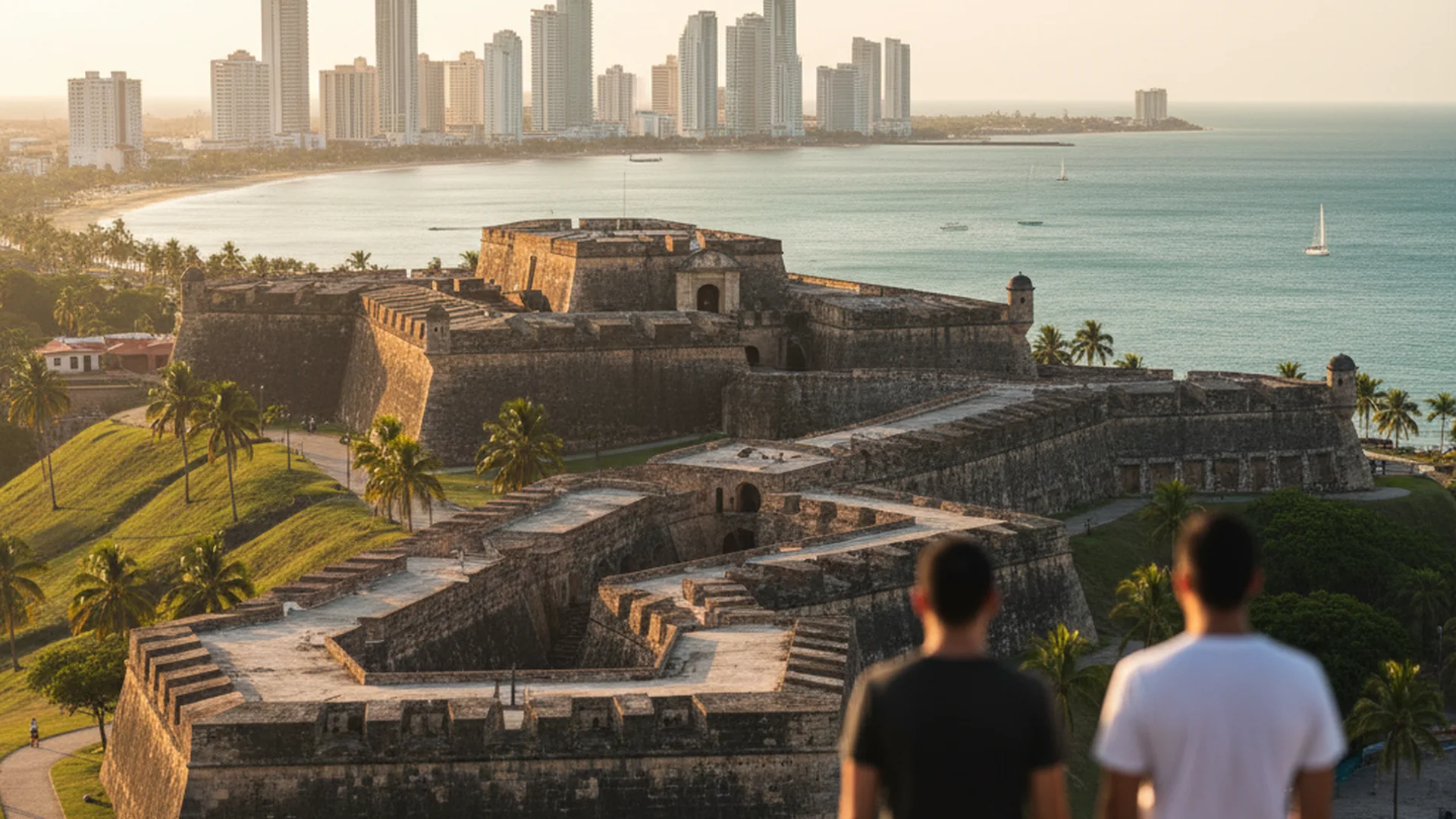
The canonical four-era shot: stand on the walls at Baluarte Santo Domingo at sunset. Foreground: seventeenth-century coral stone. Middle: eighteenth-century ramparts. Distant left: nineteenth-century red-tile Cathedral dome. Background right: Bocagrande's 1970s-plus condo skyline. Every layer of the city in one frame.
Prices in COP with USD conversions at approximately 4,000:1. Specific venues, hours, and prices change, verify before booking. Last full review: April 2026.
Specific question while you read? Ask Catalina, the Cartagena Guide concierge.¿Pregunta específica mientras lees? Pregúntale a Catalina, la concierge de Cartagena Guide.Chat with Catalina ›Habla con Catalina ›
Mapa de lugares en esta guía
8 lugares marcados. Haz clic en cualquier marcador para más detalles.
Cartagena es una ciudad de coral construida en capas. Las murallas, fuertes y casas coloniales abarcan de 1533 a 1798. Los grandes edificios civiles alcanzaron su pico con el Palacio de la Inquisicion de 1770. El Teatro Heredia de 1911 es el toque de la era Republicana. Los rascacielos de Bocagrande se levantaron entre 1970 y los años 2020. Un caminante que sepa qué buscar ve los cuatro períodos desde las murallas al atardecer. Esta guía te dice qué buscar.
Las murallas
Alrededor de 11 kilómetros rodeando el Centro Histórico y Getsemaní, 9 metros de altura, hasta 15 a 20 metros de grosor en la base (las fuentes varían). Piedra de coral de la isla de Tierrabomba, mortero de cal, arena aglutinante, refuerzo de ladrillo en puntos de tensión. La construcción comenzó en 1586 después del saqueo de Francis Drake; el ingeniero italiano Battista Antonelli diseñó el plan original. Francisco de Murga fortaleció Getsemaní a partir de 1631. Después del saqueo francés de 1697 por el Barón de Pointis, la Corona expandió masivamente el programa, y Antonio de Arevalo (1715 a 1800) lideró la expansión del siglo dieciocho que produjo las murallas que ves hoy.
Patrimonio de la Humanidad por la UNESCO en 1984 como parte de "Puerto, Fortificaciones y Grupo de Monumentos, Cartagena". Veintidós baluartes en total. Los clave: San Francisco Javier (sur, cerca de Plaza de los Coches), La Merced, Santa Clara, Santa Catalina (norte y zona de San Diego), Santo Domingo (el Cafe del Mar está encima de éste), Santiago, San Lucas, San Ignacio (oeste y suroeste), y el Reducto (propio de Getsemaní). Camina la muralla completa de norte a sur en segmentos: Baluarte Santa Catalina a las 7 AM para murallas vacías y luz suave; murallas oeste (Santo Domingo a San Ignacio) a las 5 PM para el atardecer. El color es piedra de coral sin pintar, gris crema, más oscuro donde golpea el rocío del mar.
Castillo San Felipe de Barajas
La fortaleza española más grande de las Américas. En el Cerro San Lázaro, este de Getsemaní. El núcleo original fue construido en 1536; reconstruido en 1657 bajo el Gobernador Pedro Zapata de Mendoza con un plan de baluartes en estrella. Expansión mayor de 1762 a 1798 por Antonio de Arevalo que duplicó la huella y añadió el sistema de túneles, baluartes externos (Los Apóstoles, La Redención, Santa Bárbara, San Carlos), y el camino cubierto. El diseño fue influenciado por la ingeniería militar francesa (escuela Vauban).
Características clave: disposición de baluartes en estrella con cobertura de fuego superpuesta; elaborado sistema de túneles subterráneos (galerías subterráneas) para movimiento de tropas y contramina, con canales acústicos para oír cavado enemigo; construcción de piedra de coral con refuerzo de ladrillo; rampa principal que lleva a una cumbre de bandera con vista de bahía de 360 grados.
Lugar del sitio de defensa de 1741; mira la historia de Cartagena para la historia completa. La puerta abre a las 8 AM; llega a las 7:30 para evitar tanto el calor como los tours de cruceros. Trae agua y una linterna de teléfono para los túneles.
Fuerte San Fernando y Batería San José (Bocachica)
En la isla de Tierrabomba, controlando el canal de Bocachica (la entrada sur estrecha a la bahía después de que la Escollera cerró Bocagrande). Los fuertes más pequeños originales de 1714 a 1725 por Juan de Herrera fueron destruidos por Vernon en 1741. Las estructuras actuales fueron construidas de 1753 a 1759 bajo el ingeniero irlandés Juan Bautista MacEvan, luego Antonio de Arevalo completó San Fernando. Batería San José fue reconstruida a partir de 1752 bajo Ignacio Sala con casamatas abovedadas, cisterna elevada, polvorín, y una batería de 21 cañones a nivel del agua.
Plano de herradura (San Fernando), terraplenes robustos hacia el mar, bóvedas a prueba de bombas. Juntos crearon campos de fuego entrelazados a través del canal de Bocachica. Acceso por bote desde el Muelle de la Bodeguita, alrededor de 40 minutos en cada dirección. Entrada gratis. Raramente visitado, lo que es parte del atractivo si te gusta la historia sin multitudes.
La Escollera (rompeolas sumergido)
Construido en 1771 por Arevalo después del sitio de 1741 que demostró la vulnerabilidad de Bocagrande. Muro de piedra sumergido a través del canal de Bocagrande entre tierra firme y Tierrabomba, forzando todo el envío por la Bocachica estrecha y fuertemente fortificada. Aún en su lugar hoy, invisible en marea normal. Los cruceros aún se acercan vía Bocachica. Mira desde Castillogrande en marea baja por la línea de agua perturbada.
Arquitectura civil colonial (casas coloniales)
Dos tipos: casas altas son de dos o tres pisos, casas de elite mercantes y nobles, con balcones, fachadas de coral estucado o ladrillo, y puertas arqueadas de tamaño para carruajes (zaguanes). Casas bajas son de un piso, casas de artesanos y clase trabajadora, fachadas más simples, patios más pequeños. Getsemaní todavía tiene mayormente casas bajas.
La característica organizadora es el patio central, un patio interior. Todos los cuartos dan al patio sombreado con fuente, palmeras, y un árbol de mango o guayaba. El mundo exterior se mantiene afuera; la vida interior se mantiene fresca vía ventilación cruzada.
Balcones (balcones voladizos)
Madera tallada (cedro, caoba), frecuentemente con barandales de hierro forjado, soportados por ménsulas de madera (canes o ménsulas) que sobresalen de la fachada. Tres tipos comunes encontrados en la jerga de guía local:
Balcón cubierto: balcón cubierto o techado, el más común en casas altas.
Balcón abierto: balcón sin techo, frecuentemente en cuartos individuales.
Balcón corrido: balcón continuo que corre sin interrupción alrededor de una esquina o la longitud completa de la fachada. Estos son los disparos de firma de Plaza de San Diego y Calle de las Damas.
Aldabas (llamadores de puerta)
Latón o bronce, fundidos en formas de animal o mano, señalaban el estatus del hogar y la profesión del dueño. Cuatro formas comunes:
León (león): oficial militar o líder de milicia, defensor de la ciudad.
Lagarto o iguana (lagarto): noble o linaje real. El lagarto fue elegido porque "sobrevivía las eras", un símbolo de linaje antiguo.
Pez o criatura marina (pez, sirena, caballito de mar): mercante, comerciante marítimo, dueño de barco.
Mano (mano): clero u hogar religioso. A veces se dice que invoca la Mano de Fátima.
El dicho español es a tal casa, tal aldaba: a cada casa su aldaba. El tamaño y la artesanía señalaban riqueza. Las mejores calles para buscar aldabas: Calle de la Factoría, Calle del Colegio, Calle de Ayos, Calle Román, Calle de Don Sancho.
Puertas, colores y la paleta de patrimonio
Las puertas son de tamaño exagerado, usualmente cedro, con una puerta de peatón cortada más pequeña (postigo) para uso diario y tachuelas de latón decorativas (clavos). La puerta exagerada se abre para un carruaje o una procesión fúnebre; el postigo se abre para todo lo demás.
La paleta policroma de terracota, ocre, amarillo, azul pálido, rosa y menta está estandarizada por códigos de patrimonio después de la inscripción de la UNESCO en 1984. Los dueños no pueden elegir libremente; los colores son aprobados de una paleta de patrimonio restringida. La apariencia actual de caja de bombones no es históricamente auténtica. Las fachadas coloniales eran mayormente encaladas en blanco o tonos tierra sobrios. La policromía es una estética de la era del turismo del siglo veinte capa sobre edificios más antiguos. Hermosa, pero nueva.
Catedral de Santa Catalina de Alejandría
Construcción de 1577 a 1612; parcialmente destruida por la ocupación de Drake de 1586 antes de la finalización. Arquitecto Simón González. Posteriores reconstrucciones añadieron la torre de campanas domed con la cúpula de baldosa roja (la silueta distintiva tipo Mudéjar que ves desde las murallas), más renovaciones interiores neoclásicas del siglo diecinueve. Exterior de piedra de coral, estucado y encalado, cúpula de baldosa roja. Ubicación: Plaza de la Proclamación (entre Plaza de Bolívar y Plaza de San Pedro). Mejor vista desde las murallas en el Baluarte Santo Domingo al atardecer; la cúpula roja contra fachadas ocre es la toma clásica del horizonte de Cartagena.
Otras iglesias clave
Iglesia de San Pedro Claver: finales del siglo dieciséis, principios del siglo diecisiete. Originalmente el Colegio Máximo Jesuita. Renombrada en 1888 después de la canonización de Pedro Claver. Piedra de coral, cúpula roja de baldosa modesta, arcada de claustro de dos pisos.
Iglesia de Santo Domingo: la más antigua en Cartagena. Fundada en 1551 en Plaza de los Coches, destruida en un incendio temprano, reconstruida a partir de 1578 en su ubicación actual, completada alrededor de 1630. La torre de campanas inclinada es real (los cimientos se hundieron de manera desigual; contrafuertes masivos fueron añadidos apresuradamente). Ornamentación mínima para una iglesia de era Barroca.
Iglesia de la Trinidad (Getsemaní): fundada en 1643, completada en el siglo dieciocho. Ancla Plaza de la Trinidad. Fachada blanca y amarilla simple, torre de campanas individual. La estatua de Pedro Romero enfrenta la iglesia.
Convento de Santa Clara (ahora Sofitel)
Fundado en 1607 para las Clarisas Pobres. Operado como convento clausurado durante aproximadamente 240 años. Siglo diecinueve: cárcel, cuarteles militares, hospital. En 1949 Gabriel García Márquez, entonces un joven reportero para El Universal, cubrió la excavación de una cripta encontrada en el sitio, donde una joven con cabello imposiblemente largo de cobre rojo fue enterrada, presuntamente posesa. El incidente inspiró su novela de 1994 Cien años de soledad.
Reabierto en 1995 como Sofitel Legend Santa Clara. La preservación mantuvo la cripta, claustro, capilla original (ahora sala de estar del lobby), confesionarios, pozos, y pisos de baldosa colonial. Los no huéspedes pueden caminar el lobby y la sala de estar de la planta baja (compra un café o un cóctel). El "Legendary Tour" de pago incluye la cripta y la sala conmemorativa de García Márquez.
Palacio de la Inquisición
1770, Plaza de Bolívar. Uno de los más finos edificios civiles coloniales en la costa del Caribe. Dos pisos de piedra de coral con fachada estucada amarilla, balcón de madera saliente (balcón corrido) corriendo la longitud completa del segundo piso, techo de baldosa. Patio interior con arcadas de piedra y un pozo. El portal de piedra profundamente tallado enfrente a la plaza es el más ornamentado en Cartagena. Ahora alberga el Museo Histórico de Cartagena. Mira la guía de museos para detalle de colección.
Teatro Adolfo Mejía (Teatro Heredia)
Abierto en 1911. Estreno formal 22 de febrero de 1912 con El Genio Alegre de los hermanos Álvarez Quintero. Arquitecto Luis Felipe Jaspe. Auditorio estilo italiano de herradura en tres niveles, inspirado por Teatro Tacón en La Habana y Teatro Reina Emma en Curazao. Construido sobre las ruinas de la Iglesia de La Merced de 1625. Renombrado Teatro Heredia en 1933 para el cuatricentenario del fundador de Cartagena, luego renombrado después del compositor cartagenero Adolfo Mejía. Cerrado y deteriorándose de 1970 a 1998, restaurado de 1987 a 1998 por el arquitecto cartagenero Alberto Samudio Trallero, reabierto 31 de julio de 1998 con un recital de Martha Senn. Fresco de techo Danza de las Nueve Musas por el artista cartagenero Enrique Grau. Alberga el Festival de Música de Cartagena cada enero y FICCI en abril.
Las Bóvedas
Construido de 1792 a 1798 por Antonio de Arevalo, el último proyecto civil español colonial dentro de las murallas. Veintitrés bóvedas a prueba de bombas más 47 pórticos. Originalmente almacenamiento de municiones y provisiones bajo los terraplenes del norte (Baluartes de Santa Clara y Santa Catalina). Uso raro como mazmorras durante las guerras de independencia (1811 a 1821). Hoy: mercado de artesanos. Veinte minutos es suficiente. La arquitectura es lo atractivo, no las compras.
Manga y la era Republicana
Finales del siglo diecinueve y principios del siglo veinte, el distrito económico de Cartagena se movió fuera de las murallas a La Matuna, Pie de la Popa y Manga. El barrio de Manga es un paisaje urbano completo de mansiones de la era Republicana (1890s a 1920s) en estilos eclécticos Caribeños-Victorianos: porches envolventes, celosías de madera, jardines tropicales. Una fase distinta de la arquitectura de Cartagena que merece su propio paseo. Mira la guía del barrio de Manga.
Cartagena moderna
Los rascacielos de Bocagrande se levantaron desde los años 1970 a través de los años 1990. Península estrecha, densamente construida con torres de condominios, la comparación con Miami Beach es inevitable. La silueta visible desde las murallas al atardecer es fotografiada constantemente. Las torres de lujo del siglo veintiuno en Castillogrande y la punta de Bocagrande (Laguito) son edificios residenciales de concreto y vidrio delgados; aún controvertidos. Los críticos dicen que restan de las vistas de la zona de amortiguamiento de la UNESCO. La UNESCO ha levantado preocupaciones múltiples veces, más notablemente alrededor de la torre Edificio Acuarela.
La toma canónica de cuatro eras: párate en las murallas en el Baluarte Santo Domingo al atardecer. Primer plano: piedra de coral del siglo diecisiete. Centro: terraplenes del siglo dieciocho. Lejano izquierdo: cúpula de baldosa roja de la Catedral del siglo diecinueve. Fondo derecho: horizonte de condominios de Bocagrande de los años 1970 y más. Cada capa de la ciudad en un marco.
Precios en COP con conversiones a USD aproximadamente 4.000:1. Venues específicos, horas y precios cambian, verifica antes de reservar. Última revisión completa: abril de 2026.
Newsletter
Get the guide in your inbox
One short email each Saturday. New posts, what's on this week, and anything worth knowing about Cartagena. No spam, unsubscribe anytime.