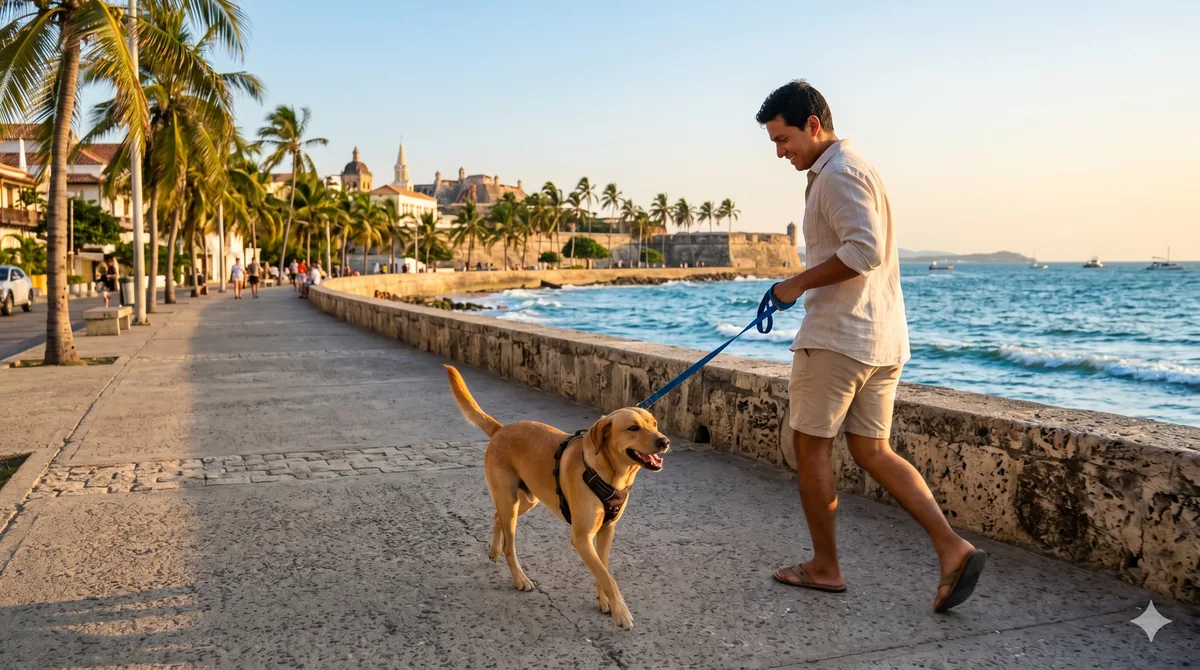

Last updated: May 2026. Cartagena is a pet-friendly city if you respect one thing above all else: the heat. People here treat dogs as family, you will see them on the Bocagrande seawall at dusk, in café doorways in the walled city, and riding the elevators of high-rise towers. But the tropical climate, the high-rise apartment living, and the import paperwork all reward owners who plan ahead. Here is what we have learned about getting a pet into Cartagena, caring for one here, and taking one out again.
This guide covers the part most people get wrong: the climate. Cartagena sits at sea level on the Caribbean coast, hot and humid year round, hotter than Medellín or Bogotá by a wide margin. A thick-coated dog from a cold country is not built for it, and the most common mistakes expat owners make here all trace back to underestimating that. We will get to the heat in detail. First, the paperwork to bring an animal in.
Bringing a pet into Colombia from the US or Canada
The good news: Colombia is one of the easier countries to import a cat or dog into, and the process has gotten smoother in recent years. There is no quarantine for pets arriving from rabies-controlled countries, which includes the United States, Canada, and most of Europe. What you do need is a short stack of documents, assembled in the right order and on the right timeline.
For a cat or dog you will need:
- A microchip (ISO standard, 15-digit). Have it implanted before the rabies shot so the vaccination record ties to the chip number.
- A current rabies vaccination, given at least 30 days before travel and still valid (under 12 months old, or within the multi-year validity stated on the certificate).
- Core vaccines up to date (distemper, parvovirus, hepatitis for dogs; the standard feline panel for cats).
- A health certificate from a USDA-accredited (US) or CFIA-accredited (Canada) veterinarian, issued within 10 days of travel.
- Government endorsement of that health certificate: USDA APHIS in the US, or CFIA in Canada. This is the step people forget. The vet signs the certificate, then it has to be endorsed by the federal authority, which is increasingly done online but still takes a few business days. Do not leave it to the last week.
- An ICA import permit. ICA (Instituto Colombiano Agropecuario) is the agency that clears live animals into Colombia. The permit is free and is usually issued within a couple of business days when you apply in advance through the ICA online portal (ica.gov.co). Apply at least two weeks before travel, and carry a printed copy alongside the endorsed health certificate. Do not rely on showing a phone screen at the inspection; Colombian officials want printed originals.
The ICA application asks for your flight details, the animal's species, breed, age, microchip number, and vaccine dates. Having the endorsed health certificate in hand before you apply makes the form straightforward. If your documents are in English, ICA accepts them as long as the key fields (dates, vaccine names, microchip number) are legible.
Bring printed originals of everything, plus a photocopy set. Colombian officials want paper, not a phone screen. Budget a real chunk of time on arrival for the inspection (more on the Cartagena airport below).
Buenos días. Traigo a mi mascota con permiso de importación del ICA. Aquí están el permiso, el certificado de salud con endoso, el carné de vacunación, y el número de microchip.
Good morning. I am bringing my pet with an ICA import permit. Here are the permit, the endorsed health certificate, the vaccination record, and the microchip number.
Airline policies and the flight itself
Colombia itself does not ban any breeds, but airlines do, and their rules are stricter than the country's. Snub-nosed breeds (bulldogs, pugs, Persians, and similar) are often barred from cargo holds, and sometimes from the cabin, because they overheat and struggle to breathe. Larger dogs that exceed the in-cabin weight limit (usually around 8 kg including the carrier) must fly as checked baggage or cargo, which carries real heat risk on a tropical route. Confirm the specific airline's pet policy in writing before you book, and book the pet slot early because most flights cap the number of animals allowed.
A practical note for Cartagena specifically: most foreign pets do not arrive on a direct international flight, because direct international service into Cartagena is limited. Many owners fly into Bogotá and connect, or fly into Bogotá and continue domestically. If you connect domestically, the international ICA clearance generally happens at your first Colombian point of entry, so factor that into your layover time.
Flying into Cartagena with a pet
Cartagena's airport is Rafael Núñez International (airport code CTG), in the Crespo neighborhood, unusually close to the city, about ten minutes from Bocagrande. If your animal arrives here as an international entry, you clear ICA at the airport. Have the import permit, the endorsed health certificate, the vaccination records, and the microchip number all together in one folder. The inspector verifies the chip, checks the paperwork against the permit, and confirms the rabies date.
The process is usually straightforward when the documents are in order, but it is not fast. Plan for one to a few hours, and do not schedule anything tight right after landing. If you are arriving on a hot afternoon (most of them are), keep the animal hydrated and out of direct sun while you wait. The terminal is air-conditioned; the walk from the aircraft and the ramp area is not.
From CTG it is a short ride to Bocagrande, Castillogrande, Manga, or the walled city. Standard taxis and ride apps will usually take a leashed or crated pet, but it is the driver's call. Ask before you load, and have your carrier or crate visible so the driver can see the animal is contained.
Disculpe, ¿le molesta si subo con mi perro? Está en su cargador y no ensucia.
Excuse me, do you mind if I get in with my dog? It is in its carrier and won't make a mess.
Finding a vet and emergency care
Cartagena has solid veterinary care, and it costs a fraction of what you would pay in North America or Europe. A routine consultation runs roughly COP 50.000 to 90.000 (USD $13 to $23 at 4.000 to 1). Vaccinations, dental cleanings, bloodwork, and routine surgeries are all available from clinics with modern equipment, and most expat-area vets are used to foreign owners and a bit of English.
A few practical points instead of specific names, since clinics open and close and the right one depends on where you live:
- Pick a clinic close to home. In Cartagena heat, a 40-minute cross-town drive with a sick animal is its own hazard. There are well-regarded clinics in and around Bocagrande, Manga, and the northern Crespo and Marbella corridor. Ask neighbors and your building's portero, they will know which one people actually use.
- Sort out emergency care before you need it. Not every clinic runs 24/7. When you choose your day-to-day vet, ask them directly: where do I go at 2am? Save that number and address in your phone now, not during the emergency.
- Specialty care is thinner here than in a big inland city. Cardiology, dermatology, and orthopedic surgery exist but are concentrated in a handful of clinics, sometimes by referral. For something complex, owners occasionally travel to Barranquilla or Medellín.
- Pet insurance is not really a thing locally. Most expat owners self-insure, setting aside the difference between Cartagena vet costs and back-home costs. Given the price gap, that math usually works out fine.
Hola, soy nuevo en Cartagena y acabo de llegar con mi perro. Quisiera registrarlo como paciente y hacer un chequeo general. También necesito saber qué antiparasitarios recomienda para el clima de aquí, porque venimos de un clima más frío.
Hello, I just arrived in Cartagena with my dog. I would like to register him as a patient and get a general checkup. I also need to know which antiparasitics you recommend for this climate, because we come from a colder one.
A quick first visit when you arrive, before anything goes wrong, serves two purposes. It establishes the animal's record at the clinic and lets the vet flag anything the move or the climate change may have stressed. It also gives you a clear answer on which flea, tick, and heartworm products are available locally and at what dose, since product names and formulations sometimes differ from back home.
Whatever clinic you choose, get your animal on year-round tick, flea, and heartworm prevention immediately. Monthly or quarterly chewables and topicals are sold at every vet and pet store, and on this coast these are not optional. Heartworm and tick-borne disease are present year round.
The heat, the thing that actually matters
If you read one section, read this one. Cartagena's climate is the single biggest factor in keeping a pet healthy and comfortable here, and it is the thing newcomers most consistently underestimate. Heatstroke in dogs is real, fast, and sometimes fatal.
- Walk early morning and after sunset, never midday. Between roughly 10am and 4pm the sun is brutal. Shift your walks to dawn and dusk, when the city itself comes alive and the pavement has cooled.
- Check the pavement for paw burns. Bocagrande's concrete and the walled city's stone absorb heat all day. Press the back of your hand flat on the ground for five seconds; if you cannot hold it, it will burn your dog's paw pads. Stick to shade and grass, or walk when the ground is cool.
- Hydration is constant, not occasional. Carry water on every outing. Many cafés will happily bring a water bowl if you ask.
- Never leave a pet in a parked car. Ever. In Cartagena heat a closed car becomes lethal in minutes, even in shade, even with the windows cracked. There is no safe version of this.
- Watch the thick-coated breeds. Huskies, shepherds, and other cold-climate dogs struggle most. A summer cut, fans, air conditioning, and shorter outings all help, but be honest with yourself about whether a heavy double-coated dog will thrive at sea level on the Caribbean.
- Know the warning signs. Heavy panting, drooling, wobbliness, bright red gums, or collapse mean get the animal cool and to a vet now. Wet them down with cool (not ice-cold) water and move to shade or air conditioning immediately.
Es una emergencia. Mi perro tiene signos de golpe de calor: jadea mucho, está muy decaído y las encías se ven rojas. Necesito atención urgente ahora.
It is an emergency. My dog has signs of heatstroke: heavy panting, very lethargic, and the gums look red. I need urgent attention right now.
Beach and saltwater cautions
The beach is a Cartagena highlight, and dogs love it, but a few cautions. Do not let a dog drink seawater; the salt causes vomiting and dehydration, which is the last thing you want in this heat. Rinse the salt and sand off afterward to avoid skin irritation. Hot sand burns paws as badly as hot pavement, so the same early/late timing applies. Keep dogs out of seaweed piles and away from anything that has washed up, jellyfish and marine stingers turn up on these beaches. And remember that many of the city's marquee beaches are crowded, vendor-heavy, and not always dog-welcoming; the quieter stretches north toward La Boquilla and Manzanillo are usually easier with an animal.
High-rise apartment living and your pet
Much of expat Cartagena lives in towers, Bocagrande, Castillogrande, El Laguito, and increasingly the northern strip. High-rise life suits some pets and frustrates others, and it is worth thinking about honestly before you commit.
What works against you: there is little to no grass at street level in Bocagrande, so dogs often have to learn to relieve themselves on tile, a balcony pad, or artificial turf. Every walk means an elevator ride and a lobby crossing, which adds friction to the four-or-more daily trips a dog needs. High floors plus heat means a long way to the nearest patch of shade. What works for you: towers are air-conditioned, secure, and many have nearby seawall or boardwalk walks. A small, low-energy, heat-tolerant dog or an indoor cat can be perfectly happy in a Bocagrande apartment. A large, high-energy, cold-climate breed will find it harder, and you will both feel it.
Manga and the lower-rise residential pockets, with more ground-floor access and the occasional garden, are gentler for dog owners than the tightly packed Bocagrande high-rises. Match the animal to the building.
Finding a pet-friendly rental
Most modern Cartagena buildings allow pets, but almost all of them have rules, and the rules are enforced by the building administration, not the landlord. Common ones: size or weight limits (often around 20 kg), restrictions on so-called "potentially dangerous breeds," a requirement that pets ride the service elevator, and a leash-in-common-areas rule. Some older or stricter buildings ban pets outright.
The single most important step: get the pet policy in writing in the lease before you sign. A landlord's friendly "claro, no hay problema" means nothing when the building administration changes or a new council enforces a dormant rule. Ask to see the building's reglamento (the propiedad horizontal regulations) and confirm the pet clause in your contract. This is exactly the kind of detail our Cartagena housing and renting guide covers in more depth, read it alongside this one if you are still apartment hunting.
One more cost note: some buildings or landlords ask for an additional pet deposit. It is negotiable and not universal, but budget for the possibility.
Pet services: grooming, daycare, and food
Day-to-day pet supplies are easy to find in Cartagena. Here is the lay of the land by category:
- Food. Premium kibble brands sold widely in Colombia (Royal Canin, Hill's Science Diet, Purina Pro Plan, Eukanuba) are stocked at large supermarkets, agro and farm-supply stores, and dedicated pet shops in the expat neighborhoods. Grain-free, fresh, and raw diets are rarer and pricier; if your animal is on a specialized diet, confirm availability before you move or plan to import it. A large bag of premium kibble runs roughly COP 120.000 to 280.000 (USD $30 to $70 at 4.000 to 1) depending on brand and size.
- Grooming. Plentiful and affordable. A full wash-and-cut for a medium dog runs roughly COP 50.000 to 110.000 (USD $13 to $28 at 4.000 to 1). In this climate a regular groom is not vanity; keeping a heavy coat trimmed genuinely helps a dog cope with the heat. Many groomers offer pickup and drop-off.
- Daycare and boarding. Guarderías (daycare) and boarding kennels operate in and around the city, useful when you travel or work long days. Quality varies, so visit in person, check that the space is air-conditioned or genuinely shaded, and ask how they handle the midday heat. Boarding runs roughly COP 40.000 to 90.000 per night (USD $10 to $23 at 4.000 to 1), more for full-service places.
- Preventatives and accessories. Tick and flea collars, chewables, beds, carriers, and toys are all easy to buy locally and generally cheaper than in North America. Stock up on the heartworm and tick prevention here rather than carrying it in.
Taking your pet out of Colombia later
When the time comes to leave, or to take your pet on an international trip, the direction reverses but the logic is the same. You will need an export health certificate, and for an animal leaving Colombia that means a vet exam and an ICA export inspection. For Cartagena residents, the ICA office for export certification is at the Rafael Núñez airport (CTG); call ahead to confirm their current hours and the exact documents your destination country requires before you make the trip with your animal. The standard sequence: a recent vet checkup confirming the animal is healthy and vaccinations are current, then an ICA export certificate issued shortly before travel (typically within about 10 days of departure), then whatever the destination country requires on its end.
That destination side is where it gets country-specific. Returning to the US is relatively simple, with current rabies documentation. Canada is similar. The UK, the EU, and rabies-free islands have stricter import rules (titer blood tests, longer lead times, sometimes quarantine) that you have to start months in advance. The rule of thumb: figure out the destination country's import requirements first, because they drive the timeline, then work backward to schedule the Colombian-side ICA export certificate so it lands inside the destination's validity window. Keep every original document; you will hand them over on arrival.
The bottom line
Cartagena is a good city for a pet if you set up for the heat and stay on top of the logistics. The import process is genuinely manageable as long as you start the endorsement and ICA permit early. Vet care is strong and cheap. The seawall at dusk is a wonderful daily walk. The failure modes are predictable: underestimating the tropical climate, skipping year-round tick and heartworm prevention, putting a heavy cold-climate dog in a hot high-rise, and signing a lease before reading the building's pet rules. Handle those four and your animal will likely settle in faster than you do.
Further reading
Related guides for moving to Cartagena with a pet:
- Housing and renting in Cartagena, pet-friendly buildings and lease clauses
- Cost of living in Cartagena, where pet care fits in your monthly budget
- Colombia visa guide, your legal basis before you settle in
- Healthcare in Cartagena, your own medical setup while you arrange your pet's
- Cartagena neighborhoods, which areas suit dog owners best
Still have questions?¿Todavía tienes preguntas?
Catalina is our concierge. Ask her about visas, neighborhoods, healthcare, prices, anything Cartagena. She answers in chat or WhatsApp, English or Spanish, free.Catalina es nuestra concierge. Pregúntale sobre visas, barrios, salud, precios, cualquier cosa de Cartagena. Responde por chat o WhatsApp, en inglés o español, gratis.
Chat with Catalina ›Habla con Catalina ›